Upcoming Cruises

TBD

Sunday, April 11, 2010

JAPAN: Japan's Stumbling Revolution

By Karel van Wolferen

Seven months after the Democratic Party of Japan’s triumph in the national elections of 30 August 2009, Hatoyama Ichiro’s government is meeting with so much trouble that rumours have begun to circulate that it is doomed.

For two decades, since he wrote his classic (and best-selling) The Enigma of Japanese Power (1989), seasoned political commentator, Karel van Wolferen, has been thinking and writing about the problem of political power, the Japanese state’s absent “centre.” Here he offers his reflections on the current crisis, the controversial Democratic Party (Minshuto) Secretary-General, Ozawa Ichiro, and the role of the Prosecutor’s Office. Van Wolferen’s outspoken defense of Ozawa (“one of the most formidable political figures in the world today”, superior to President Obama in his “political skills and understanding of the dynamics of power”), his critical attention to what he sees as the failure of the Japanese media, and his warnings of the possible consequences of a failure and/or collapse of the Hatoyama government, merit careful reading.

This analysis was written for the monthly Chuo Koron, where it appears in Japanese in the March 2010 issue. The Asia-Pacific Journal is grateful to the author for his permission to publish it here in English. (GMcC)

The next couple of years will be crucial for the realization of genuine Japanese democracy. More than that. If the Minshuto leaders succeed in carrying out their aim of creating a cabinet-centered government this will be a grand example for others – one of the very few positive turns of fate in the political life of our planet. But the obstacles to achieving this are formidable. Not only domestic forces but also Washington will seek to torpedo the plans for a truly independent Japan that can stand on its own feet in the world. Understanding those obstacles well could help Japanese citizens contribute to the chances for a good outcome.

If a few years ago we had heard that in a world of more war, increasing economic misery and political dysfunction in many places, it would be Japan, of all countries, serving up a shining example of political improvement, most people, including me, would not have believed it. Then something very big happened. For the first time a credible opposition party took over the reins of the official government and said we want to be a true government; a political steering wheel. What happened was bigger, I think, than is yet realized today by most Japanese.

Put it in the context of recent history. After a brilliant three decades of economic achievement following World War II, Japan seemed to have lost a clear purpose, was stagnating, and had stopped giving its people a sense that their lives were improving. Something important was lacking in the political system, something that would allow it to plot an alternative, more promising, course. In 1993 reformist-minded politicians who understood the difference between administrative and political decision-making were given a short time to create a political center to the Japanese system, but they were too few and had almost no administrative backing. On the positive side, however, they discovered each other and could eventually form the credible opposition party that has now taken over.

A new consciousness had spread through the public in 1993. Drastic changes were not only desirable but also possible. It became common for prominent political figures, commentators and businessmen, to reiterate in their speeches and writing the desirability of fundamental political reform. Such a promise seemed to come close to fulfillment with the surprise election of Koizumi as president of the Jiminto (LDP). But he, the first celebrity and TV star prime minister of Japan, turned out to be only a fake reformer, thus proving the point that the Jiminto with all its encrusted relationships and habits would have to be shoved aside for attempting a truly new beginning in Japanese politics.

That opportunity finally arrived with the great majority that Minshuto managed to gain in the elections of last August. And the top Minshuto figures, who – proof that they are serious – had stuck together since 1993, lost no time in making clear that they intended to inaugurate a new era.

What Minshuto’s intentions to establish a genuine government entail is not easily understood by people who are not fully aware of the way in which Japanese political institutions developed in the Meiji Period. The question of what policies its politicians espouse is less relevant than the fact that they wish to create a policy making center; which means a center of political accountability. Special measures for crippling elected politicians had purposely been built into the system.

What Minshuto must try to do is nothing less than to break with the tradition of governance established by the founder of Japan’s bureaucracy (as well as the military), Yamagata Aritomo. Yamagata did not want the purity of a supposedly harmonious Japanese nation, grouped around an innately benevolent emperor, to be spoiled by contentious politicians. A political system run by them could not be harmonious because they had to fight each other to get elected. Yamagata introduced arrangements to make sure that they never could have the power they were officially supposed to exercise. He should, along with Bismarck, Lenin and Theodore Roosevelt, be ranked among the greatest figures who shaped the geopolitics of our planet just over a century ago. His measures allowed a political system to evolve in which military bureaucrats would eventually hijack the country in the 1930s for ill-considered purposes. His legacy endured in the odd Japanese relationship between career officials (bureaucrats) and elected officials (Diet members).
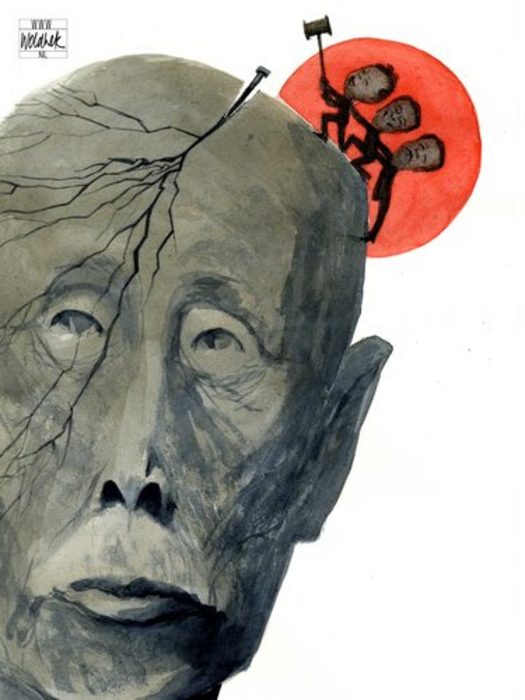
DPJ assault on the Yamagata Edifice

Siegfried Woldhek 2009

(other Woldhek cartoons)

To call the task that Minshuto has taken upon itself a heavy one is very, very, understated. It has simply not been tried before. There are no models from Japanese experience to follow. Almost everywhere Minshuto ministers will turn to re-examine policies, they will meet with partial, and sometimes heavy, opposition; not from the public that elected them, but from entrenched interests embedded in the old non-democratic establishment that they want to overcome. While the basic institutions for democracy, like parliament, the cabinet, and so on, were established in the Meiji Period, they were not used in line with their original purpose, and the many lesser institutions that allow politician-directed governance to function must now be built almost from scratch, giving many impatient observers the impression that Minshuto coalition ministers cannot make it work. Bureaucrats in the Ministry of Foreign Affairs as well as Defense, for example, are doing their best to beguile the new politicians to stick to the conventional ways of their ministries, which has already resulted in a tragically missed opportunity for a major move forward in relations with Moscow. Bureaucrats and politicians in this case missed the significance of remarks by President Dmitry Medvedev made in Singapore in November, indicating willingness to re-open the stagnated diplomacy concerning Japanese claims to the Northern Islands. The Prime Minister’s Office is not functioning at all as it should for propagating Minshuto’s main messages for the same reason of bureaucratic conventionalism and, worse, policy subversion. What is expected from Minshuto would be daunting under the best circumstances. But current circumstances resulting from ingrained habits are dismal.

A political system that has survived for a long time is not something one can easily change, as it has developed strong defense mechanisms. When after a year’s absence from Japan (the longest time away since 1962), I returned a year ago, Japanese friends were enthusiastic about how after the summer elections things would change dramatically, with Ozawa becoming prime minister. I asked them: “what about the scandal that will aim to bring Ozawa down?” It was entirely predictable.
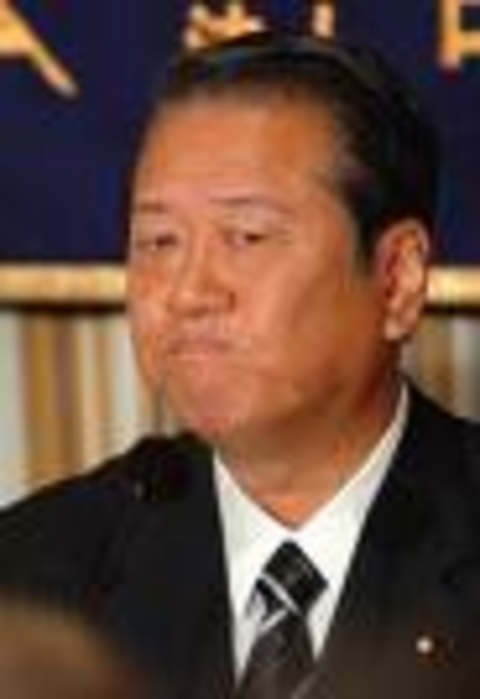
Minshuto Secretary-General Ozawa

Why? Because the Japanese bureaucratic system does not only have ancient built-in defenses, it has something akin to an immune system. We need to take a step back to see this in perspective. All countries have a concrete power system that is different from their theoretical one. All countries live with political honne and tatemae. The substantial system of power exists, as it were, inside the official political system that is described and regulated by such things as the constitution. The informal, unofficial, substantial system of power relations may change and drift farther away from what it should be in principle. The past decade of American political history provides a perfect example of that: power arrangements centered on the military-industrial complex and huge financial and insurance firms are stronger than the causes the American electorate has voted for. There is nothing in the American constitution that guarantees them such a position. The Japanese case is, by comparison, particularly interesting. The outlines of its informal structure have remained virtually unchanged over the post-World-War-II decades, as they have survived changes in the law or appeals to the constitution. While in the United States new laws, like those pertaining to health insurance and earlier ones regulating banking practices promote the development of informal American corporatism, an important aspect of the unofficial Japanese system is that its crucial political transactions and relationships are simply beyond the purview of the law. The Japanese unofficial political system is blatantly extralegal.

All unofficial systems of political (and of course economic) power must have ways to protect them against forces that could bend them out of shape. And the law helps with that in most cases. But not in Japan, unless it concerns heavy criminal conduct. This means that the informal but substantial Japanese System is vulnerable to excess. It has been quite all-right for Japanese business to pay for the election of Japanese politicians (as in numerous other countries), but if one politician gets so much that he achieves a kind of power that threatens the balance inside the system, action must be taken. Hence the Tanaka Kakuei scandals. Entrepreneurism is fine, but if one entrepreneur becomes so successful that he threatens unofficial social and labor arrangements, like Ezoe Hiromasa who with Recruit was actually helping to create a labor market for sarariman, he must be stopped [1]. If another entrepreneur is breaking unwritten rules of the unofficial system with financial dealings, and pokes fun at the established figures to boot, we get a Horiemon case [2]. After making a study of famous Japanese scandals, I wrote an article for Chuo Koron nineteen years ago, in which I concluded that the Japanese System had an immune system against excesses of otherwise permissible conduct, and that this immune system consists of the Japanese public prosecutor working in tandem with the Japanese media. At that time the headlines were taken up for months by a huge security brokerage scandal, involving compensation for stock market loss. This was an exquisite example of what I was analyzing because the supposedly guilty financial firms had actually been operating under the informal instructions of Ministry of Finance bureaucrats. But the result had been a threat to the Japanese financial system as a whole. What followed were the ritualistic apologies demanded from a political culture that assumes those rituals help restore harmony.

Reformist politicians constitute an open invitation for the prosecutor-media team to develop hawk eyes and find a minor case, or an imagined case, of wrongdoing. Remember when Kan Naoto was Japan’s most popular politician because he had demanded that the officials in his ministry told the truth in connection with HIV infected blood products? Within a couple of years an invented scandal to undermine his prestige had to follow. Because, make no mistake, democratic procedure may have placed them where they are, but the official representatives of the Japanese voter are a potential threat against the smooth operation of the informal system. Now, the Minshuto government is about the biggest threat to the unofficial power system it has experienced in living memory. A greater threat than a program to bring the actual power system closer to what it is supposed to be, is hard to imagine. So, right after Hatoyama became prime minister, the prosecutor-media team got into action to whip up a scandal designed to undermine his position.
Change of Government = Change of Japan

Minshuto

Let us think some positive thoughts concerning the Japanese public prosecutor. Japan’s crime rate is relatively low, and the authorities are not filling Japanese prisons to the brim, as is the case in some other countries. The public prosecutors deserve praise for the way in which they keep the penal system geared more to repentance, reform, and return to society, than to punishment. There is also little doubt that the Japanese public prosecutor is genuinely concerned with maintaining social order, and that prosecutors think of themselves as entirely responsible, even as heroically brave, when they go after what they conceive of as the disturbers of the right order in society and politics. But at the moment that makes them a threat to Japanese democracy; Minshuto politicians will therefore continue to be a target for the disruptive energies of the prosecutors.

In the same way that the Japanese extralegal political system is a legacy of Yamagata Aritomo, the self-image and the concrete role played by the public prosecutor go back to another major historical figure: Hiranuma Kiichiro. He was a fanatical believer in the moral superiority of the officials supposedly carrying out ‘the Will of the Emperor’. Like Yamagata he saw himself as a guardian of the mystical, morally pure, nation depicted in kokutai ideology, which had to be preserved from the onslaught of modern political ways, like Marxism, or liberalism, or simply democratic elections. The influence of his followers after 1945 helped to prevent reforms of the Japanese judiciary, which in many respects considers itself to be placed above the law. We can interpret the activities of the public prosecutor today as hearkening back to these higher spiritual values that rise far above what politicians can make of government. The foremost Dutch Japanologist, Wim Boot, compares them to the Censorial System of ancient China.

Foreign legal specialists have long been astonished by the discretionary powers of the Japanese prosecutor. Much of their power derives from the extraordinary leeway they have in making decisions about who to target for prosecution. In lighter criminal cases they can decide whether or not to go after a culprit, and can be extremely lenient, especially if the person they have been questioning is remorseful and makes a show of repentance. This works well for ordinary people who have broken the law but do not deserve to be punished with more than a case of fright, and approaches to law enforcement in some other countries could benefit from taking these Japanese ways as an example.

If they decide on harsh treatment and want to break down suspects, however, they will use tricks and psychological pressure and lengthy pre-trial incarceration to force confessions. But for the purpose of counteracting ambitious reformist politicians the public prosecutor uses grey areas of the law, as practically applied. There exists a broad area of vagueness between what is normally admissible in actual practice and what is definitely illegal. In many countries there exists no clear line between what is permissible tax avoidance and unlawful tax evasion. In Japan, on top of interpretable tax rules, there exists a rich vague area relating to political funding rules, which is a favorite weapon for the public prosecutor. Many Japanese know how arbitrary the investigations of the public prosecutor are. But still, there is a widespread sense also among sympathizers that, for example, Ozawa should at least show ‘sincerity’ and apologize. This is in keeping with the demands of ritual that belong to the unofficial power system. In Ozawa’s case, the arena for the ritual is now the Diet itself, even among Minshuto members, and the public at large, where it is taking on grotesque proportions as the newspapers whip up what they falsely present as ‘public demands’. The rituals of apology and ‘voluntary’ resignation constitute bowing one’s head to the informal system.

Without cooperation of the media the immune system does not work, as it is not the alleged wrong-doing that floors politicians, but the public scandal that the media can get going. Prosecutors are continually leaking information to the newspapers about the cases they intend to tackle, and give journalists and editors enough warning to be present when they raid anyone’s offices. These leaks about ongoing investigations are, of course, not in keeping with a system that sticks to lawful procedures, but we have already seen that the public prosecutor operates as if above the law.

Because of the fairly homogeneous interpretation of what is happening, the strong similarity of their commentary, and the relatively great impact they have on the reading public, Japanese newspapers, more than newspapers elsewhere that I know of, create political reality as it exists in people’s minds. In that way they tend to be more a participant in, rather than monitor of, domestic power dynamics. The big newspapers can fairly easily bring an end to a sitting government. Quite a few senior editors have mindsets like senior Japanese bureaucrats, for whom the preservation of the existing order in their world must always remain an almost sacred priority.

In one of the saddest developments of our time, newspapers almost everywhere in the industrialized world are experiencing great difficulties, and because of their growing dependence on commercial interests they have ceased to be reliable monitors of political developments. While the Japanese media situation is a bit better than that, it must be considered very regrettable that at this time of momentous change in Japan’s political life the newspapers appear to be unable to rise to the occasion and become reliable chroniclers. Until now most reporting about the new government has consisted of a huge distraction of attention from what matters for the future of all Japanese, settling instead for the routine scandal mongering that serves no one.

We may blame this on ingrained habits. The reporters and editors do what they are good at doing. Japanese political reporters cut their teeth on getting the details right about the infighting among the habatsu (factions) of the Jiminto, and later the ups and downs of government coalitions. When I covered political news in Thailand after its fairly regular military coups, I used to look up my Japanese colleagues in Bangkok because they were the world’s top experts on the factionalism inside the Thai army. No surprise therefore that right after the formation of the Hatoyama government a lot of attention went to real and imagined signs of strains among the coalition partners. No surprise that the newspapers get excited about small disagreements among Minshuto ministers that drift up to the surface. Now, it was perfectly understandable that the internal bickering and open wars within the Jiminto produced prime copy (as a journalist I also followed the fine and juicy details of the Kaku-Fuku factional war), [3] because the politicians of the then so-called ruling party were, as we have seen, not producing anything that could be called policy.

Koizumi, who profited much from the national mood wanting political reform, indulged in fake reformist moves at the behest of Ministry of Finance officials, which were not properly analysed by a media apparently mesmerized by celebrity glamour. Commentators could apparently not distinguish neoliberal economic fashion from the political repair the public was waiting for. After him we had one Jiminto cabinet after another also structurally incapable of developing policy to cope with much-changed circumstances, inside Japan as well as in the world. They did not construct a political steering wheel. They could only fall back on the administrative decisions of various ministry officials. Administrative decisions, which make necessary adjustments for maintaining a course that was designed in the past, must clearly be distinguished from political decisions, which establish a new course, a fresh departure, an essential structural change. In those post-Koizumi years, the newspapers enjoyed their role in bringing down cabinets, and we had a new prime minister every year.

That development appears to have been habit-forming as well, considering the continuous speculation about whether the Hatoyama government will last or whether it should resign. Much is made of the declining popularity of the new government from 70% to somewhere around 30% according to the newspaper polls. Such figures are notoriously unreliable, as the big papers always tell the public what public opinion ought to be. And since the newspapers ask those polled what they think of a new cabinet’s policies before a cabinet has had a chance to lay them out, all Japanese administrations – except for the PR-driven one of Koizumi – experience such steep decline.

Quite a few things about the Minshuto situation seem forgotten by the press. We read indignant comments about a ‘power grab’ by Ozawa, or about Hatoyama relying on Ozawa. Of course he is. He cannot do it alone. It is because of Ozawa that Japan is getting this chance to break through the Yamagata Aritomo tradition and create a genuine government with a political steering wheel. Without Ozawa there would not have been the party political upheaval of 1993; he started it. Without him there almost certainly would not have been a credible Minshuto opposition party. Without Ozawa Minshuto would certainly not have gained its landslide victory last August, perhaps not even a majority. Ozawa is one of the most formidable political figures in the world today. No head of government in Europe can be compared to him. And Washington’s Obama does not come close in the way of political skills and an understanding of the dynamics of power. Ozawa is continually criticized for a number of things, including his autocratic manners, but few widely read columnists appear to be interested in the question as to why he is what he is. Could Minshuto become a success without him? His Minshuto colleagues, who of course are also partially influenced by the media-created political reality, must think very hard before asking such an extraordinary leader to retire. Ozawa simply has no equal among prominent politicians with regard to a combination of determination and an over-all understanding of Japan’s informal power system.

If Minshuto were to lose its cohesion caused by a loss of determination through the manner in which the informal power system captures it, we will probably witness a very undesirable development. The emergence of a two party system, as existed before World War II, appears to have become less likely. The Jiminto is breaking up. Many splinter parties are likely to compete in future elections and, without a firm Minshuto presence, form temporary and frequently changing coalitions. Bureaucratic power will increase, and create a newly stagnant situation of administrative rule, probably worse than what existed under official Jiminto governance.

Another crucial subject, a potential hindrance on the path to Minshuto’s success, does not receive the close media attention it deserves. The U.S.-Japan relationship was something that practically everyone took for granted. The problem has been that Washington has not treated Japan as a fully independent country. This situation has already been fundamentally changed by the Hatoyama cabinet. Merely by having opened the subject of inequality for discussion means that things can never be the same again. But the Obama administration is apparently not ready for a non-Jiminto government, which was made poignantly clear by the stern messages of Hillary Clinton just before the election and those of Robert Gates soon after it. The matter of moving an American Marine base in Okinawa is apparently being turned into a test case to see whether the new government understands who is boss.

Many governments, including Washington, have long wished for Japan to take a more active role on the world stage. Its economic might changed the fate of industries in the United States and Europe, but from a geopolitical point of view, and in diplomacy, it was barely visible. The rest of the world got used to what was early on labeled as an ‘economic giant but political dwarf’. And now, when the new government says that this undesirable imbalance must change, Americans can only whine about military base arrangements different from what they want.

The two cases of the public prosecutor relentlessly pursuing supposed lawbreaking by Ozawa and American insistence on Japan implementing what Washington had earlier forced the Jiminto to agree to in 2006 have something in common. They share the lack of a general sense of proportion. A stranger to Japan, just reading big newspaper headlines between December and February on a visit, would get the impression that Ozawa was trying to evade something like a murder conviction. Any financial misreporting by Ozawa’s assistants, a misdemeanor that in other democracies would be quietly investigated, does not remotely have the weight warranting the pillory of Ozawa we have just witnessed. And considering that the public prosecutor had so little to go on that he was forced to dismiss the case against Ozawa himself, we can only conclude that things have been crazily out of proportion. That such a relatively small thing could be the source of speculation about an end to the first Minshuto cabinet, and be the basis of daily front page reporting of mainly invented public opinion about the need for Ozawa to resign, like the fever chart of a hospital patient, would make strangers unacquainted with Japanese ways wonder about the sanity of political life here. I just read an editorial in one of the major newspapers that makes the point that while no evidence could be found, this does not mean that Ozawa is innocent. It is a statement that indicates a state of hysteria among some editors, giving the impression that it has become a personal vendetta for them.

In the Futenma base case we see a new American presidency entirely missing the significance of what is happening in Japan. Obama and his advisers risk undermining new possibilities for creating a stable new cooperative relationship. Over what? Over something that ought to be minuscule in their global strategic vision. We learn from this that the Obama administration does not have its act together with respect to the revamped diplomatic attitude toward the world it announced when taking over from George W. Bush. It also proves that the American military has taken over far more American foreign policy than the details that relate to the countries it occupies. But considering that almost all of the top American officials dealing with Japan are ‘alumni’ of the Pentagon, this lack of a sense of proportion, this tunnel vision, should not surprise us.

When you can upset something very big with something that in neutral eyes can only be judged to be pretty small you have extraordinary power. We need to contemplate the vagaries of power when we contemplate the story of today’s Japan. It has undergone the biggest power-shift since the 1950s, and Minshuto has already changed some things beyond a point where they can go back to what they were. But that does not mean that its power has been consolidated. Its strength will be tested again and again. An untimely departure of the Hatoyama cabinet would be very unfortunate. With the Jiminto in charge, an annual change of prime minister hardly mattered. But a return to the ‘musical chairs’ method of change would be disastrous for Japan’s political future. The consolidation of Minshuto power will, of course, require dealing with the problem of the misplaced priorities of the public prosecutor, and of journalists who feed on leaks from the prosecutor's office like mad dogs.

When Ozawa first became the target of investigations last spring, which forced him to resign as Minshuto president, foregoing the chance to become prime minister, several Diet members were quoted as saying that if the prosecutor’s office “would apply the same standards to all of us”, the Diet would be as good as empty.

To be sure, the public prosecutor theoretically would have had the power in Jiminto days of emptying, say, half the Diet. But you can imagine that this power would not last beyond the first move of such idiotic action, because everyone in Japan, including the newspapers would conclude that the public prosecutor had gone mad.

This thought experiment demonstrates an important quality of power: it is not absolute. Power is a rather elusive thing; hard to catch conceptually in a concrete way. It has no substance that relates in any way to the laws of Newtonian physics. You cannot measure it, count it, or express it in numbers. The attempts of some specialists in political science to quantify power fail miserably. Power is in essence different from influence, which can be measured. It derives its nature to a large extent through what it is in the eyes of the recipient, the person or group to which it is directed (and is in this way somewhat comparable to love). Take an example from recent history. You will remember what happened to the power of the Soviet Union just before the end of the Cold War. A huge power system existed, which was believed to be unshakeable. It had defined the nature of our post-World-War-II geopolitics. Then something relatively small triggered events that led to the collapse of the Berlin Wall. In no time in 1989 the great power emanating from Moscow that kept populations in Eastern Europe in thrall was gone. It vanished in less than a week. Why? Because it rested on the psychology of fear. Fear of Soviet tanks. And that disappeared suddenly because Gorbachev demonstrated that he had meant what he said about not using violence to stop developments.

What we have just witnessed in Japan, and will probably witness again, is a power struggle. On one side, reformist politicians eager to implement true reform of the structure of the Japanese power system, and on the other venerable career officials who believe that the established order is something sacred. But the power of these career officials will melt like ice and snow when editorial writers and television commentators warm up to the exciting political possibilities that have opened up for Japan. Being human beings interested in public affairs, as well as Japanese with at least a residual sense of patriotism, such a switch of focus ought not be too difficult for them.

With the U.S.-Japan relationship we have another very curious power relationship, whose problems could be solved in favor of Japan. The world’s two greatest industrial powers relate to each other in unique fashion; there is nothing comparable to it. Hatoyama’s critics who blame him for mishandling diplomacy vis-à-vis Washington overlook the fact that normal diplomacy is not possible in this case, because the United States does not truly recognize Japanese sovereignty – an indispensable condition for diplomacy. It has been taken as a matter of course that Japan would in the end always do what the United States wanted. The Hatoyama government must deal with unfinished post-World War II business that its Jiminto predecessors have never looked straight in the eye.

People speak automatically about the United States and Japan as allies. But, again, we have a conceptual problem here. An alliance is a relationship entered into voluntarily by two or more independent states. When this supposed alliance began Japan had no choice in the matter. During the Occupation following World War II, Washington turned Japan into a protectorate, and has since continued to treat to Japan as such – while, more recently, urging Japan to participate in American military ventures in other countries. Virtual protectorate status has certainly had some great advantages. Japan’s very rapid growth as a trading power was much facilitated by its sheltering in the American strategic and diplomatic shadow. But, most importantly for Japan’s place in the world until recently was that the main things by which a state is recognized internationally were carried out by American proxy. In other words, Japan did not need to present itself to other countries with a strong government, capable of making fundamental political decisions.
We only need to think this through to see the connection between Japan’s lack of a political steering wheel until now and its pathological dependence on the United States. I think that the foremost Minshuto politicians, and certainly Ozawa, are aware of the mutual dependence of these two factors. As long as the United States appeared to supply a substitute for genuine large-scale Japanese diplomacy and strategic arrangements, there was no urgent need for a Japanese government capable of supplying those. And as long as no formal government in Tokyo balked at Japan being treated as a protectorate Washington could afford to meet Japanese sensibilities with disdain, as it is doing now with respect to the Marines on Okinawa. It is therefore natural that by establishing a true political center the conditions that have kept this dependency relationship going are radically altered.

The problem goes deeper nowadays. A big complication is that the United States has slipped into the grip of a militant nationalism. It is hardly a secret that its designs to deal with the emerging world reality include building military encirclement for containing China. It counts on Japan to be part of that plan. Hence the importance Washington attaches to its bases on Okinawa. But why should Japan give so much space and money to help maintain an American military empire? Fear that the United States will withdraw protection from Japan comes from ingrained habits of thought that under the changed geopolitical order since 1989 can only be called naive. I am surprised that so few Japanese are apparently aware of the fact that the United States needs Japan much more than Japan needs the United States, especially considering how important Japanese support for the dollar has been. Besides, as is the case for Europe, American protection guarantees have become highly questionable.

When a completely out-of-proportion small thing upsets something quite big, this happens through its power of intimidation. The United States has power over Japan because many Japanese, including some of its publications, are intimidated. Scared that Japan will be naked; left vulnerable to hostile powers in the future. The public prosecutor has the power to help wreck the course to a better democracy because of the media connivance with its intimidation of ambitious politicians. The two have come together in a very unfortunate confluence of circumstances. At this time when all responsible members of all political parties need to pull together to ensure that Japan becomes a fully sovereign state – of, by, and for the people, and not the bureaucracy or other usurpers of legitimate power – the prosecutor's office is having one of its egocentric moments, fulfilling its need rigidly to preserve the order it has always known without ever taking a step back to consider the political health of the nation. And Japan's mass media is unwittingly (or is it deliberately?) collaborating with the American government's hope of having its own way in Okinawa in the event the present government fails, by contributing to the building frenzy of demand for Ozawa and even Hatoyama to resign (for acts or non-acts that amount to, if anything, misdemeanors). This would be a great setback for popular sovereignty in Japan.

The unofficial Japanese political system, which Japan’s new government wants to curb, has been kept going through a lot of built-in and almost automatic intimidation, which is the exercise of extralegal powers. Because of that history elected officials in Japan can easily be intimidated because they are used to it. The manner and tone and the substance of what Clinton and Gates said clearly aimed to intimidate the Japanese public. It is crucially important for the future of the Hatoyama cabinet that it not give in to such intimidation. Solving the conflict to Japan’s advantage can be accomplished by doing nothing for a while, and reiterating that fundamental discussions about the future of the relationship must come first. Nothing bad will happen to Japan if, in the absence of an important American compromise, the deadline set for May is postponed until after such serious mutual rethinking.

Coping with domestic intimidation is more difficult for the Hatoyama cabinet. Normally, the way to counter intimidation is to fight straight back – by exposing the intimidator's motives, strategy, and tactics. Politicians of a mind to criticize the Public Prosecutors Office cannot easily do so, as they risk being accused of interference. Political committees to look into ‘alleged abuse’ of public prosecutor powers are unlikely to abolish a tradition rooted in pre-World War II days. Only an independent and vigilant media can counter the office's abuse of its delegated and assumed powers. Japan's media is free. But if it is to help foster a healthier democracy in a truly sovereign state, then it must switch from its present obsession with chasing and even creating scandals, to being a responsible monitor of domestic and global politics – and otherwise learn to use its potential power more wisely. Japan’s citizens, who voted for political reform, should take a step back, take in what is happening at the moment, and urge their media to do precisely that.

Notes

[1] Ezoe Hiromasa – Founder of Recruit Co. specializing in job placement publications. A victim of mainstream press hysteria, he was forced by prosecutors to make a confession in 1988. The scandal brought down the Takeshita cabinet.

[2] Horiemon – Takafumi Horie, the very successful entrepreneur who broke unwritten rules of the business world, challenged its practices, was arrested, and in 2007 found guilty of securities fraud.

[3] Kaku-Fuku war – The grand battle between the habatsu (clique) of Tanaka Kakuei and that of Fukuda Takeo, and their respective loyalists, which virtually split the LDP during the 70s, 80s and early 90s.

Karel van Wolferen is a Dutch journalist, writer and Emeritus University Professor of Comparative Political and Economic Institutions at the University of Amsterdam.

He is the author of The Enigma of Japanese Power and of George W. Bush and the Destruction of World Order, as well as numerous books in Japanese to be found here.

His website in English is karelvanwolferen.com

See also his 2009 essay, written on the eve of the Democratic Party’s election victory, "Lifting Japan's Curse of Muddling Through," and his "Japan-U.S. Relations Prosper on Isolation."

Recommended citation: Karel van Wolferen, "Japan’s Stumbling Revolution," The Asia-Pacific Journal, 15-2-10, April 12, 2010.

View Asia-Pacific Journal Article...

JAPAN: Mao Asada receives Guinness Book world record

Mao Asada received a Guinness Book world record for her three Vancouver Olympic triple axels.

Mao Asada received a Guinness Book world record for her three Vancouver Olympic triple axels.  (AP Photo/Shuji Kajiyama)

April 11, 11:38 AM

By Joshua Williams

In a unique addition to Mao Asada’s 2010 accomplishes, Japan’s top figure skater now has the honor of holding a Guinness Book world record.


On April 11th, at the Stars on Ice tour in Tokyo, Mao Asada was officially award the Guinness Record for the most triple axels performed by a women in one competition; she had completed three at the 2010 Vancouver Olympic Games, one in her short program and two in her free.


The Guinness record tops off her strong 2009-2010 season where she took Silver in the Olympics, won at the World Championships for the second time, as well as took first in the Four Continents tournament and Japan National Championships.


Mao Asada becomes the third Japanese figure skater to have graced the pages of the Guinness Book; the other two are Midori Ito and Miki Ando, NHK News noted. Ito was awarded a Guinness Record in 1989 for the most perfect scores in a competition, she had had received seven 6.0s from judges at the World Championships.  Ando took her Guinness Record in 2002 for being the first women to have landed a quadruple jump in competition.

Asada commented, “I’m extremely happy. I want to see the book with my name in it as soon as possible,” according to the Yomiuri.

The 2011 edition of the Guinness Book of World Records is reportedly scheduled to go on sale in September of this year.

View Japan Headlines Examiner Article...

JAPAN: Japanese cameraman among dead in Thailand protests

Japanese TV cameraman Hiroyuki Muramoto for Reuters was killed in Thailand protests on April 10th.Japanese TV cameraman Hiroyuki Muramoto for Reuters was killed in Thailand protests on April 10th.  (AP Photo/Reuters)

A Japanese TV cameraman working for the Tokyo branch of Reuters news agency has been listed among the dead in violent clashes between anti-government protesters and national troops in Bangkok, Thailand.


Hiroyuki Muramoto, a 43-year old husband and father of two who had worked for Reuters as a cameraman for over 15 years, fell to a gunshot wound to the chest during rally violence on April 10th, the news agency reported.


Muramoto had left for Thailand on April 8th to cover the ongoing “Red Shirt” demonstrations against the current military-backed government, and was scheduled to return back on the 22nd, ANN News noted. The Associated Press stated that at least 20 people had been killed, including four soldiers, and well over 800 injured as fighting ensued.


Who, or even what side, killed Muramoto is currently unknown. One large potential clue, the fatal bullet, could not be found as it had exited through Muramoto’s back. Reuters reported that Thai soldiers had been using tear gas and guns with rubber bullets, and that the Thai government claims protesters were carrying guns and throwing gasoline bombs and grenades. Investigations in Muramoto’s death are said to be planned.


Reuters Editor-in-Chief David Schlesinger stated, “I am dreadfully saddened to have lost our colleague Hiro Muramoto in the Bangkok clashes. Journalism can be a terribly dangerous profession as those who try to tell the world the story thrust themselves in the center of the action. The entire Reuters family will mourn this tragedy."

Junpei Tachi of Reuters Public Relations Department in Tokyo echoed those words to Japanese press.


Sankei News added that Muramoto’s family, including wife, daughters and parents, along with three of Muramoto’s colleagues, are heading to Thailand, but have not given any comments to reporters yet due to the shock of their loss.

View Japan Headlines Examiner Article...

CHINA: Reef crash ship 'to face charges'

The Great Barrier Reef

Bulk carriers regularly take short cuts through the Reef

Page last updated at 11:46 GMT, Sunday, 11 April 2010 12:46 UK

Those responsible for a Chinese ship running aground on the Great Barrier Reef and leaking oil will be prosecuted, Australian authorities say.

Transport Minister Anthony Albanese said the vessel was clearly on an unlawful route and compensation would be sought for the spill.

"We'll be throwing the book at those responsible," Mr Albanese said.

In a separate case, three men have been charged with steering their cargo ship through a restricted area of the Reef.

The men, from Vietnam and South Korea, will appear in an Australian court on Monday, accused of taking their coal carrier on an unauthorised route through one of the world's most valuable marine wildlife reserves.

It is alleged that their vessel, the MV Mimosa, was not registered with the Reef Vessel Tracking System and failed to respond to attempts by the authorities to establish contact.

If found guilty, the men could face a maximum fine of more than A$200,000 ($205,000).

Oil fear

The Chinese vessel, the Shen Nang 1, rammed into a sandbank some 70km (43 miles) off the east coast of Great Keppel Island on 4 April after straying off its permitted route.

"It is quite clear that this vessel went on a course that was unlawful," Mr Albanese told reporters after flying over the stranded ship.

"The Australian government will ensure that the full force of the law is brought to bear on those responsible," he said.

"And we will also ensure... compensation is paid with regard to the cost of cleaning up."

Salvage crews have been pumping fuel oil from the vessel, which was carrying carrying 950 tonnes of oil and about 65,000 tonnes of coal.

Inflatable booms are in place around it to contain any oil that may spill.

In the wake of these incidents, it has emerged that bulk carriers regularly take short cuts through the world heritage-listed marine park - reef "rat-runs" that cut down on voyage times and therefore save money.

The Australian government has vowed to tighten up its maritime laws in response .

The Great Barrier Reef is the world's largest reef system and extends for more than 2,500km.

Map of Queensland showing where ship is stranded

View BBC News Article...

JAPAN: New Japanese political party forms from dissidents, "Tachiagare Nippon"

A new Japanese third pole political party, Tachiagare Nippon, or "The Sunrise Party of Japan."

A new Japanese third pole political party, Tachiagare Nippon, or "The Sunrise Party of Japan."  (image: Tachiagare Nippon press release)

April 11, 7:14 AM

By Joshua Williams

A new Japanese political party named “Tachiagare Nippon” was officially announced on April 10th by six active politicians unhappy with the current top national political trends.


Tachiagare has been formed largely from dissident members of the Liberal Democratic Party (LDP), the long-standing political party that lead Japan until their historical defeat to the Democratic Party of Japan (DPJ) in the lower house elections last fall. The six founders include five Japanese Diet members – three from the lower house (Takeo Hiranuma, Kaoru Yosano, and Hiroyuki Sonoda) and two from the upper house (Takao Fujii and Yoshio Nakagawa) – as well as the Governor of Tokyo (Shintaro Ishihara).


The name Tachiagare Nippon literally translates to “Stand up, Japan” or “Rise, Japan,” but according to Sankei News the group has chosen the official English name of “The Sunrise Party of Japan.”  Along the similar themes, the group has created a party symbol that combines Mt. Fuji, the rising sun, and the ocean - things which the group says expresses the beauty of the Japanese nation.


Tachiagare states that they have taken on a three point main stance of overthrowing the DPJ, revitalizing Japan, and realigning politics. They have also stated outright that they are going to be “anti-DPJ and un-LDP.” 

Kaoru Yosano proclaimed at an April 10th press conference, “The DPJ has no political philosophy or thought. The LPD does not have the necessary fighting spirit to be the main opposition party.”


However, the new party has a couple disadvantages from the start. First is their size; while they are aiming to increase their numbers in the Japanese Diet during the next election to stop the DJP from having a simple majority, they are currently only five members strong. Winning new seats will not be an easy task, particularly with other smaller parties vying for seats as well.


Also, there is a problem of age; the founding group’s youngest member is 67 years old. The Mainichi reported that other politicians have begun making jokes about the group, calling them the “New Silver Party” or the “Twilight Party,” and questioning their ability to appeal to younger voters.


Beyond that, some question if they are really any different from the LDP.


Whether Tachiagare, or any of the other minor non-DPJ or LDP coalition political parties, will be able to create the momentum for a new wave of third party power in the Japanese national politics will not be known at least until summer, when the next set of national elections for the upper house is scheduled.

View Japan Headlines Examiner Article...

RUSSIA: Putin returns to crash site to pay last respects to Kaczynski

 Putin returns to crash site to pay last respects to Kaczynski

Alexey Nikolsky/RIA Novosti

14:4511/04/2010

Russian Prime Minister Vladimir Putin flew back on Sunday to the site of the Polish plane crash near Smolensk in west Russia to pay last respects to Polish President Lech Kaczynski who was killed in the incident.

The Soviet-made TU-154 carrying Kaczynski hit the top of trees as it attempted in thick fog to land at a Smolensk airport in west Russia on Saturday morning, killing all the 97 people on board the plane.

The plane was taking Kaczynski and a delegation of top Polish officials to a ceremony to pay tribute to some 20,000 Polish officers who were executed in the Katyn forest and other locations by Soviet secret police in 1940.

Jaroslaw Kaczynski, the twin brother of the late Polish president, earlier on Sunday identified the body of Lech Kaczynski.

The press secretary of the regional governor said on Sunday that the Polish president's body would be delivered to Poland today.

The bodies of the other Polish plane crash victims have been delivered to Moscow for identification.

SMOLENSK, April 11 (RIA Novosti)

View RIA Novosti Article...

HONG KONG: Hip Cafes in a Hong Kong Noodle District

Part of the selection at Tuckshop in Tai Hang, a neighborhood in Hong Kong. Part of the selection at Tuckshop in Tai Hang, a neighborhood in Hong Kong/Veronica Zaragovia

April 11, 2010, 6:00 am

By VERONICA ZARAGOVIA

Hong Kong locals will tell you the island’s Central district is for “gweilos,” a derogatory term for non-Chinese people, and they wouldn’t be too far off. The district is home to high-end boutiques, clubs and plenty of Westerners.

But four metro stops to the east is the quiet, charming neighborhood of Tai Hang.

As recently as a few years ago, the area was best known for its auto repair shops. But now, Tai Hang (which means “Long Gutter” in Cantonese), an easy 10-minute jaunt from exit B of the Tin Hau MTR stop, is full of fruit stalls and noodle shops nestled between hip cafes owned and staffed by Hong Kongers.

Mimi Liu, manager of Tuckshop, an Asian dessert store and bakery in Tai Hang, says she hopes that as the neighborhood evolves, it stops short of becoming the next Central.

“The rent is already almost double,” Liu said, compared to when Tuckshop opened two years ago.

For now, visitors to Tai Hang don’t come to see or be seen — they come to relax before or after hitting the bustling shopping area of Causeway Bay. Here are some spots worth the sidetrack to rest your feet and grab a pick-me-up.

Tuckshop (1 Lily Street; 852-2571-1648) has bright pink awnings and brick walls, and specializes in small treats like Korean and Filipino ice cream bars.

A latte at Café Y Taberna.

A latte at Café Y Taberna.  Veronica Zaragovia

Café Y Taberna (16C King Street; 852-2577-7165) is decorated with a full wall-sized bookshelf, wooden floors and hanging lamps. It boasts a wide selection of Belgian beers, gourmet lattes with decorated milk foam; a short menu of Thai dishes is also available.

Panda (94 Tung Lo Wan Road 852-2503-5888; http://panda-japanese-curry.blogspot.com/) specializes in hearty Japanese, home-style curry dishes and attracts a mostly teenage clientele.

At Café on the Corner (4 King Street; 852-2882-7135), a jazz soundtrack is paired with a small, mostly Italian menu.

La Casa (7 King Street; 852-6163-1388) offers an oyster bar amid warm lighting and red walls.

To satisfy the sweet tooth, there’s Jam Bakery (28 Shepherd Street; 852-2805-6696; www.jambakery.com), which sells delights like chocolate crème brulée layer cake and mango napoleons; baking lessons are also available.

GuGu cafe (19 School Street; 852-2895-0019) has housemade cakes, truffles and cookies, a minimalist décor, and plenty of natural light.

If the pastel mint green walls at Mr. Sweetheart (Sun Fat Mansion, 144 Tung Lo Wan Road; 852-3175-3868) don’t draw you in, its fruit smoothies and sweet soups, like double boiled aloe with honey and ginseng, might.

View New York Times Article...

JAPAN: Once drawn to U.S. universities, more Japanese students staying home

 Sunday, April 11, 2010; A15

By Blaine Harden

TOKYO -- Takuya Otani would love an MBA from a top U.S. business school, but he won't apply. When he graduates from college in Tokyo next year, he'll pass on an American degree and attend graduate school in Japan.

"I am a grass-eater," Otani said wistfully, using an in-vogue expression for a person who avoids stress, controls risk and grazes contentedly in home pastures.

Once a voracious consumer of American higher education, Japan is becoming a nation of grass-eaters. Undergraduate enrollment in U.S. universities has fallen 52 percent since 2000; graduate enrollment has dropped 27 percent.

It is a steep, sustained and potentially harmful decline for an export-dependent nation that is losing global market share to its highly competitive Asian neighbors, whose students are stampeding into American schools.

Total enrollment from China is up 164 percent in the past decade; from India, it has jumped 190 percent. South Korea has about 76 million fewer people than Japan, but it now sends 2 1/2 times as many students to U.S. colleges.

Just one Japanese undergraduate entered Harvard's freshman class last fall. The total number of Japanese at Harvard has been falling for 15 years, while enrollment from China, South Korea and India has more than doubled.

Harvard President Drew Gilpin Faust said that when she visited Japan last month, she met with students and educators who told her that Japanese young people are inward-looking, preferring the comfort of home to venturing overseas. They also told her they view the economic advantage of attending a U.S. college as questionable.

"An international degree is not as valued," Faust said she learned from her encounters here.

Looking for 'harmony'

The skepticism extends beyond students. At big Japanese companies, many bosses don't like what they see as the sometimes uppity and overly independent ways of American-educated young Japanese, said Tomoyuki Amano, chief executive of Tomorrow Inc., which publishes a magazine about foreign education.

Amano said many employers prefer the "harmony" that comes from hiring the locally educated, who they believe work longer hours, complain less and request fewer vacations.

Amano, 28, said he speaks from bitter personal experience.

After graduating six years ago with a degree in management from California State University, Chico, he returned to Tokyo and took a job with Hitachi, Japan's largest electronics manufacturer.

"I really felt that I could not question anyone who was older than me," Amano said. "I also learned that it was going to be hard to get a promotion or take a vacation. Promotions tend to go to those who attend the same Japanese schools as the bosses."

Bottom-line considerations are steering many young Japanese away from U.S. colleges, said Tadashi Yokoyama, chairman of the board of Agos Japan, a Tokyo company that prepares students to take language exams and other tests needed for admission to foreign schools.

"This is not a time in Japan for intellectual curiosity," said Yokoyama, who graduated from UCLA in the early 1980s. "You have to think about investment and return."

In the 1970s and '80s, when Japan's economy was booming, the bottom line did not matter for many young Japanese. It was fashionable, stimulating and affordable for them to travel the world, study English in foreign settings and attend college in the United States. Their parents had money, and jobs were plentiful when they came home.

The collapse of the bubble economy in the 1990s changed those calculations. And the construction inside Japan of more than 200 new universities has made it easy to find an affordable education without enduring jet lag and having to learn English.

At the same time, Japan's low birthrate is constricting college enrollment, both inside and outside the country. The number of children under the age of 15 has fallen for 28 consecutive years. The size of the nation's high school graduating class has shrunk by 35 percent in the past two decades.

"When you combine a big decrease in the student population with a big increase in the number of Japanese universities and couple that with rising tuitions in U.S. colleges, you can understand why priorities have changed," said Tokoyama.

A mixed experience

An exception to the trend: Some in corporate Japan still send promising young employees to graduate school in the United States. Eighty major companies pay Agos Japan to prep their workers for graduate schools in the United States and other countries.

When these employees return to Japan with MBAs and other advanced degrees, however, they often find that their companies don't know how to make use of their skills -- and that they are penalized for having stepped off the corporate ladder.

NTT Data, a major information technology company, sent Masaki Honda to UCLA for an MBA. But "during the two years I was gone, I was regarded as a net cost to the company," said Honda, who is now president of Agos Japan. "I lost seniority compared to my peers and my performance while I was in business school was evaluated as 'C' for mediocre."

For all the risks and frustrations of higher education in the United States, some young people remain willing to go.

Nobuko Tabata, 29, is heading off next fall to Philadelphia for the two-year MBA program at the University of Pennsylvania's Wharton School.

"I want to know the world's highest-level people," she said. "I want to be a higher-level manager. It would be easy for me to stay in Japan, but I need more."

Tabata, a certified public accountant who works for her family's transport company, has spent $25,000 and devoted the past two years to studying English, taking tests and polishing application essays. She is married to a CPA who works for Sony, who will probably remain in Japan.

She said she is eager to be challenged and to learn the latest skills in corporate management -- and ready to sleep just three or four hours a night.

"I think I am a meat-eater." she said.

Special correspondent Akiko Yamamoto contributed to this report.

View Washington Post Article...

JAPAN: Risk of Japan going bankrupt is real, say analysts

Risk of Japan going bankrupt is real, say analysts

A shopper walks past a shop advertising a sale in Tokyo. Debt problems in Greece may currently be in the spotlight but Japan is walking its own financial tightrope, analysts say, with a public debt mountain bigger than that of any other industrialised nation.(AFP/File/Yoshikazu Tsuno)

Sun Apr 11, 2:19 am ET

by Kyoko Hasegawa

TOKYO (AFP) – Greece's debt problems may currently be in the spotlight but Japan is walking its own financial tightrope, analysts say, with a public debt mountain bigger than that of any other industrialised nation.

Public debt is expected to hit 200 percent of GDP in the next year as the government tries to spend its way out of the economic doldrums despite plummeting tax revenues and soaring welfare costs for its ageing population.

Based on fiscal 2010's nominal GDP of 475 trillion yen, Japan's debt is estimated to reach around 950 trillion yen -- or roughly 7.5 million yen per person.

Japan "can't finance" its record trillion-dollar budget passed in March for the coming year as it tries to stimulate its fragile economy, said Hideo Kumano, chief economist at Dai-ichi Life Research Institute.

"Japan's revenue is roughly 37 trillion yen and debt is 44 trillion yen in fiscal 2010, " he said. "Its debt to budget ratio is more than 50 percent."

Without issuing more government bonds, Japan "would go bankrupt by 2011", he added.

Despite crawling out of a severe year-long recession in 2009, Japan's recovery remains fragile with deflation, high public debt and weak domestic demand all concerns for policymakers.

Japan was stuck in a deflationary spiral for years after its asset price bubble burst in the early 1990s, hitting corporate earnings and prompting consumers to put off purchases in the hope of further price drops.

Its huge public debt is a legacy of massive stimulus spending during the economic "lost decade" of the 1990s, as well as a series of pump-priming packages to tackle the recession which began in 2008.

Standard & Poor's in January warned that it might cut its rating on Japanese government bonds, which could raise Japan's borrowing costs amid the faltering efforts of Prime Minister Yukio Hatoyama's government to curb debt.

The system of Japanese government bonds being bought by institutions such as the huge Japan Post Bank has been key in enabling Japan to remain buoyant since its stock market crash of 1990.

"Japan's risk of default is low because it has a huge current account surplus, with the backing of private sector savings," to continue purchasing bonds, said Katsutoshi Inadome, bond strategist at Mitsubishi UFJ Securities.

But while Japan's risk of a Greek-style debt crisis is seen as much less likely, the event of risk becoming reality would be devastating, say analysts who question how long the government can continue its dependence on issuing public debt.

"There is no problem as long as there are flows of money in the bond market," said Kumano.

"It's hard to predict when the bond market might collapse, but it would happen when the market judges that Japan's ability to finance its debt is not sustainable anymore."

"And when that happens, the yen will plummet and a capital flight from Japan's government bonds to foreign bonds will occur," he said.

Yet others argue that there is no precedent for the ratio of debt to GDP nearing 200 percent being dangerous.

Nomura Securities economist Takehide Kiuchi cited Britain's government debt in the post-war period "which reached 260 percent but (the government) didn't face a debt crisis.

"There is no answer to the question of what the critical level of debt is for a government to go bust."

The likes of single-currency Greece and non-eurozone countries are also different in that the latter group have flexible currency exchange rates which are more closely calibrated to their fiscal conditions, he said.

Instead, the most realistic hazard brought by huge Japanese debt is prolonged deflation under a shrinking economy, say analysts.

"Regaining fiscal health needs fiscal austerity, which could weigh on economic growth," said Kiuchi.

"And when the economy is bad, people don't spend money as they are worried about their future, which in turn intensifies the deflational trend," he said.

Continued deflation could further worsen Japan's fiscal health because of less tax revenue and more stimulus spending, stirring fears over big tax hikes, which in turn weigh on demand and again reinforce deflation, analysts said.

The key to breaking the vicious cycle is drafting a feasible economic growth strategy for Japan, they said.

"If the economy grows, tax revenue increases," Kumano of Dai-ichi Life said.

Since 2001 Japan's annual growth rate has peaked at 2.7 percent in 2004.

The economy shrank 1.2 percent in 2008 and 5.2 percent last year.

Prime Minister Yukio Hatoyama's centre-left government has pledged to announce details of its new strategy in June, which aims to lift annual growth to two percent by focusing on the environment, health, tourism and improved ties with the rest of Asia.

View AFP Article on Yahoo...

JAPAN: Toyota response to complaints takes on a confrontational tone

Toyota

The accelerator pedal assembly of a Toyota Avalon is connected to monitoring equipment at a demonstration at the company's Torrance headquarters last month. (Mark Boster / Los Angeles Times / March 8, 2010)

9:22 PM PDT, April 8, 2010

By Ralph Vartabedian and Ken Bensinger

Special teams are sent to investigate, and sometimes discredit, reported problems.

When its customers claim their Toyota or Lexus vehicles suddenly accelerate, the company is at the ready with teams of technicians that it can deploy rapidly to examine the reports -- and in some cases discredit them.


The teams, dubbed SMART for "swift market analysis and research team," were publicly unveiled by Toyota on Thursday, but have been deployed at least seven times in the last month.


They scored big successes when they helped undermine a recent claim by a San Diego motorist who said his Prius took him on a 20-minute high-speed ride down the freeway and another by a New York housekeeper who said her Prius flew into a wall even though her foot was on the brake.


Toyota's critics say it has every right to dispute inaccurate claims, and its legions of devoted customers have cheered the rigorous response on Internet forums.


The SMART teams are part of a much broader public relations and legal strategy Toyota is using to confront critics, an approach that has toughened in recent weeks. Toyota is now staking out its position before major scientific investigations into sudden acceleration have gotten started, and before federal officials have completed regulatory reviews. Last week, federal safety regulators enlisted the government's top technical experts to examine the problem.


Critics say the company is acting prematurely and in some cases spreading misinformation.


"It is a very aggressive and misleading campaign," said Clarence Ditlow, executive director of the Center for Auto Safety. "Toyota can't win this battle by slinging mud, but they are trying."


In at least one case, a SMART inspection backfired, adding ammunition to a lawsuit against the company. The team discovered that a repair under the recall campaign for sticking accelerator pedals had not been properly completed.


Toyota's strategy represents a big change in the last six weeks.

In February, Toyota Chief Executive Akio Toyoda told Congress, "As the CEO of the company, I will make sure that we will never ever blame the customers going forward."


Exactly what that meant is not quite clear, because the company said it now intends to dispute the reports of its customers when it sees something questionable.


"When we see something that needs addressing, we're going to respond," company spokesman Mike Michels said. In some cases, customers have claimed sudden acceleration for mechanical behavior that involves "normal functions of a vehicle," Michels said.  He added, "We're getting a lot of stuff coming out of the woodwork."


Auto safety experts said Toyota has every right to defend itself against phony claims, but its approach has led to countercharges that the company is spreading outright falsehoods.


Ditlow is furious over an e-mail Toyota sent to some reporters, a copy of which he provided to The Times, alleging that he was on the payroll of plaintiff attorneys. Ditlow said that neither he nor his organization takes money from lawyers. Ditlow said his funding comes from nonprofit foundations, auto insurers, consumers and its publications.


Congressional investigators, meanwhile, complain that Toyota has sent multiple teams of lobbyists after them to sow discord among committee staffers. Toyota lobbyists are trying to disrupt the House Oversight and Government Reform Committee's investigation, a staffer on the committee said.


Toyota has also taken on several congressional witnesses.
David Gilbert, a professor of automotive technology at Southern Illinois University at Carbondale, testified before the House Energy and Commerce Committee in February that his experiments showed potential flaws in Toyota's electronic engine control system.


Two Toyota employees resigned from a board of advisors for Gilbert's academic department.


Toyota then hired testing firm Exponent Inc., which helped the automaker put together a demonstration for the media at Toyota's U.S. sales headquarters in Torrance countering Gilbert's results point by point.


"It is unfortunate they felt the need to do that," Gilbert said. "I didn't expect Toyota would like what I found, but I was surprised by the magnitude of the response. What were they trying to prove, that they could squash me like a bug? Well, I suppose they could."


The attack on Gilbert has worried other academic experts that they could be the next target if they are critical of the company.


"Most of the academics completely support Gilbert," said Michael Pecht, director of an electronics reliability lab at the University of Maryland who has studied sudden acceleration for 10 years. "I think that there is a fear in the Toyota Exponent tactics."


Sean Kane, president of the consulting firm Safety Research and Strategies, has been another Toyota critic who the company has characterized as an operative of law firms.


Kane claims Toyota backed an online consumer poll that attempted to discredit him. The poll, a copy of which was provided by Kane, asks a series of questions about Kane, Gilbert and allegedly inaccurate reporting by ABC News.


Embedded in one question, for example, was the statement, "The American people deserve the truth about the safety of their cars, not biased studies by trial lawyer consultants who stand to make millions suing Toyota."


"We do opinion surveys all the time," Toyota spokesman Mike Michels said. "We were researching the potential for getting messages out, in particular for our advertising."


Meanwhile, the SMART inspections have yielded mixed results.
On March 15, the company drew dozens of reporters to an event at Qualcomm Stadium in San Diego where it was able to cast doubt on claims by James Sikes that his 2008 Prius had suddenly accelerated a week earlier.


The company asserted that the accelerator pedal was working properly and the brake pedal had been repeatedly depressed, implying Sikes did it intentionally to mimic a sudden acceleration event.


Released several days later, the California Highway Patrol report about the incident said nothing about suspected fraud and noted simply that the brakes were burned out. It said Sikes was examined afterward by emergency medical personnel and found to have a "very high" blood pressure and heart rate.


SMART did another inspection last month in Harrison, N.Y., after a woman reported that the Prius she was driving suddenly accelerated into a wall. An inspection of the vehicle electronics by Toyota found that the driver never had her foot on the brake in the moments before impact.


But the SMART team may have helped Toyota's adversaries on March 12, when it inspected a 2007 Camry after an alleged sudden acceleration event.


Linda Tang, an Orange County resident who is suing Toyota over alleged defects in the Camry electronics, said her vehicle suddenly accelerated after she had taken it to a dealership for repairs under recall.


Toyota initially did not inspect the vehicle. It was only after Tang's attorney enlisted congressional investigators to contact the Department of Transportation that the inspection was scheduled.
At a sophisticated Toyota facility in Orange County, a large team of company technicians spent nearly seven hours going over the vehicle. Two federal safety investigators flew in from Washington to oversee the inspection. They were joined by an automotive electronics expert hired by Tang's attorney.


Near the near the end of the day, the Toyota technicians acknowledged a major error.


A shim that was supposed to have been installed in the gas pedal assembly under the recall to prevent sticking was missing, according to federal officials and allegations in Tang's suit.


"It was shocking," said William Rosenbluth, the automotive electronics expert who works for Tang's attorney, Michael Lewis Kelly. "It wasn't there and the paperwork says it was put in."
Toyota officials declined to discuss the inspection.

View Los Angeles Times Article

RUSSIA: For Poland, plane crash in Russia rips open old wounds

Poland grievesMourners stand amid a flood of candles and flowers outside the presidential palace in Warsaw. (Sean Gallup / Getty Images / April 10, 2010)

April 11, 2010

By Megan K. Stack, Reporting from Moscow

The 97 aboard a Soviet-era plane were heading to Katyn, site of the 1940 massacre of Polish prisoners of war. Now Poland, which hasn't forgotten its tragic past, must grieve the loss of its key leader

The plane crash that killed Polish President Lech Kaczynski on Saturday gutted a nation's leadership and silenced some of the most potent human symbols of its tragic and tumultuous history.
It was, in a sense, a nation colliding with its past: The aircraft ran aground on a patch of earth that has symbolized the Soviet-era repressions that shaped much of the 20th century, near the remote Russian forest glade called Katyn where thousands of Polish prisoners of war were killed and dumped in unmarked graves by Soviet secret police in 1940.


The toll cut a swath through Poland's elite. The 97 dead included the army chief of staff, the head of the National Security Bureau, the national bank president, the deputy foreign minister, the deputy parliament speaker, the civil rights commissioner and other members of parliament.


Also aboard the plane were war veterans and surviving family members of Poles killed by the Soviets. There was 90-year-old Ryszard Kaczorowski, Poland's last "president-in-exile" during the Soviet years. And Anna Walentynowicz, the shipyard worker whose dismissal in 1980 sparked the Solidarity union protests that eventually led to the collapse of Polish communism and made the symbolic first chink in the Berlin Wall.


And of course, Kaczynski, a former Warsaw mayor who had been imprisoned for his opposition to communism.


"The contemporary world has not seen such a tragedy," said Polish Prime Minister Donald Tusk, who as head of government holds the reins of power in the country. He called for two minutes of silence at noon Sunday.


The pavements of central Warsaw were transformed into a sea of light as late-night mourners burned thousands of candles. On Pilsudski Square, a trail of flickering flames stretched more than 50 yards from the Grave of the Unknown Soldier to the towering white cross marking the site where Pope John Paul II first said Mass to his compatriots in 1979.


Flying on a 26-year-old Soviet-designed plane, the presidential delegation was headed for a Roman Catholic Mass to mark the 70th anniversary of the deaths at Katyn. It was to be a tribute to long-smothered truth.


The massacre was denied for decades by the Soviet Union, and even today Russian reluctance to open the investigation files on the Polish prisoners remains a deeply sensitive topic between Moscow and Warsaw. To many Poles, the very name Katyn is shorthand for decades of secret grief and impotence in the face of Soviet power.


"I just have this feeling that Katyn is a sort of diabolical place in Polish history," said Tomasz Lis, a prominent Polish journalist and author. "It's just unimaginable; it's horrible."


As the news spread, a shiver of repulsion ran through a shocked Poland.


"This is unbelievable; this tragic, cursed Katyn," Kaczynski's predecessor, Aleksander Kwasniewski, said on Polish television. "It's hard to believe. You get chills down your spine."


The tragic irony of the crash was so extreme that it seemed destined for conspiracy theory. Russian officials were careful to pledge in the first hours to closely involve Poland in the investigation. Russian Prime Minister Vladimir Putin, rushing to the scene of the crash, announced that he would personally head the inquiry.


Poland was invaded by the Soviet Union during World War II, and lived for decades under Moscow's domination. Long after the fall of the Berlin Wall, ties with Russia remain strained by old anxieties over independence.


As the presidential plane winged toward the western Russian city of Smolensk on Saturday morning, thick cords of fog wrapped the city. On the ground, air traffic controllers urged the crew to land either in Minsk, the capital of Belarus, or in Moscow rather than risk navigating the fog, Russian officials said.


But time was pressing. The crew decided to risk the landing, and ignored the instructions from the air traffic controllers, the Russian air force said.


"The Polish presidential plane did not make it to the runway while landing," Smolensk region Gov. Sergei Antufyev told reporters. "Tentative findings indicate that it hit the treetops and fell apart. Nobody has survived the disaster."


On the ground, about 1,000 people, many of them Poles, were milling around the memorial site. A Polish priest was to say Mass once the presidential delegation arrived.


"We were getting ready for the Mass and everybody was expecting the president to arrive any minute," said Yan Rachinsky of Russia's Memorial human rights group. "Suddenly people started talking quietly about something. There were many concerned faces. . . . Soon people started running around and talking to each other. Everybody was wondering what was going on. It was an atmosphere of tension."


The priest led a prayer. Then the Polish ambassador stepped up to break the news. The presidential plane had crashed, he told the crowd. There were no survivors.


"It was a moment of complete shock," Rachinsky said. "We were standing there speechless. We couldn't believe it."

Tears wetting nearly every face, Rachinsky said, the group went ahead with the Mass.


By late afternoon, 97 bodies were being packed into coffins and flown to Moscow for identification. The flight recorders had been found, and investigators were studying them for clues.


In an address shortly after the crash, Russian President Dmitry Medvedev was careful to emphasize recent improvements in relations between Russia and Poland.


"These days we conducted memorial events in Katyn together grieving over the victims of totalitarian times," Medvedev said. "All Russians share your grief and mourning."

Last week, Tusk, the Polish prime minister, traveled to Katyn to mark the massacre. In what was regarded as a turning point in the often frosty relations between Moscow and Warsaw, Putin also attended the ceremony.


Kaczynski, a frequent and outspoken critic of the Kremlin, was not invited to that ceremony.


Unlike Tusk's visit, which was given prominent news coverage in Russia, Kaczynski's plans to attend Saturday's commemoration were all but unmentioned. A few weeks ago, the Russian Foreign Ministry publicly complained that Kaczynski had not sent official word of his planned visit. The ministry had heard of his intentions from press reports, officials said.


The crash throws Polish politics into uncertainty. Kaczynski was to run for reelection in October; a government spokesman said Saturday night that Poland would hold an early presidential election, but no date had been set.


The leading left-wing candidate, Jerzy Szmajdzinski, was aboard the plane. And Polish law calls for another of the candidates, speaker of the lower chamber of parliament Bronislaw Komorowski, to take over as head of state after the president's death.


Kaczynski, 60, was elected to the presidency in 2005. He and his twin brother, Jaroslaw, were Soviet-era child actors who grew up to cut a prominent path through Polish politics. Kaczynski rose from the ranks of the Solidarity trade union before falling out bitterly with the group's leader, Lech Walesa, who went on to become Poland's first post-Soviet president.


In 2006 and 2007, the early years of Kaczynski's presidency, his twin served as prime minister.


The circumstances of Kaczynski's death carry a particular irony because of his long-standing interest in shedding light on some of the more painful moments of Poland's past. As mayor of Warsaw, he championed the construction of the Museum of the Warsaw Uprising, a tribute to the crushed resistance to the Nazis in 1944.
During his presidency too, Kaczynski frequently hearkened back to the heroic days of Solidarity's struggle against communism.


"Poland needs to reconsider its mistakes," he said in 2005.  "But more than that, it needs a consensus based on truth."

Times staff writer Sergei L. Loiko in Moscow and special correspondent Kate Connolly in Warsaw contributed to this report.

View Los Angeles Times Article

Saturday, April 10, 2010

S. KOREA: Foot-and-mouth outbreak

File photo shows soldiers burning barns following a a foot-and-mouth scare close to Seoul

SEOUL — South Korea on Sunday began culling almost 30,000 farm animals in a bid to contain the highly contagious foot-and-mouth disease following its outbreak two days ago, officials said.

The disease hit a cattle farm in Ganghwa, some 40 kilometres (25 miles) west of Seoul, last Friday and has since infected four more farms nearby, they said.

Ganghwa county spokesman Bae Hung-Kyu said animals on 227 farms within three kilometres of contaminated farms would be killed.

The planned cull was much bigger than the agriculture ministry's Saturday announcement that about 16,000 livestock at 140 farms would be slaughtered.

Bae said the rapid spread of the disease meant the cull had to be larger than originally planned.

Foot-and-mouth disease affects animals such as cattle, pigs, deer, goats and sheep. The virus can be spread between animals, through the air and on clothing. However, it is rarely transmitted to humans.

South Korea ordered a halt to pork and beef exports in January this year when an outbreak of the disease was confirmed in Pocheon, northeast of Seoul.

Outbreaks in 2000 and 2002 cost South Korea an estimated 450 billion won (400 million dollars).

View AFP Article on Google

JAPAN: Japanese reporter for Reuters killed amid Bangkok chaos

A Japanese man working for Reuters news agency has been shot dead amid clashes between protesters and security forces in the Thai capital, a hospital doctor said late Saturday evening. The doctor told Kyodo News that the slain man had a bullet hole in his chest, with an exit wound on the other side, and carried identification that showed him to be Hiroyuki Muramoto, an employee of Reuters. (AFP)

JAPAN: Military handguns clear Narita customs, mistakenly brought into Japan

Apr 10 01:50 PM US/Eastern

NARITA, Japan, April 11 (AP) - (Kyodo)—A cargo shipment of roughly 350 military handguns that was meant to be transported from Germany to Turkey was mistakenly allowed into Japan after clearing customs at Narita airport last year, sources with knowledge of the matter said Saturday.

Customs officials successfully recovered all of the handguns after a hardware vendor in Chiba Prefecture, who received the mislabeled cargo, reported the matter to local police, according to the sources at the airport.

The handguns arrived at the airport in March last year in three wooden boxes bearing labels issued for items bound for the Japanese vendor. The boxes were treated as duty-free and cleared customs after only document screening.

The vendor had ordered duty-free hardware items and the labels for them were apparently attached to the boxes containing the handguns, they said.

The handguns were returned to the sender last November after customs officials determined there was no danger of the weapons reaching the domestic underground market or potential criminals in the future.

A customs official at Narita airport, which handled about 1.8 million tons of cargo last year, said it is virtually "impossible to check every single cargo item." The airport deployed two gun-sniffing dogs and a large-scale X-ray screening device in April last year as part of measures to prevent smuggling.

View AFP Article on Breitbart...

JAPAN: Miyuki Hatoyama: Japan's First Lady in Outer Space?

Kyodo / Reuters

Monday, Sep. 07, 2009

By Coco Masters / Tokyo

With hair that sometimes reveals a shock of white, sometimes goes all black, Miyuki Hatoyama, 66, is striking enough in person. That she is visible at all is a surprise. In Japan, the wives of politicians are often neither seen nor heard. But Miyuki Hatoyama has become something of an international media phenomenon because of remarks in a book she once wrote — and, oh yes, because her husband, Yukio Hatoyama, 62, is assuming the office of Prime Minister after what many are calling one of the most important elections in post-war Japanese history.

After his Democratic Party of Japan displaced the Liberal Democrats from more than half-a-century in power, her words in a 2008 book entitled Most Bizarre Things I've Encountered made it around the world and momentarily overshadowed his victory. In the book, she claimed that in her sleep aliens took her soul to the planet Venus, which she described as being very green. The headlines around the world were shocked, shocked, in a predictable way, with bad puns from London to New York, and even in neighboring South Korea, China and Taiwan. (See the top 10 colorful first spouses.)

But the Japanese weren't surprised. They know her as a regular contributor to Mu Magazine, a publication that explores such subjects as UFOs, the possibility that the world may end in 2012 and the esoteric mysteries of the giant heads of Easter Island and the lost sun-worshipping civilizations of South America. (She speaks openly of "eating" the morning sun for energy.)  She is sometimes referred to as "Mrs. Occult," because she wrote a monthly spiritual column in Mu,. Never shy about her opinions, she propagates them with gusto on television, discussing everything from religion to cooking, with the authority of a lifestyle guru or "life composer," as she describes herself. One day, she has said, she would like to direct an Oscar-award winning film starring Tom Cruise, whom she claims to have known in a previous life, when the actor was Japanese.

Her husband approaches her beliefs with support and measured skepticism.

"I can understand to a degree [ the existence of UFOs]," the incoming Prime Minister has said, according to a Japanese blog. "But being told by your wife 'I've gone and returned from Venus,' still bewilders me."

But he is clearly devoted and has also said in interviews how much he is invigorated by being with her (allowing her, it is said, to style his hair, which, with its pompadour-like height, defies the slicked-down look Japanese politicians are used to sporting.) (See pictures of Japan from 1989 to today.)

Already unconventional with her outspokenness, Miyuki Hatoyama can claim a background uncommon for most Japanese women: she was born abroad and has lived overseas for more than 10 years in her adulthood, she has had more than one career, and she is in her second marriage. Born in Japanese-occupied Shanghai, she returned when she was one year old and grew up in Kobe. By 18, under the name Miyuki Waka, she was acting with the all-female Takarazuka Theater troupe, a traditional Japanese revue with a style somewhere between a glitzy Las Vegas spectacle and a Pyongyang parade to celebrate Kim Jong Il's birthday. (See pictures of the rise of Kim Jong Il.)

After moving to the U.S. with her first marriage, she was working in a Japanese restaurant in San Francisco when she met Yukio Hatoyama, who is a veritable Japanese Kennedy (his grandfather, Ichiro Hatoyama, was Prime Minister and his father served as Foreign Minister). At the time, Hatoyama was getting his graduate degree in engineering at Stanford University. In a recent interview in the weekly Japanese magazine Aera, Miyuki said Hatoyama was surprised by his own passionate side when he met her; she said that he stayed on in America to do his Ph D. because of her. After she divorced her first husband, the two married in San Francisco in 1975. They have a son, Kiichiro.

In her interview with Aera, she recalled the time when Hatoyama first won public office, in 1986 to represent a constituency in the northern island of Hokkaido:

"People seemed surprised to see flashy clothes and shoes, but I don't like to change myself."

Indeed, she has her own flair when it comes to fashion: from a jacket made with her husband's old ties cut and sewn at the cuffs and hemline; to a hemp sackskirt of her own design. When she and her husband cast their votes on Aug. 26, he wore a suit, she wore jeans. (See the fashion looks of Michelle Obama.)

Meanwhile, Japanese reaction to her burst of global fame has been overwhelmingly positive, if low-key. (There had already been one unofficial fan site for her even before the UFO quote got out.) And, in the afterglow of her husband's epoch-ending victory, there is talk about how her honesty and outspokenness are symbolic of what many hope will be a new, less constricting era. She certainly believes his ascension to power is a sign of change in Japan, one that she is happy to be a part of.

"I think he will be a completely new style of leader..." she told Aera. "I think that the time has arrived and that his ideas are understood."

As they await his formal assumption of office, the Hatoyamas live in the affluent Denenchofu neighborhood in western Tokyo, appears idyllic. The two are often seen taking walks together. In the Aera interview, she says that her husband always dons rubber gloves and washes the dishes after dinner.

"No matter how busy he is," she says. "He says 'I feel bad if you make something and you also have to wash the dishes.'"

She indicates she will still watch over his style and appearance, perhaps dressing him a little more conservatively dressed than before. She told the magazine that she won't make him wear what the Japanese call "cool biz," a casual summer look that she finds inappropriate for the role of Prime Minister. Nevertheless, when she becomes Japan's next first lady, she has said that nothing much else will change about how she goes about her life.

"I'll take trains just like I used to."

She may refrain, however, from mentioning any future voyages on UFOs.

— With reporting by Yuki Oda

View Time Article

RUSSIA: Plane Crash Kills Polish President: A Blow to Russia-Poland Relations

A firefighter walking near some of the wreckage at the crash site where Polish President Lech Kaczynski, his wife and some of the country's most prominent military and civilian

A firefighter walking near some of the wreckage at the crash site where Polish President Lech Kaczynski, his wife and some of the country's most prominent military and civilian leaders died Saturday April 10, 2010. APTN / AP

Saturday, Apr. 10, 2010

By Simon Shuster / Moscow

The president of Poland was killed in a plane crash on Saturday in western Russia, setting off a new cycle of grievances between Russia and Poland on a day that was supposed to serve the cause of reconciliation between them.

President Lech Kaczynski, his wife and some of his top security officials were among the 96 people killed in the crash. As the fuselage of the Soviet-made Tupelov airplane (operated by a Polish airliner) still smoldered in forest near the city of Smolensk, the grim irony of their deaths became clear to the stunned Polish nation: Their president had been on his way to Russia to commemorate the massacre of tens of thousands of Poles, who had been executed on the order of Soviet dictator Josef Stalin in 1940 in those same forests in the region of Smolensk. (Read a TIME story on Poland and Russia.)

Blame for the crash has fallen on the pilot, who reportedly ignored warnings from air traffic control and tried to land on Saturday morning in dense fog, snagging the tail of his plane on a tree about a mile from the airport.

"The pilot was advised to fly to Moscow or Minsk because of heavy fog, but he still decided to land. No one should have been landing in that fog," an air traffic control official told Reuters, indicating that recklessness may be behind the tragedy.

Russian law enforcement officials said they had opened an investigation, and Prime Minister Vladimir Putin called to express his condolences to Polish Prime Minister Donald Tusk, who reportedly wept upon hearing of the catastrophe on Saturday.

Kaczynski, who became Poland's president in 2005, had been a dogged critic of Putin and Russia's efforts to restore influence over the former Soviet Union. He sparred with the Kremlin over the bans Russia imposed on Polish food imports in recent years, calling them part of a strategy of political blackmail and manipulation. In 2006, he even proposed that the European Union impose sanctions on Russia for its economic bullying in Eastern Europe. His animosity had deep roots. In 1980, he spent nearly a year in prison for "anti-socialist" activities when the Moscow-backed communist government imposed martial law in Poland. After his release, he became a leader of the underground Solidarity movement that campaigned for democratic reform, helping to topple the communist regime.

One of the key initiatives of his career was to achieve greater openness and recognition from Russia about the massacre of Polish officers by the Soviet secret police in 1940. He insisted that the two countries could not build normal ties without achieving reconciliation over these crimes. On Wednesday, Putin made an unprecedented gesture of good will on this issue, becoming the first Russian leader ever to commemorate Stalin's mass executions of Poles alongside a Polish leader. Prime Minister Tusk had flown in to Smolensk that day for the ceremony in the village of Katyn, where most of the 22,000 political murders were carried out by Stalin's NKVD secret police, a forerunner to the KGB.

After the ceremony, which marked the 70th anniversary of the killings at Katyn, Putin gave a controversial explanation of why Stalin had ordered them. He said Stalin was seeking revenge for the death in 1920 of Red Army soldiers in Polish prisoner of war camps, where around 32,000 troops under Stalin's command who had been captured by the Poles died of hunger and disease.

"It is my personal opinion that Stalin felt personally responsible for this tragedy, and carried out the executions [of Poles in 1940] out of a sense of revenge," Putin said at a press conference.

He also disappointed many in Poland by failing to call the massacres a war crime or to pledge that the perpetrators' names, which are now sealed in Russia's secret archives, would finally be opened to the Poles.

But for most people in Poland and in Russia, Wednesday's ceremony with Tusk was still seen as a remarkable step forward in the process of reconciliation. President Kaczynski was due to arrive on Saturday for another ceremony along with a delegation of more than 80 Polish officials and relatives of the victims of the Katyn massacres. "I hope I get a visa," Kaczynski had joked when announcing the visit. As part of the ceremony, he was due to receive an urn of soil from the forests were the thousands of Polish officers had been executed with a bullet to the base of the neck.

The horrific irony of the crash that cut short this visit was not lost on officials in Russia, who expressed their shock and grief over the incident.

"The soul can only shudder from the realization that Katyn has claimed more victims," said Konstantin Kosachyov, head of the foreign affairs committee of Russia's parliament.

Mourners in Warsaw had already begun to gather by the presidential palace on Saturday to lay flowers and light candles. The political impact of the crash will likely be felt in Poland for years to come.

Under the constitution, new presidential elections will have to be held, and replacements will also need to be found for the chief of Poland's military and the deputy minister of foreign affairs, as well as scores of other officials who were on that flight. How the tragedy will effect relations between Poland and Russia will depend a lot on how Russia handles the investigation of the crash alongside Polish authorities. For his part, Putin is traveling to Smolensk on Saturday to help oversee the inquiry and meet with Tusk, who has also said he is coming to the scene of the crash. But whatever the investigators find among the wreckage, Poles will now have yet another tragic reason to mourn their countrymen in the forests around Katyn.

Polish President Lech Kaczynski

Polish President Lech Kaczynski Katarina Stoltz / Reuters

View Time Article

JAPAN: Japan rebels launch new opposition party

Japan's former finance minister Kaoru Yosano and four other political veterans on Saturday launched a new party ahead of July polls as their conservative opposition camp struggles to regain power. Former trade minister Takeo Hiranuma assumed head of the party, named "Stand up Japan" and consisting of former members of the Liberal Democratic Party (LDP), which lost its half-century grip on power in last year's lower house election. (AFP)e

RUSSIA: Week In Review With Daniel Schorr

April 10, 2010

TRANSCRIPT EXCERPT

SCOTT SIMON, host:

This is WEEKEND EDITION from NPR News. Two major stories we're following today. The president of Poland has been killed in a plane crash in western Russia. He was traveling with his wife and several of Poland's top military and civilian leaders to an event to mark the 70th anniversary of a massacre of Polish officers by Soviet secret police. The plane crashed in thick fog with 96 people aboard. Apparently no survivors.

And also today, sad news from West Virginia, where rescuers have found the bodies of four missing miners. They've been missing since Monday, when an explosion tore through the Upper Big Branch Mine. And coming up we'll have a report from Raleigh County, West Virginia.

First, a look back at some of the week's other news. We're joined by NPR senior news analyst Dan Schorr.

Hi, Dan.

DAN SCHORR: Hi, Scott.

SIMON: And, Dan, a critical week for U.S./Russian relations, seemingly.

SCHORR: Oh, yes.

SIMON: President Obama just returned from signing a new nuclear treaty with Russia. Is this what he once referred to, I guess, last year as a reset of that relationship?

SCHORR: Well, a reset button, yes. I'll tell you. The relations with Russia seem to be proceeding now on two tracks - the good side and the not so very good side. The good side is they had this summit meeting with President Obama, who does very well in such meetings. They began calling each by their first names. They came out and announced that they have agreed to a treaty now to reduce by one-third the stockpiles of nuclear weapons, which are in wretched excess anyway.

And then there is the other side. They made a point of saying that Russia still does not accept the idea of having an American defense against missiles based partly in East European countries, and if they go ahead with that, that's about the end of everything.

Also, there's the latest uprising in Kyrgyzstan, where it turns out that the president, who now has been installed by Russia, is probably planning to ask the United States to vacate the Air Force base that we have in Kyrgyzstan, which is very important because we need it now to begin moving troops to Afghanistan.

SIMON: Well, some people would submit that the relationship has been reset to the disadvantage of the U.S.

SCHORR: I am not sure - the U.S. can take care of itself. I don't see why it's to the disadvantage of the U.S. They agree on what they agree on. And they don't agree on what they don't agree on.

SIMON: The administration also released what's called the, in fact, the NPR review - Nuclear Posture Review.

SCHORR: Yes.

SIMON: Announcing that America...

SCHORR: Are they allowed to do that?

SIMON: You'd think it'd be copyrighted. I'm sure we have lawyers working on it, right, right? But the government can't afford to pay any kind of settlement, so I guess they figured that NPR would just look the other way.

America won't use its nuclear arsenal against non-nuclear states. What does this mean?

SCHORR: Well, for many, many years, ever since there's been a nuclear race, the question has been how to govern it, how to make sure people know what we'll fight for, what we won’t fight for. Back in 1953, I remember, the Eisenhower Secretary of State John Foster Dulles came out with what he called the Doctrine of Massive Retaliation. Because the Russians had so many troops massed along the Iron Curtain, they were saying, okay, you got a lot more conventional forces than we have. However, just so you'll know, that we will respond if necessary with a massive retaliation, meaning including nuclear, against a conventional attack.

Well, that went on and they've been trying to get off that for a long time. And now (unintelligible) how about the idea that the United States promises not to use nuclear weapons against a non-nuclear state. This, of course, is preparing to hit the meeting on non-proliferation, which is coming this next week as a next big event where they agreed to do something about proliferation of weapons.

There remains that there are nuclear weapons. The danger of nuclear weapons probably becomes mainly today from terrorists or rogue states than it does from Russia and the United States, and we're fitting into the new mold of where the threat comes from.

SIMON: But is this also a means of saying to - I'll be this specific - North Korea, if you don't develop a nuclear weapon, you're in no danger of a nuclear attack from the United States, but if you do develop a nuclear weapon, that bet is off the table?

SCHORR: Well, exactly. And that goes double for Iran.

SIMON: Next week, there's a big summit of world leaders in Washington to discuss nuclear security around the world and specifically the threat of nuclear terrorism. What do you foresee coming out of that meeting?

SCHORR: Statements of how they're going to work together. They'll establish probably some international body to keep track of what is known in the world. I mean, we have now about nine countries with nuclear weapons. U.S. has 90 percent of all of them, but they're there. Some that we don't know where they are.

And I think the organization has to be created. And apparently that is what they have in mind at this great summit meeting in which there is an international effort directly devoted to finding out who is trying to develop nuclear weapons and how to slow them down.

SIMON: Question I feel moved to ask you this week: Based on your vast historical experience and your lifetime as a reporter, what do disarmament treaties accomplish or not really?

SCHORR: Well, there is a school of thought that if you have a disarmament treaty, that the answer's going to be that it opens up for anybody who doesn't want to go into disarmament and makes an opening for him and it does more harm than good. That's been argued in the past.

On the other hand, if states can get together to take in concert what they're going to do about weapons now that we're in the nuclear age, then there is no hope at all.

. . .

SIMON: NPR's senior news analyst Dan Schorr. Thanks so much.

SCHORR: All right. My pleasure.

View NPR Article

Friday, April 9, 2010

JAPAN: Man takes flight attendant hostage at Narita airport during deportation

A Nigerian man has been charged after he allegedly took a flight attendant hostage aboard an airplane preparing to depart Narita airport, near Tokyo, when he was to be deported in January, according to an indictment document. The 46-year-old man allegedly grabbed the flight attendant around the neck on the plane Jan. 27, poked her with a key and demanded his release, the document says. The man was immediately overpowered by an immigration officer and was arrested, the police said. (AP)

View article...

JAPAN & N. KOREA: Fee row shines spotlight on Japan's pro-North Korean schools

The framed portraits of North Korea's past and present leaders, the "two Kims", gaze down solemnly from the wall as 30 pupils hunch over their desks in a slightly decrepit classroom. The boys are dressed in dark blue school blazers, and the girls in traditional chima chogori costumes. A map of the Korean peninsula hangs on the wall, and the teacher talks about its troubled history. At first glance, this school could be in Pyongyang. In fact, it is in Japan, where a row over school funding has put a spotlight on this Tokyo school and nine others like it, operated by Chongryon, the pro-Pyongyang organisation that serves as North Korea's de facto embassy. (AFP)

TRAVEL: How I Became a Better World Traveler

Thibault Camus / AP

Published Apr 9, 2010 (From the magazine issue dated Apr 19, 2010)

By Seth Stevenson | NEWSWEEK

The joy of travel is to let different cultures seep into your identity. It's not to bring your own culture with you so you can inflict it on the native populace.

Recently, while circling the earth for a travel book, I experienced one of my greatest thrills as a globe-trotter: I was mistaken for a German. Don't misunderstand. I am no Germanophile. It's just that wherever I journey, I try hard to blend in with the locals. So when a German woman stopped me in the town square in Cologne and asked me for the time—in German! clearly assuming I was also German!—I couldn't help but congratulate myself on a job well done. I'd successfully melted into my surroundings, shedding my Americanness the way a snake sheds a sheath of dead skin.

Now, I can hear you asking: Seth, why would you want to pretend you're not American? Are you ashamed of your country? Far from it. I adore America. The reason I disguise my nationality is mostly anthropological. Think about those nature photographers in the wild who camouflage themselves, not wanting their presence to alter the behavior of the animals they're observing. Now imagine me, people-watching from a table at a café in Antwerp, or Quito, or Cape Town. If I've got my NFL jersey on and my white tube socks pulled up to midcalf, I turn myself into an object of curiosity for the locals. Their behavior changes as their eyes are drawn to my blinding white hosiery. I'm no longer the watcher, but the watched. Remember, as you shake out your duffel bag for a summer on the road, the great joy of travel is to let different cultures seep into your identity. It's not to bring your own culture with you so you can inflict it on the native populace.

So how do you avoid coming off American? In general, you should shun corporate logos, stick to blandly neutral colors, and—I can't emphasize this enough—don't ever wear white tube socks. In particular, don't wear them with knee-length shorts and a pair of overdesigned running shoes. That outfit is a dead giveaway that you hail from the land of the free and the home of the brave. (Also known as the land of the baseball cap and the home of the baggy khaki trousers. Better ditch those, too.)

Of course, no matter how you dress, you will still bear indications of your nationality. Your haircut. Your jewelry. Your American-flag tattoo. Perhaps the biggest tip-off is the way you walk. We walk big—swinging our arms, letting our legs amble wide—in a manner that's fitting for folks from a country with plenty of empty space. Citizens of densely populated Europe exhibit a far more compact posture, with elbows and knees tucked tight and arm swings restrained.

The longer you're on the road, the easier it becomes to disappear into foreign environments. It just happens naturally. If you've packed light—as you always should—you'll end up buying a new shirt or two somewhere along your journey. Maybe a new pair of shoes. Probably some socks. Eventually your wardrobe turns into a hard-to-identify collage of the places you've visited. Over time you'll lose track of what's going on back home and instead start following the local news. And then one day you'll stroll through the town square and a woman will ask you the time in German. But since you don't speak German, you'll just hold your watch up to her face.

Stevenson, a contributing writer for Slate, is the author of  Grounded: a Down to Earth Journey Around the World.

View article…

TAIWAN: Boyle has a Taiwan equivalent

AS a younger man, Taiwan's Lin Yu-chun sang for hours on end, trying to get his mind off the sneers he endured because of his portly figure. The round-faced soprano with the bowl haircut never imagined his voice...

S. KOREA: Birthday Preparations

A South Korean worker decorates lanterns to celebrate Buddha's upcoming birthday on May 21 at the Chogye Temple in Seoul, South Korea.Ahn Young-joon / AP

A South Korean worker decorates lanterns to celebrate Buddha's upcoming birthday on May 21 at the Chogye Temple in Seoul, South Korea.

View Time Article...

CHINA & JAPAN: China executes three Japanese drug smugglers

China executed three convicted Japanese drug smugglers on Friday, just days after another Japanese citizen was put to death for the same offence -- prompting concerns in Tokyo that ties could suffer. The trio were executed in the northeastern province of Liaoning, Xinhua news agency reported, citing an announcement from China's supreme court. The Japanese foreign ministry confirmed it had been notified by the Chinese side. On Tuesday, China executed 65-year-old Mitsunobu Akano -- the first Japanese citizen to be put to death in the country since diplomatic ties were re-established in 1972. (AFP)