Upcoming Cruises

TBD

Monday, February 1, 2010

SHANGHAI, CHINA: For a City With Everything Else, Design Hotels

A suite at the Mansion Hotel.  Qilai Shen for The New York Times

March 11, 2007

Journeys | Shanghai

By ANDREW YANG

IN recent years, Shanghai has witnessed the appearance of all the accoutrements that befit a quickly growing, cosmopolitan city, with high-end restaurants like Jean Georges and flagship fashion boutiques such as Armani and Dolce & Gabbana popping up in the city's more affluent sections.

Until now, one kind of establishment has eluded the city: the boutique hotel. But a new wave of these hotels are opening this year, providing yet another lure to entice the young international travelers who are already flocking to this city, whose transformation is occurring at breathtaking speed.

While the label “boutique” has evolved in recent years to describe hotels of almost any size that feature a modern design concept, three new establishments — Jia Shanghai, the Mansion Boutique Hotel and M Suites — will epitomize the term.

Jia Shanghai, an outpost of the popular Philippe Starck-designed Hong Kong hotel, will have 55 rooms, while the Mansion Hotel, in a renovated French villa-style manor, will have just 30 rooms. M Suites, part of a new development on Suzhou Creek, with just 24 rooms, is the most boutique of them all.

With major brands racing to open locations in the city — among them the W, Park Hyatt, the Peninsula and the Mandarin Oriental — these new establishments represent just a small percentage of the available rooms in the city's vast hospitality landscape. Yet the appeal, in terms of buzz and prestige, is tremendous.

The Jia Shanghai (in a former apartment building), where comfort is not sacrificed for design. Qilai Shen for The New York Times

In April, Jia Shanghai is to open at 931 West Nanjing Road, (86-21) 6217-9000. Its arrival in Shanghai has been noted in the local press and in international travel publications like Travel & Leisure, and in guidebooks such as the Luxe city-guide series. With just about no hotel experience, Yenn Wong, the 28-year-old Singaporean entrepreneur behind the Jia concept, opened Jia Hong Kong in 2003 with the boutique-hotel originator himself, Mr. Starck, and created a runaway success that was also Hong Kong's first designer boutique property. (Ms. Wong has opted to go with the Australian firm Hecker Phelan & Guthrie to design the Shanghai hotel.)

“There are a lot of frequent travelers now, and there are more choices,” she said. “Even with Philippe Starck, we downplayed the design of the rooms, and made it more comfortable. And that worked very well.”

Jia, which means “home” in Chinese, is based on a hotel-as-domestic space concept, where rooms feel like apartments. “This concept is something we are going to translate to all our other properties,” she said. Another branch of Jia is to open in Krabi, Thailand, next year.

Located within a former apartment building, Jia Shanghai will feature an Italian restaurant on the second floor to be managed by the celebrity chef Salvatore Cuomo, the entrepreneur who has a chain of high-end and mid-priced Italian restaurants throughout Japan. Eventually, a bar and lounge will open on the roof. The interiors will be a series of modern but warm spaces, with touches like timber-paneled walls, a minimal style with hints of chinoiserie, and funky accents like Gio Ponti chairs and sofas by Antonio Citterio.

The hotel is entered with a private key card, a move the hotel says is intended to give guests a sense of privacy as well as exclusivity. “We think there's a niche for this kind of product,” said Daniel Ong, the hotel's general manager, noting that the rates for the hotel are in the mid-range, with rack rates around $275 a night — and sometimes lower — making it more affordable to a younger crowd who are not on corporate accounts.

That same fashionable crowd has also been flocking to the Pier One development, along the city's Suzhou Creek. Not too far away from the gallery district, the former Union Brewery has been renovated into a night-life playground, which includes a huge supper club on the ground floor, a rooftop bar and — sandwiched in between — M Suites, at 88 Yi Chang Road, (86-21) 5155-8399, or www.msuites.com.cn.

Set in a re-landscaped public park, the hotel, which opened in January, features a range of accommodations, from single rooms at 980 yuan (about $130 at 7.9 yuan to the U.S. dollar) to the Empress Suite at 2,888 yuan. While the design is meant to be modern and sleek — with large flat-screen TVs, and circular beds in some rooms — it's similiar to what's offered at W hotels.

Like the other entrepreneurs, Miao-Miao Jiang, M Suites' executive director, was also quick to emphasize the lack of designer hotels in Shanghai. “Not many others have done it here,” she said. “So I don't think we have too many competitors. Also, who else can be near the downtown business center, with a park, underground parking spaces and a boating dock?” Indeed, the hotel does feature these amenities, but its location, in a largely industrial area on the edge of the city center, puts it in an unconventional category.

If both Jia and M Suites were meant to reflect Shanghai's desire for modern amenities, the Mansion Hotel, at 82 Xinle Road, (86-21) 5403-9888, in the heart of the city's French Concession district, is a complete throwback to the swinging Shanghai of the 1920s.

Situated in a French manor-style house that was once the home of a notorious Chinese mob boss, the Mansion Hotel has been rehabilitated from a largely abandoned shell that as recently as last spring had badly sagging wood floors. With its gut renovation completed last month, this charming five-story limestone structure has been painstakingly restored into a 30-room property that feels more like a member's club for the Fortune 500 set.

Right before the hotel's partial opening last month, its developer, Lu-Jun Yin, cranked an old Columbia gramophone from 1910, and instantly the cavernous lobby, with its 15-foot ceilings, filled with a 1920s recording of the Beijing opera singer Mei Lanfang.

“We wanted to make this hotel part of the story we want to tell about old Shanghai,” he said, noting the other classic vintage antiques housed in the new glass cases all throughout the hotel's lobby. Every detail of the hotel reflects the building's former grandeur, said Mr. Yin, now the chief executive officer of Boutique Hotels International, which is behind the development of the Mansion Hotel. In the French Concession on Xinle Road, a trendy corridor that includes coffee shops, wine bars and independent fashion boutiques, the Mansion Hotel is discreetly tucked behind a gated courtyard that has a manicured garden with a small pond.

Trying to create a hospitality experience steeped in history was an idea Mr. Yin first explored when he was general manager of Xintiandi several years ago, and opened 88 Xintiandi, the complex's signature hotel. While that project was in a new building surrounded by old shikumen, or traditional Shanghai courtyard houses, the idea had stayed with him ever since. “I really think it's a new way to retain the city's character,” Mr. Yin said.

Because of the crowd that the hotel hopes to attract — corporate executives and other elite travelers — the hotel is commanding possibly the highest rates anywhere in Shanghai, with $550 for a basic room to $880 for suites. Each room has 15-foot ceilings and a large Jacuzzi.

The Mansion Hotel sits behind a walled courtyard.   Qilai Shen for The New York Times

The Mansion's rooftop has been renovated into a bar, which looks out over the low rooftops of the French Concession. Since the hotel is small, Mr. Yin said, the public facilities, such as the first-floor lounge, the private dining rooms and the rooftop, are available primarily to guests staying at the hotel. Special key cards for entry will be issued to select friends and associates of the hotel, giving the Mansion a clubhouse-like feel.

While all of these new boutique hotels seem to signal the city's rising glamour among international travelers, these properties have all arrived, seemingly simultaneously, because of a shared belief that the market is finally ready.

“Until now, the need has not been fulfilled,” said Ms. Wong, of Jia Shanghai. “The people who will stay with us are not people who will normally stay in megahotels. They are a discerning lot.”

The success of these establishments will depend on their personalities, she noted, and to a degree the personalities of their developers.

Ms. Wong said the recent wave of boutique hotels may be just the beginning. Already, there is talk about other properties around the city, including another location in the French Concession and another vacant site on the riverfront Bund district that is under development.

“In the next few years,” she predicted, “there will be a boom in boutique hotels.”

View Article in The New York Times

CHINA, US & TAIWAN: U.S. Arms for Taiwan Send Beijing a Message

Prime Minister Wen Jiabao of China with President Obama during the president's visit to China last November.  Pool Photo by David Gray
February 1, 2010

News Analysis

U.S. Arms for Taiwan Send Beijing a Message

By HELENE COOPER

WASHINGTON — For the past year, China has adopted an increasingly muscular position toward the United States, berating American officials for the global economic crisis, stage-managing President Obama’s visit to China in November, refusing to back a tougher climate change agreement in Copenhagen and standing fast against American demands for tough new Security Council sanctions against Iran.

Now, the Obama administration has started to push back. In announcing an arms sales package to Taiwan worth $6 billion on Friday, the United States leveled a direct strike at the heart of the most sensitive diplomatic issue between the two countries since America affirmed the “one China” policy in 1972.

The arms package was doubly infuriating to Beijing coming so soon after the Bush administration announced a similar arms package for Taiwan in 2008, and right as tensions were easing somewhat in Beijing and Taipei’s own relations. China’s immediate, and outraged, reaction — cancellation of some military exchanges and announcement of punitive sanctions against American companies — demonstrates, China experts said, that Beijing is feeling a little burned, particularly because the Taiwan arms announcement came on the same day that Secretary of State Hillary Rodham Clinton publicly berated China for not taking a stronger position on holding Iran accountable for its nuclear program.

While administration officials sounded a uniform public note, cautioning Beijing not to allow this latest tiff to damage overall relations, some administration officials suggested privately that the timing of the arms sales and the tougher language on Iran was calculated to send a message to Beijing to avoid assumptions that President Obama would be deferential to China over American security concerns and existing agreements.

“This was a case of making sure that there was no misunderstanding that we will act in our own national security interests,” one senior administration official said. A second Obama administration official, also speaking on the condition of anonymity because of the sensitivity of the issue, said pointedly: “Unlike the previous administration, we did not wait until the end of our administration to go ahead with the arms sales to Taiwan. We did it early.”

But larger questions remain about where the Obama administration is heading on China policy, and whether the new toughness signals a fundamentally new direction and will yield results that last year’s softer approach did not.

Beyond the wars in Afghanistan and Iraq, management of the American relationship with China is one of Mr. Obama’s biggest foreign policy challenges.

Flush with cash, China’s economy is growing mightily, and China has become one of the biggest foreign lenders to the United States. China also is an increasingly critical American trading partner and a global rival in influence and economic power.

“The president’s view is that obviously we have to have a mature enough relationship with China that we can be candid and firm where we disagree and cooperate forcefully when we agree,” a senior administration official said. He insisted that the timing of the arms package and Mrs. Clinton’s tough words were “not designed to send a gratuitous message to China, but to demonstrate the firmness of our position.”

China has a history of getting off to a tough start with American administrations. President Bill Clinton alienated Beijing with tough talk on human rights, even signing an executive order that made renewal of trade privileges for China dependent on progress on human rights. But Mr. Clinton reversed himself in 1994, saying that the United States and China would move forward faster on issues of mutual concern if Beijing was not isolated.

Similarly, President George W. Bush’s first dealings with the Chinese were also fractious, including an effort to recover American airmen whose spy plane was forced down off the Chinese coast.

“The Obama administration came in exactly the opposite,” said Steven Clemons, director of foreign policy programs at the New America Foundation. “They needed China on economic issues, climate change, Iran, North Korea. So they came in wanting to do this lovely dance with China, but that didn’t work.”

Instead, China pushed back hard, including at the Copenhagen climate change summit meeting in December, when Beijing balked at American and European demands that China agree to an international monitoring system for emissions targets. Twice, the Chinese prime minister, Wen Jiabao, sent an underling to represent him at meetings with Mr. Obama, in what diplomats said was an intentional snub. Mr. Obama later had to track down Mr. Wen, surprising him and appearing at the doorway of a conference room where Mr. Wen was meeting with the leaders of South Africa, Brazil and India.

The United States and China eventually reached a compromise on the monitoring agreement, but the whole incident left a bad taste in the mouths of many Obama administration officials, who believed China had deliberately set out to belittle Mr. Obama, and who were determined to push back and reassert American authority.

“The Chinese,” said James J. Shinn, who was assistant secretary of defense for Asia during the Bush administration, “now seem to have a palpable sense of confidence that they’re more in the driver’s seat than two years ago, across a whole range of issues.”

For Mr. Obama, the arms sale to Taiwan, which China considers a breakaway province, may be only the first of many instances this year in which he will run afoul of Beijing.

Some foreign policy experts said that the administration now seemed intent on poking at the sovereignty issues that have long been China’s Achilles’ heel. Mrs. Clinton noted on Friday that Mr. Obama would soon be meeting with the Tibetan spiritual leader, the Dalai Lama — a meeting that White House officials put off last summer to avoid alienating Beijing in advance of Mr. Obama’s China trip. China regards the Dalai Lama as an advocate of Tibetan independence.

“China is feeling very confident these days, but the one thing that the Chinese freak out about consistently are sovereignty issues,” said Mr. Clemons of the New America Foundation. “So anything related to Taiwan or Tibet will get them going.”

Added to that, the administration has been championing Internet freedom recently, another source of public tension with Beijing. China’s government is embroiled in a fight with Google over that company’s complaints about Internet censorship and hacking attacks it says originated in China.

But the tougher American positions do not change the fact that Mr. Obama needs Chinese cooperation on a host of issues. Beyond his efforts to rein in Iran’s nuclear ambitions, the president is also working with Beijing on similar ambitions in North Korea.

And Mr. Obama announced in his State of the Union address last week that he planned to double American exports in the next five years, an ambitious goal that cannot be met unless he somehow persuades China to let its currency appreciate, making Chinese products more expensive in the United States and American products more affordable in China.

View Article in The New York Times

BEIJING, CHINA: The Forbidden City

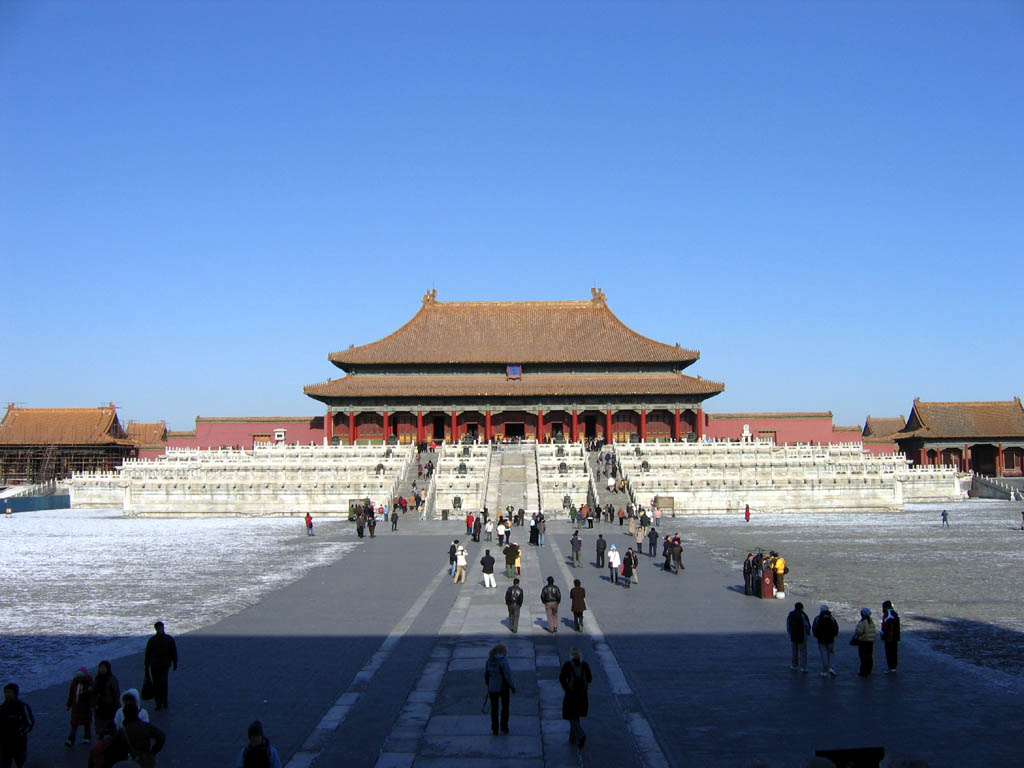
File:Forbidden city 07.jpg

At the top of any “TO DO” list for Beijing has got to be The Forbidden City.  Here is sampling of takes on this most famous complex in the city:

WIKIPEDIA: 

The Forbidden City was the Chinese imperial palace from the Ming Dynasty to the end of the Qing Dynasty. It is located in the middle of Beijing, China, and now houses the Palace Museum. For almost five centuries, it served as the home of the Emperor and his household, as well as the ceremonial and political centre of Chinese government.

Built from 1406 to 1420, the complex consists of 980 surviving buildings with 8,707 bays of rooms and covers 720,000 m2 (7,800,000 sq ft). The palace complex exemplifies traditional Chinese palatial architecture,and has influenced cultural and architectural developments in East Asia and elsewhere. The Forbidden City was declared a World Heritage Site in 1987, and is listed by UNESCO as the largest collection of preserved ancient wooden structures in the world.

Since 1925, the Forbidden City has been under the charge of the Palace Museum, whose extensive collection of artwork and artifacts were built upon the imperial collections of the Ming and Qing dynasties. Part of the museum's former collection is now located in the National Palace Museum in Taipei. Both museums descend from the same institution, but were split after the Chinese Civil WarREAD MORE

ZAGAT: 

A “spectacular” glimpse into “China’s imperial history”, this “huge complex” in Dongcheng (voted Beijing’s Most Popular attraction) was home to “royal families” for nearly 500 years; “if you want to see all” of its “countless buildings”, “breathtaking architecture” and “amazing art”, “you need an entire day”, but to “maximize the experience”, consider hiring “one of the English-speaking guides” – or at least “watch The Last Emperor before you go”; P.S. around Survey time, much was “being restored for the Olympics”, and reports of early unveilings said it’s “looking better than ever.”

PETER GREENBERG:

This is the largest and best-preserved Imperial Palace in the world. There are 8,000 rooms left of the original 9,999 that were built, and the complex is one of the five world-famous palaces. The Forbidden City has a moat and a wall around it. The reason for the security is simple: emperors and empresses of the Ming and Qing Dynasties lived here, so for more than 500 years (1368-1911), it was the governing center of China. The palace is well worth a look.

NATIONAL GEOGRAPHIC:

"The world's largest courtyard-style house, with staggering proportions. For five centuries, this was the center of the universe."—Dr. Robert Jacobsen, chair of Asian art, Minneapolis Institute of Arts. The 180-acre imperial compound was built in the early 15th century and was the seat of power during the Ming and Qing dynasties. Tip: Go in the early morning or cold weather to avoid crowds. www.dpm.org.cn

FODOR’S:

Undeniably sumptuous, the Forbidden City, once home to a long line of emperors, is Beijing's most enduring emblem. Magnificent halls, winding lanes, and stately courtyards await you-welcome to the world's largest palace complex.

As you gaze up at roofs of glazed-yellow tiles—a symbol of royalty—try to imagine a time when only the emperor ("the son of God") was permitted to enter this palace, accompanied by select family members, concubines, and eunuch-servants. Now, with its doors flung open, the Forbidden City's mysteries beckon.

The sheer grandeur of the site—with 800 buildings and more than 8,000 rooms—conveys the pomp and circumstance of Imperial China. The shady palaces, musty with age, recall life at court, where corrupt eunuchs and palace officials schemed and bored concubines gossiped.

The most impressive way to reach the Forbidden City is through the imposing Gate of Heavenly Peace (Tiananmen), connected to Tiananmen Square. The Great Helmsman himself stood here to establish the People's Republic of China on October 1, 1949, and again to review millions of Red Guards during the Cultural Revolution. Ascend the gate for a dramatic view of the square. You must check your bags prior to entry and also pass through a metal detector.

The Meridian Gate (Wumen), sometimes called Five Phoenix Tower, is the main southern entrance to the palace. Here, the emperor announced yearly planting schedules according to the lunar calendar; it's also where errant officials were flogged. The main ticket office and audio-guide are just west of this gate.

The Hall of Supreme Harmony was used for coronations, royal birthdays, and weddings. Bronze vats, once kept brimming with water to fight fires, ring this vast expanse. The hall sits atop three stone tiers with an elaborate drainage system with 1,000 carved dragons. On the top tier, bronze cranes symbolize longevity. Inside, cloisonné cranes flank the imperial throne, above which hangs a heavy bronze ball—placed there to crush any pretender to the throne.

Emperors greeted audiences and held banquets in the Hall of Middle Harmony (Zhonghedian). It also housed the royal plow, with which the emperor himself would turn a furrow to commence spring planting.

The highest civil service examinations, which were personally conducted by the emperor, were once administered in the Hall of Preserving Harmony (Baohedian). Behind the hall, a 200-ton marble relief of nine dragons, the palace's most treasured stone carving, adorns the descending staircase.

A short jaunt to the right is Hall of Clocks and Watches (Zhongbiaoguan), where you'll find a collection of early timepieces. It's pure opulence: There's a plethora of jeweled, enameled, and lacquered timepieces (some astride elephants, others implanted in ceramic trees). Our favorites? Those crafted from red sandalwood.

Now you're approaching the very core of the palace. Several emperors chose to live in the Inner Palace with their families. The Hall of Heavenly Purity (Qianqinggong) holds another imperial throne; the Hall of Union and Peace (Jiaotaidian) was the venue for the empress's annual birthday party; and the Palace of Earthly Peace (Kunninggong) was the empress's residence and also was where royal couples consummated their marriages. The banner above the throne bizarrely reads DOING NOTHING.

On either side of the Inner Palace are six western and six eastern palaces—the former living quarters of concubines, eunuchs, and servants. The last building on the western side, the Hall of Mental Cultivation (Yangxindian), is the most important of these; starting with Emperor Yongzheng, all Qing Dynasty emperors attended to daily state business in this hall.

The Gallery of Treasures (Zhenbaoguan), actually a series of halls, has breathtaking examples of imperial ornamentation. The first room displays candleholders, wine vessels, tea sets, and a golden pagoda commissioned by Qing emperor Qian Long in honor of his mother. A cabinet on one wall contains the 25 imperial seals. Jade bracelets, golden hair pins, and coral fill the second hall; carved jade landscapes a third.

North of Forbidden City's private palaces, beyond the Gate of Earthly Tranquility, lie the most pleasant parts of the Forbidden City: the Imperial Gardens (Yuhuayuan), composed of ancient cypress trees and stone mosaic pathways. During festivals, the emperors, empress, and concubines all scrambled to the top of the strange rock hill in the northwest of the gardens, called the Hill of Accumulated Elegance. You can exit the palace at the back of the gardens through the park's Gate of the Divine Warrior (Shenwumen).

  • Cost: Y30
  • Open: Oct. 16-Apr. 15, daily 8:30-4:30; Apr. 16-Oct. 15, daily 8:30-5

FROMMERS:

The universally accepted symbol for the length and grandeur of Chinese civilization is undoubtedly the Great Wall, but the Forbidden City is more immediately impressive. A 720,000-sq.-m (7,750,015-sq.-ft.) complex of red-walled buildings and pavilions topped by a sea of glazed vermilion tile, it dwarfs nearby Tian'an Men Square and is by far the largest and most intricate imperial palace in China. The palace receives more visitors than any other attraction in the country (over seven million a year, the government says), and has been praised in Western travel literature ever since the first Europeans laid eyes on it in the late 1500s. Yet despite the flood of superlatives and exaggerated statistics that inevitably go into its description, it is impervious to an excess of hype, and it is large and compelling enough to draw repeat visits from even the most jaded travelers. Make more time for it than you think you'll need.

The palace, most commonly referred to in Chinese as Gu Gong (Former Palace), is on the north side of Tian'an Men Square across Chang'an Dajie (tel. 010/6513-2255; www.dpm.org.cn). It is best approached on foot or via metro (Tian'an Men Dong, 117), as taxis are not allowed to stop in front. The palace is open daily from 8:30am to 5pm during summer and from 8:30am to 4:30pm in winter. Regular admission (men piao) in summer costs ¥60 ($8/£4), dropping to ¥40 ($5.35/£2.65) in winter; last tickets are sold an hour before the doors close. Various exhibition halls and gardens inside the palace charge additional fees. All-inclusive tickets (lian piao) had been discontinued at press time, perhaps in an effort to increase revenues, but it's always possible these will be reinstated. Tip: If you have a little more time, it is highly recommended that you approach the entrance at Wu Men (Meridian Gate) via Tai Miao to the east, and avoid the gauntlet of tiresome touts and tacky souvenir stalls.

Ticket counters are marked on either side as you approach. Audio tours in several languages (¥40/$5.35/£2.65 plus ¥100/$13/£6.65 deposit; the English version is narrated by Roger Moore) are available at the gate itself, through the door to the right. Those looking to spend more money can hire "English"-speaking tour guides on the other side of the gate (¥200-¥350/$27-$47/£13-£23) per person, depending on tour length). The tour guide booth also rents wheelchairs and strollers at reasonable rates. Note: Only the central route through the palace is wheelchair-accessible, and steeply so.

The Big Makeover -- An immense $75-million renovation of the Forbidden City, the largest in 90 years, will be completed in two phases (the first by 2008, the second by 2020). Work began on halls and gardens in the closed western sections of the palace in 2002. Effort was concentrated on opening the Wuying Dian (Hall of Valiance and Heroism) in the southwest corner of the palace; the Jianfu Gong Huayuan (Garden of the Palace of Building Happiness) in the northwest; followed by Cining Huayuan (Garden of Love and Tranquillity) next to the Taihe Dian. Wuying Dian, formerly the site of the Imperial printing press, should be open when you arrive, displaying a collection of Buddhist sutras, palace records, and calligraphy. Also slated to reopen is Jianfu Gong Huayuan, which has undergone an ambitious restoration as the entire section was devastated by fire in 1923. Cining Huayuan is said to be opening in 2008. Plans also call for the construction of new temperature-controlled buildings to house and exhibit what is claimed to be a collection of 930,000 Ming and Qing imperial relics, most now stored underground.

On the other side of the palace, within the northern section of the Ningshou Gong Huayuan, a remarkable building is undergoing restoration with assistance from the World Cultural Heritage Foundation. Qianlong commissioned the European Jesuit painters in his employ to create large-scale trompe l'oeil paintings, which were used both in the Forbidden City and in the Yuan Ming Yuan. Juanqin Zhai, an elaborately constructed private opera house, houses the best remaining examples of these paintings, including a stunning image of a wisteria trellis, almost certainly painted by Italian master Castiglione.

Background & Layout

Sourcing of materials for the original palace buildings began in 1406, during the reign of the Yongle emperor, and construction was completed in 1420. Much of it was designed by a eunuch from Annam (now Vietnam), Nguyen An, but without improvements to the Grand Canal, construction would have been impossible -- timber came from as far away as Sichuan, and logs took up to 4 years to reach the capital. The Yuan palace was demolished to make way for the Forbidden City, but the lakes created during the Jin (1122-1215) were retained and expanded. Between 1420 and 1923, the palace was home to 24 emperors of the Ming and Qing dynasties. The last of these was Aisin-Gioro Puyi, who was forced to abdicate in 1912 but remained in the palace until 1924.

The Forbidden City is arranged along a north-south meridian, aligned on the Pole Star. The Qing court was unimpressed when the barbarians designated Greenwich Royal Observatory as the source of the prime meridian in 1885; they believed the Imperial Way marked the center of the temporal world. Major halls open to the south. Furthest south and in the center is the symmetrical outer court, dominated by immense ceremonial halls where the emperor conducted official business. Beyond the outer court and surrounding it on both sides is the inner court, a series of smaller buildings and gardens that served as living quarters. During the Ming, only eunuchs were allowed to pass between the two courts, enhancing their power.

The palace has been ransacked and parts destroyed by fire several times over the centuries, so most of the existing buildings date from the Qing rather than the Ming. The original complex was said to contain 9,999 rooms, testament to the Chinese love of the number nine, and also to an unusual counting method. The square space between columns is counted as a room (jian), so the largest building, Taihe Dian, counts as 55 rooms. Using the Western method of counting, there are now 980 rooms. Only half of the complex is open to visitors (expected to increase to 70% after repairs are completed in 2020), but this still leaves plenty to see.

The Inner Court (Nei Ting)

During the Ming, only the emperor, his family, his concubines, and the palace eunuchs (who numbered 1,500 at the end of the Qing dynasty) were allowed in this section. It begins with the Qianqing Men (Gate of Heavenly Purity), directly north of the Baohe Dian, fronted by a magnificent pair of bronze lions and flanked by a Ba Zi Yingbi (a screen wall in the shape of the character for "eight"), both warning non-royals not to stray inside. Beyond are three palaces designed to mirror the three halls of the Outer Court.

The first of these is the Qianqing Gong (Palace of Heavenly Purity), where the emperors lived until Yongzheng decided to move to the western side of the palace in the 1720s. Beyond is Jiaotai Dian (Hall of Union), containing the throne of the empress and 25 boxes that once contained the Qing imperial seals. A considerable expansion on eight seals used during the Qin dynasty, the number 25 was chosen because it is the sum of all single-digit odd numbers. Next is the more interesting Kunning Gong (Palace of Earthly Tranquillity), a Manchu-style bedchamber where a nervous Puyi was expected to spend his wedding night before he fled to more comfortable rooms elsewhere.

At the rear of the inner court is the elaborate Yu Huayuan (Imperial Garden), a marvelous scattering of ancient conifers, rockeries, and pavilions, largely unchanged since it was built in the Ming dynasty. The crags allowed court ladies, who spent their lives inside the Inner Court, a glimpse of the world outside. Puyi's British tutor, Reginald Fleming Johnston, lived in the Yangxin Zhai, the first building on the west side of the garden (now a tea shop).

From behind the mountain, you can exit the palace through the Shenwu Men (Gate of Martial Spirit) and continue on to Jing Shan and/or Bei Hai Park. Those with time to spare, however, should take the opportunity to explore less-visited sections on either side of the central path.

Western Axis

Most of this area is in a state of heavy disrepair, but a few buildings have been restored and are open to visitors. Most notable among these is the Yangxin Dian (Hall of Mental Cultivation), southwest of the Imperial Garden. The reviled Empress Dowager Cixi, who ruled China for much of the late Qing period, made decisions on behalf of her infant nephew, the Guangxu emperor, from behind a screen in the east room. This is also where emperors lived after Yongzheng moved out of the Qianqing Gong.

Eastern Axis

This side tends to be peaceful and quiet even when other sections are crowded. Entrance costs ¥10 ($1.35/65p) and requires purchase of useless over-shoe slippers, which quickly disintegrate (¥2/25¢/15p). The most convenient ticket booth is 5 minutes' walk southwest of the Qianqing Men, opposite Jiulong Bi (Nine Dragon Screen), a 3.5m-high (11 1/2-ft.) wall covered in striking glazed-tile dragons depicted frolicking above a frothing sea, built to protect the Qianlong emperor from prying eyes and malevolent spirits (that are only able to move in straight lines). The Qianlong emperor (reign 1736-1795) abdicated at the age of 85, and this section was built for his retirement, although he never really moved in, continuing to "mentor" his son while living in the Yangxin Dian, a practice later adopted by Empress Dowager Cixi, who also partially took up residence here in 1894.

Zhenbao Guan (Hall of Jewelry), just north of the ticket booth, has all 25 of the Qing imperial seals, ornate swords, and bejeweled minipagodas -- evidence that the Qing emperors were devoted to Tibetan Buddhism. One of the highlights is the secluded Ningshou Gong Huayuan, where the Qianlong emperor was meant to spend his retirement. Water was directed along a snakelike trough carved in the floor of the main pavilion. A cup of wine would be floated down the miniature stream, and the person nearest wherever it stopped would have to compose a poem, or drink the wine. The Qianlong emperor, whose personal compendium of verse ran to a modest 50,000 poems, was seldom short of words.

East of the garden is the Changyin Ge, sometimes called Cixi's Theater, an elaborate green-tiled three-tiered structure with trap doors and hidden passageways to allow movement between stages. Further north is sumptuous Leshou Tang, built entirely from sandalwood, where the Qianlong emperor would read, surrounded by poems and paintings composed by loyal ministers set into the walls and framed by blue cloisonné tablets. Cixi slept in the room to the west. The following hall, Yihe Xuan, is not a good place to bring friends from Mongolia or Xinjiang. The west wall has an essay justifying the Qianlong emperor's decision to colonize the latter, while the east wall has a poem celebrating the invasion of Mongolia. In the far northeastern corner is Zhen Fei Jing (Well of the Pearl Concubine), a surprisingly narrow hole covered by a large circle of stone. The Pearl Concubine, one of the Guangxu emperor's favorites, was 25 when Cixi had her stuffed down the well by a eunuch as they were fleeing in the aftermath of the Boxer Rebellion. According to most accounts, Cixi was miffed at the girl's insistence that Guangxu stay and take responsibility for the imperial family's support of the Boxers.

Also worth seeing is the Hall of Clocks (Zhongbiao Guan), a collection of timepieces, many of them gifts to the emperors from European envoys. Entrance to the exhibit costs ¥10 ($1.35/65p).

LONELY PLANET:

The Forbidden City, so-called because it was off-limits to most of the world for 500 years, is the best preserved cluster of ancient buildings in China. The old world of beautiful concubines and priapic emperors, ball-breaking (and broken) eunuchs and conspicuous wealth still hovers over the lush gardens, courtyards, pavilions and great halls of the palace.

Most of the buildings are post-18th century; there have been periodic losses due to an injudicious mix of lantern festivals and Gobi winds, invading Manchus and, in this century, pillaging and looting by both the Japanese forces and the Kuomintang. A permanent restoration squad takes about 10 years to renovate its 720,000 square metres, 800 buildings and 9000 rooms, by which time it's time to start all over again.

The palatial former living quarters now function as museums. Opening hours are irregular and no photos are allowed without prior permission. Special exhibits sometimes appear in other palace museum halls, so check the expat magazines, such as That's Beijing , for details.

Ignore unscrupulous characters who insist that you must have an official guide to see the palace; it isn't true. For around Y40 , rent a funky automatically activated audio tour instead.

NEW YORK TIMES:

Tai Miao

Location:  East of Tian'an Men, Dog Cheng QuCityBeijing

Phone010/6525-2189

Price Admission ¥2 (25¢/15p); admission to bell exhibit ¥10 ($1.35/65p)

Sometimes the biggest surprises are under your nose. Just east of Tian'an Men stands the only example of an imperial ancestral hall (zu miao) remaining in China; here are grand imperial edifices in a sleepy, atmospheric setting. Laid out in accordance with the ancient principle from the Rites of Zhou, "Ancestors to the left, land to the right" (zuo zu you she), the wooden tablets (paiwei) that represented the ancestors of the imperial house were housed to the left of the Forbidden City (the land was offered its due at the Altar of Land and Grain, housed in Zhongshan Gongyuan to the west). Beyond the Halberd Gate (Ji Men), untouched since it was constructed in 1420, the three main buildings are lined up on a central axis. Sacrifices to the ancestors took place in the southernmost building (Xiang Dian). This is one of only four buildings in Beijing to stand on a three-tiered platform, a hint that it was the most sacred site in imperial Beijing. Mao renamed it the Workers' Cultural Palace (Laodong Renmin Wenhua Gong), and the wooden tablets were pilfered during the Cultural Revolution. The workers have moved on, and the complex is largely deserted. Once you reach the moat at the northern end of the complex, turn left. Immediately opposite is Zhongshan Gongyuan; to the right stands Wu Men and the Forbidden City. Infinitely preferable to running the souvenir vendor gauntlet north from Tian'an Men, entering the Forbidden City from Tai Miao may be the best ¥2 (25¢/15p) you'll ever spend.

If you have your own experience and opinion on The Forbidden City, please share with others by clicking on the COMMENT button below. 

Sunday, January 31, 2010

S. KOREA: Korea activists target foreign English teachers

Watchdog

Yie Eun-woong, volunteer manager of the Seoul-based Anti-English Spectrum, investigates complaints from parents about foreign teachers. Angry teachers groups call him an instigator and a stalker. (John M. Glionna / Los Angeles Times / January 20, 2010)

A South Korea group uses the Internet and other means to track foreign teachers, in an effort to ferret out illegal or unsavory behavior. The teachers say they're victims of stalkers and rumors.

January 31, 2010

By John M. Glionna

Reporting from Seoul - Sometimes, in his off hours, Yie Eun-woong does a bit of investigative work.


He uses the Internet and other means to track personal data and home addresses of foreign English teachers across South Korea.
Then he follows them, often for weeks at a time, staking out their apartments, taking notes on their contacts and habits.

He wants to know whether they're doing drugs or molesting children.


Yie, a slender 40-year-old who owns a temporary employment agency, says he is only attempting to weed out troublemakers who have no business teaching students in South Korea, or anywhere else.


The volunteer manager of a controversial group known as the Anti-English Spectrum, Yie investigates complaints by South Korean parents, often teaming up with authorities, and turns over information from his efforts for possible prosecution.


Outraged teachers groups call Yie an instigator and a stalker.
Yie waves off the criticism. "It's not stalking, it's following," he said. "There's no law against that."


Since its founding in 2005, critics say, Yie's group has waged an invective-filled nationalistic campaign against the 20,000 foreign-born English teachers in South Korea.


On their website and through fliers, members have spread rumors of a foreign English teacher crime wave. They have alleged that some teachers are knowingly spreading AIDS, speculation that has been reported in the Korean press.


Teacher activists acknowledge that a few foreign English instructors are arrested each year in South Korea -- cases mostly involving the use of marijuana -- but they insist that the rate of such incidents is far lower than for the Korean population itself.


"Why are they following teachers? That's a job for the police," said Dann Gaymer, a spokesman for the Assn. for Teachers of English in Korea. "What this group is up to is something called vigilantism, and I don't like the sound of that."


In November, the president of the teachers group received anonymous e-mails threatening his life and accusing him of committing sex crimes.


"I have organized the KEK (Kill White in Korea)," one e-mail read in part. "We will start to kill and hit [foreigners] from this Christmas. Don't make a fuss. . . . Just get out."


Yie acknowledges that he has been questioned by investigators but denies any involvement in the threats of violence.
"To be honest," he said, "a lot of our group members believe the teachers made this all up."


The debate over foreign English teachers is symbolic of a social shift taking place in a nation that has long prided itself on its racial purity and singular culture, South Korean analysts say.

In less than a decade, the number of foreigners living in South Korea, with a population of nearly 49 million, has doubled to 1.2 million, many of them migrant workers from other Asian nations.

Also included are the foreign English teachers, most from the United States, drawn here by compensation packages that may include as much as $2,500 a month plus free rent and a round-trip ticket to teach a Korean population obsessed with learning from native speakers.


Yie's efforts have the support of some educators who say many foreign teachers lack the skills to run a classroom.


"This has nothing to do with race. It is all about teaching," said Kim Young-Lan, a sociology professor at Sookmyung Women's University in Seoul.


The government has tried to stem what it sees as a troubling number of racist incidents. A 31-year-old man was charged last year for a verbal outburst against an Indian man and a Korean woman traveling together on a city bus in Seoul.


But some teachers from abroad say Korean laws regarding their status remain discriminatory. Foreign English teachers must undergo HIV tests and criminal and academic checks that are not required of Koreans doing the same work, they say.


Yie says he has nothing against foreigners. Growing up near the city of Osan, he often rode with his taxi driver father and encountered foreigners who served at the U.S. military base there. "I learned to pick out the good guys from the bad guys," he says.


In 2005, by then living in Seoul, he joined the fledgling activist group after seeing an upsetting posting on a website: claims by foreign teachers that they had slept with Korean students.
Yie, who is single and has no children, volunteered to help organize an effort to rein in such behavior.


"People were angry; most of them were parents with kids," he said. "We all got together online and traded information."
Gaymer says he doubts that such a posting ever existed. Instead, he says, Koreans were angry about photos posted on a job website showing foreigners dancing with scantily clad Korean women.


"They were consenting adults at a party with foreign men," he said. "They weren't doing anything bad or illegal."


Yie's group, Gaymer says, has used the incident as a rallying call. "They're posting online pictures of teachers' apartments and whipping each other into a nationalist frenzy, creating a hysteria against all English teachers, troublemakers or not," he said.

Yie, who says his group is managed by half a dozen key figures and has 300 other members, created a system for parents and others to report bad teachers. The group says it has contributed to several arrests, including the recent bust of several foreign instructors for gambling and marijuana possession.


"I'm being called a racist who judges the entire group by the mistakes of the few," Yie said. "I'm trying to look at these teachers with an open mind."

Ju-min Park of The Times' Seoul Bureau contributed to this report.

View Article in Los Angeles Times

JAPAN & HAITI: Rooney on Earthquakes

January 31, 2010 4:58 PM

When a quake struck Japan in 1923, Andy Rooney's father was there. Some of the lessons learned then and now remain the same.

 
Watch CBS News Videos Online

RUSSIA: On this Day (Jan 31) in 1714

Portrait of Peter the Great by Jean-Marc Nattier

Portrait of Peter the Great by Jean-Marc Nattier

On January 31, 1714, Russian Emperor Peter I, aspiring to boost the literacy level amongst teenage members of the nobility, issued his decree only allowing the young men to get married after they had completed their studies.

In the strictest sense, it was not until Peter’s coming to power that formal state-run educational establishments began to emerge in Russia. Before that, aside from minor attempts to set up schools undertaken by various Russian leaders, the youth in Russia was homeschooled, attended classes at church, or received a special education, mastering one of the trades.

Peter, after his Grand Expedition to Europe in 1697-98, was deeply impressed by the developments of European industry and science and wanted to evoke the thirst for knowledge and science in the younger noble generation.

The rather witty decree provided that “to every region should be dispatched a number of persons keen in mathematics, to teach the noble offspring arithmetic and geometry and those who disobey are to be punished, as they are not to get married until all sciences are comprehended.”

However, in the times of Peter, to feed his vast military campaigns, educational establishments were majorly focused on preparing staff for the army. Peter’s demands toward education were very high, therefore, some schools did not even have a fixed graduation date – the students were only allowed out after they displayed a decent knowledge of all taught disciplines. Very often, Peter himself actively oversaw the entire educational process, coming to classes and field practices and personally honoring the best students. According to Peter’s decree of 1701 general education was available for people regardless their rank.

The teachers to schools were invited from abroad, as well as transferred straight from the army and navy with real-life experience to share. The so-called first stage of studies was devoted to the basics of the Russian language and arithmetic, while the next stage included higher levels of trigonometry and geometry, and the final stage was about astronomy and navigation science. Though admission was open to everyone, only those higher on the social hierarchy could resume their education further than the first stage. Besides which, the higher educational establishments did not admit common people anyway. The lower-class graduates could later become orderly room clerks or do a variety of other supplementary jobs in the Admiralty. The noble graduates were sent to the Navy, to the artillery, or to the infantry regiments.

Every educational establishment under Peter was very focused on discipline; an unexcused absence could be punished by punitive labor or even death – however, such fatal punishment was never actually carried out. These strict measures were brought about by the fact that, along with the tangible advantages, the educational system brought obvious complications. The military service slacking on the part of the young nobility significantly increased due to a list of reasons: first, the actual service was now a lot harder and more complicated; besides this, another decree issued by Peter demanded that for entering the compulsory military service, the noble youth had to have a certain educational background, which automatically became compulsory, too; on the other hand, the landownership had become hereditary, rendering the practice of allotting the good servicemen amounts of land obsolete. As a result, the increased difficulty of the military service was aggravated by the simultaneous decrease of material remuneration. Unwillingness to serve in the army spawned the unwillingness to study in the first place. Slacking service and schools had become the nobility’s major vice and social disease, bringing about harsh and usual punishments, like punitive labor or ban on marriage.

Schools were nevertheless established, more and more over time, and all across Russia, stretching deeper into the Urals and other Russian regions, forming the basis for the state educational system of the youth and giving ground to opening higher educational establishments.

View Article on Russia Today

TRAVEL: How to Have a Perfect Time in Port

Travel photo: Concierge.com

January 2010

by Wendy Perrin

Cruises may be a steal nowadays, but your total trip cost can skyrocket once you factor in shoreside sightseeing and activities, especially if you opt for the ship's group tours. So how do you get the most for your time and money in port?

[1] If your lifelong dream is to see a particular sight—say, the Acropolis—book a cruise that starts, ends, or overnights in that port. Ships can cancel port calls because of unforeseen circumstances such as bad weather or a labor strike. On a Mediterranean cruise, for instance, rough seas prevented our ship from sailing into Piraeus Harbor—which meant we missed our one and only day in Athens.

[2] Decide well in advance how to spend your hours in port. Web access can run a dollar a minute at sea, so waiting till you're on board to check out port options is expensive. And don't rely on the concierge desk, since most any cruise line's goal is to sell you its tours. Start your excursion research right after booking a cruise.

[3] Perusing the list of shore tours sold by the cruise line is a good way to begin your research, but don't stop there. Check out the Web sites of local tourist boards, as well as sites specializing in day-trips—ShoreTrips.com, Viator.com—and local tour agencies with a focus on your interests (say, fly-fishing or wineries).

[4] Find local events scheduled for the day you're in port. Is there a cultural festival or sports tournament happening? Read local English-language newspapers online for event listings, and check museum Web sites for exhibitions and hours.

[5] Calculate travel time from the ship to the sights you want to see. The trip from Barcelona's pier to its Gothic Quarter is a ten-minute taxi ride, whereas going from Civitavecchia into Rome can take two hours. To compute your travel time, ask which pier your ship will use and whether it will anchor or dock. If it anchors—which means you must line up to board tenders to go ashore—passengers who have signed up for a ship tour will likely get to disembark before those with independent port plans. The cruise line should be able to tell you travel time from the pier to destinations included in its shore tours.

[6] Research public transit options. They can be faster, not to mention a lot cheaper and more authentic, than the ship's bus tour. Lonely Planet guidebooks often have good logistical information, and you can usually find train, bus, and ferry schedules online.

[7] For the greatest flexibility, rent a car or hire a taxi by the day or half-day. On islands or in ports where there's a rental car agency at the pier (and where the cost isn't prohibitive), I've found that renting a car is the best way to see the sights. If driving seems too risky, opt for a taxi. On European and Caribbean islands, cabs usually cost about $120 for four hours, and many drivers speak some English.

[8] In ports where everybody will be headed to the same famous landmark, book a private car and driver in advance. The car can meet you the minute you disembark, allowing you to bypass the taxi line and the groups boarding the buses. By booking a car and driver in Izmir, Turkey, we beat the crowds to the Greco-Roman city of Ephesus, then headed to the ancient wine- and olive-oil-making village of Sirince for a Turkish feast, not a tourist in sight. The cost of the transportation, Ephesus tickets, and lunch for four? $272. The ship's bus tour to Ephesus for four? $508. Hire a car and driver either through an excellent cruise travel agent who knows guides and drivers worldwide (see "Perrin's People," August 2009) or through a local concierge: If you plan to have lunch at a resort, for example, you could ask its concierge to arrange for the car.

[9] Where private arrangements are too expensive and logistics too challenging, opt for a ship tour. When I looked into booking a private day-trip to the Pyramids from the port in Alexandria, the cost for four was more than $2,000. Instead, we chose the cruise line's excursion to Giza for $199 per person and enjoyed desert jeep and camel rides that would have been impossible to organize on our own.

[10] When the only way to gain access to a monument or activity is via a ship-arranged group tour, book early—before it sells out. Our one day for seeing Alexandria itself was a public holiday, so to visit its famous library, the Bibliotecha Alexandrina, we had to take a tour organized by the ship. Indeed, the sole way to participate in many adventure activities—four-wheel drives, dogsledding, helicopter rides—is often via a ship tour.

Join Wendy Online: For timely travel advice and to ask Wendy your pressing questions, head to perrinpost.truth.travel.

View Article in Conde Nast Traveler

CHINA: China, and children as a commodity

Little Girl PosingJanuary 31, 2010

It seemed a perfect match, until adoption became big business in China.

Editorial

Over decades now, infertility or the simple desire to offer a child the chance for a better life has sent would-be parents to China in search of a baby to adopt. For so many, it was the perfect match.

On one side of the Pacific were well-to-do couples yearning to share their love and good fortune; on the other were a plethora of little girls abandoned by impoverished parents in need of a son to support them in old age, or in violation of the country's so-called one-child policy.


No one liked to think of adoptions in unseemly market terms, but in fact this was a case of supply and demand. Whether paying for egg donors and surrogate mothers in the United States, or for lawyers and adoption agencies abroad, those who sought children knew that lots of money changed hands -- $15,000 to $30,000 in paperwork, travel and fees for a Chinese baby. Still, why call it commerce when such aching needs were concerned, and what did it matter if everyone was better off?


That's how it seemed, anyway, as tens of thousands of babies arrived in the United States in the 1990s and 2000s from Hunan, Guangdong and other provinces with names previously unknown to many of the adoptive parents. The overwhelming majority of adoptees were girls, moving from an often-soulless orphanage into the tearful embrace of a new family and a newly decorated bedroom in the likes of Indiana, Minnesota or California.

Unfortunately, not everything was as it seemed. Although many of the babies indeed were abandoned, demand ultimately began to outpace supply, and as Barbara Demick of The Times' Beijing Bureau recently reported, some babies were taken from birth parents in remote villages by coercion, fraud or kidnapping. Official orphanages, which received $3,000 per child from the adoptive parents, began paying up to $600 per newborn in expenses and more to finders, some of whom were government officials. In recent years, some Chinese parents have begun to talk about how they were threatened or tricked into giving up their daughters, sometimes in lieu of fines they could not afford for having a second or third child.

Chinese law prohibits commerce in children, and in 2005 the government conducted a high-profile prosecution of a trafficking ring in Hunan province for receiving payments to procure 85 babies who were then placed abroad with unwitting adoptive parents. Demick spoke with one of the traffickers, recently released from jail, who said he had purchased newborns in Guangdong province and supplied them to orphanages in Hunan. He said his supplier sold more than 1,000 babies to orphanages in Hunan and Jianxi provinces, which frequently disguised the children's origins, saying they had been discovered at a market or near a bridge in Hunan. "The merchandise may have been human, but it was a trading business like any other. Cash on delivery; prices set by laws of supply and demand. . . . The orphanages would often phone in their orders and haggle over the price," Demick wrote.

Chinese officials have told foreign agencies and governments that the Hunan case was an aberration, but a report to the Dutch parliament last year by the Netherlands-based World Children claimed the agency had evidence that the backgrounds and identities of Chinese children put up for adoption more recently had been changed, and that children still were being traded for cash. Moreover, although the Chinese government acknowledged that the children in the Hunan case had been sent abroad, it did not clarify where all of them went, according to the report.

Chinese adoptions have dropped dramatically from their peak in 2005, when nearly 8,000 babies arrived in the United States. Last year the number was about 3,000, due to a scarcity that stems from many causes. Chinese society is wealthier, with more families able to support an illegal child or two. Domestic adoptions are on the rise, and the attitude toward girls has changed along with opportunities for them in China's urbanized economy; women too can support parents in their old age.

We would like to believe that another reason for the scarcity is that the Chinese government is vigorously enforcing existing anti-trafficking laws under the Hague convention on intercountry adoption. U.S. officials say they have no evidence of ongoing violations. They note that with a wait now of three to five years for newborns, nearly half of those coming to the United States are older or special-needs children who have been in care for a while.

But many who follow the issue closely believe abuses persist, although no one seems to know how widespread they are.
There is a cultural divide between the Chinese system's tendency toward secrecy and Americans' belief in their right to know. Given that China is still the largest source of adopted babies in the United States, however, it is imperative that U.S. officials demand openness and transparency regarding the background of these children, and that U.S. agencies deal only with proven, reputable orphanages in China. The Chinese must bend over backward to clarify the origins of babies and to create a thorough databank of information to ensure that all babies are offered for adoption voluntarily. No parent should be forced or tricked into relinquishing a child.

The donations that adoptive parents are required to pay to orphanages -- raised to about $5,000 last year -- also should be dropped or redirected. The Chinese government considers this a social welfare fee to help fund the orphanages and care for the children who are still there, many of them with special needs. It should fund these orphanages in a way that does not create local incentives to find more babies for adoption.

In the past, Americans may not have dreamed that their pursuit of parenthood could create a market for abandoned or abducted children -- obviously that was never their intention. But now that the issue has come to light, they too must be vigilant. Their children inevitably will ask where they came from, who they are and why they were put up for adoption. For the sake of both parents and children, they should have answers.

View Article in Los Angeles Times

Cruise Planning

by Heather Hopkins Clement

My travelling companions for my next cruise, Caroline and Janabeth, came over for an afternoon of cruise planning yesterday.  I had piles of maps, brochures and books related to the various destinations for us to sort through to map out our plans.

I have always been a planner, and I am especially one when it comes to cruising in East Asia.  I wholeheartedly agree with the author of  “How to Have a Perfect Time in Port”:

Decide well in advance how to spend your hours in port.  Web access can run a dollar a minute at sea, so waiting till you're on board to check out port options is expensive. And don't rely on the concierge desk, since most any cruise line's goal is to sell you its tours. Start your excursion research right after booking a cruise.

The last thing you want to be doing when you walk the gangway ashore is trying to figure out what you will do that day and how to get there.  It is a waste of your precious time ashore and could eat up so much of your time that once you figure out what you really want to do, you find there is not enough time to do it. 

There are so many good resources on the web, and they’re FREE!  I’ve posted quite a few of the links on my blog for easy reference.  The first place to start is with the national tourist organization for the countries you plan to visit.   They have a ton of information on their websites.  Many also have representative offices overseas, and if you contact them via phone or email, they will often send you a packet of printed materials about what to do when you go ashore.  It’s especially helpful to request maps (if available), so you can locate where the sights you wish to visit are located in relation to where the ship will dock.  You can then begin to figure other logistics such as a realistic itinerary (time-wise), mode(s) of transportation, recommended restaurants (esp. important if you have any dietary restrictions), and related fees.  This will then help you budget  and calculate how much local currency you will need.

Here in Southern California, I have found the  Los Angeles offices of the Japan National Tourist Organization, the Korea Tourism Organization and the Taiwanese Tourism Bureau to be most helpful.  The more specific details you give them about what you are looking for, the better they can assist you.  I have also received some good maps from the China National Tourist Office, but I have not had any personal interaction with the staff, and the information is limited.  I have yet to find the Russian equivalent of these organizations, so if anyone knows of such a resource, please let me know.

If the information you receive from the national tourist organization is not specific enough for your particular needs, contact the tourist organization for that city.  In some cases, they may be more helpful.  A good example of this is Shanghai.  While the information I have received to date from the China National Tourist Organization leaves some room for improvement, there is a wealth of information available about Shanghai. online including the city’s official travel site.  As you probably already know, Shanghai is hosting the World Expo this year, and they have gone all out to make the city tourist friendly.  If you are requesting any overseas office send you materials, you obviously need to do this weeks, if not months, in advance to allow sufficient time for the materials to reach you and for you to sort through them carefully.

Local newspaper sites can also be quite helpful.  For example, the Shanghai Daily’s Live in Shanghai section, includes a comprehensive city guide, information on cultural events throughout the city, and downloadable maps.

Another item you may want to add to your “TO DO” list in advance, is picking up a little of the local language.  Knowing basic pronunciation, greetings, etc. can go a long way.  There are some great resources online:

As for our planning, we were able to sketch out most of our plans yesterday and make a list of information we still needed to research before we depart.  During Q&A sessions onboard, I am often asked some variant of “Given all your knowledge and experience, what do YOU plan to do ashore?”  So, stay tuned and I’ll give you more specifics on our plans.

CHINA: China spends billions to study dinosaur fossils at sites of major discoveries


Tuesday, January 26, 2010; HE01

By Ariana Eunjung Cha

ZHUCHENG, CHINA -- What killed the dinosaurs? Scientist Wang Haijun thinks the answer may be buried inside a 980-foot-long ravine in the Chinese countryside 415 miles southeast of Beijing where hundreds of the creatures may have huddled in the final moments before their extinction.

The fossils here -- more than 15,000 fractured, mangled and blackened bones from about 65 million years ago in the late Cretaceous period right before they went extinct -- support theories of a catastrophe. Global fires. Explosions. Climate change.

"This find is very important for understanding the very end of the age of dinosaurs," said James M. Clark, a paleontologist at George Washington University who has examined some of the fossils.

The excavation here, believed to be the largest dinosaur fossil site in the world, is one of a number of groundbreaking research projects in a country that once shunned science because it was associated with the elites.

As a construction boom sweeps through China, workers digging into the ground and clearing forests for highways and high-rises are inadvertently stumbling upon relics that are rewriting our understanding of the distant past.

The Chinese government, which during the Cultural Revolution in 1966-76 was responsible for dismantling scientific research institutions, banishing many intellectuals to farms and systematically destroying historical artifacts, is now throwing billions of dollars into projects in archaeology, historical ecology and paleontology.

For decades, much of the important research into dinosaurs was in the United States, at sites in Utah and Montana. But over the past two to three years, attention has shifted to China, with major discoveries in Zhucheng and other sites.

In northeastern China in March, scientists discovered a new fossil indicating that many dinosaurs may have had featherlike fuzz, which they said suggests a closer relationship between birds and dinosaurs than previously thought. In Inner Mongolia, researchers dug up an entire herd of young, ostrichlike dinosaurs that they said will provide critical insight into how the creatures grew up. And in the desert in the far west, another group found a dinosaur with no teeth, trapped in a "death pit" that once was probably full of mud.

Zhucheng, with miles of gated industrial complexes featuring signs advertising canned food and men's suits, looks like any other factory town aboveground. But underneath this city of 1 million, there's a treasure trove of dinosaur remains, more than 50 metric tons of which have been collected.

They are so numerous here that "fossils can even be found in some farmers' private courtyard areas and next to their houses," said Xu Xing, a paleontologist at the Chinese Academy of Sciences who is one of the lead researchers on the excavation here.

Residents in and around Zhucheng, on China's east coast in Shandong Province, have been digging up "flying dragon" bones for use in medicinal concoctions for generations. But it took a long time for the state to recognize their value.

Dinosaur researchers "had absolutely no money in the 1990s," said Clark, who has been coming to China to do research since 1991. But by 2002, the government put a stop to people who smuggled dinosaur bones and eggs and sold them. Now, Clark said, "because they are finding so many amazing fossils, the Chinese government is putting a lot of money into it."

As a result, there are more than 30 excavation sites in this area, the largest of which was discovered in 2008 and has been nicknamed the "Dinosaur Stream."

At the time dinosaurs were roaming across China, Zhucheng is thought to have been an area of grasslands submerged under several feet of water.

The researchers theorize that the dinosaurs were killed by the force of an explosion from a volcanic eruption or a meteor impact and then were caught in a flash flood, landslide or even a tsunami that threw them together. Perhaps several such disasters occurred over a period of years.

"It's very hard to understand why there are so many dinosaurs dead in one place," said Wang, the principal technician on the excavation.

The pit has yielded some of the world's largest duck-billed dinosaur specimens, bones of a type of dinosaur that had never been seen outside North America, and at least six new species.

One of the new dinosaurs has a pointy, triangular chin, kind of like a pelican's bill but made of bone. Xu says it is "the strangest creature I have ever seen."

What's even more intriguing is that there are seven distinctive "floors" of dead dinosaurs in the pit. Some of the soil is yellow, other layers are red clay, which Xu said seems to show that "there wasn't just one event. The dinosaur bones are preserved in different layers, suggesting they were killed in several different times," he said.

Local officials are less interested in these mysteries. What they see in Zhucheng are money-making opportunities. Wang Kebai, head of the Zhucheng Municipal Tourism Bureau, has contracted with a U.S. company to draw up plans for a dinosaur museum and park that he and other officials boast will rival Disneyland. He said he expects 2 million visitors a year.

Wang said the potential is so great that the government may order scientists to stop digging and simply put glass around some of the bones in the soil and rocks so that tourists can see them in the state that they were found, rather than in isolated cases in a museum, with signs on them.

"There are so many bones," Wang reasoned. "Not all of them need to be studied."

Researcher Wang Juan contributed to this report.

View Article in the Washington Post

JAPAN & RUSSIA: Japan protests over Russian border guard shooting

 Japan protests over Russian border guard shooting

Sergey Krivosheev

TOKYO, January 31 (RIA Novosti)

Japan's Foreign Ministry on Sunday issued a protest after Russian border guards opened fire at two Japanese fishing vessels off the disputed South Kuril islands.

The border guards fired warning shots from a helicopter and then had to open direct fire at the Japanese fishing vessels on Friday when the trawlers refused to stop after entering Russia's territorial waters off Kunashir Island, the Russian coastal guard service said.

The fishing boats returned to their port of Rausu with numerous bullet holes on their hulls, the Japanese Foreign Ministry said, adding that the border guards' actions could have resulted in the loss of life and were completely inappropriate.

The ministry also said the vessels were fishing under bilateral agreements and urged Russia to take measures to avoid such incidents in the future.

Tokyo's continued claim over four South Kuril Islands (Iturup, Kunashir, Shikotan, and Habomai) has so far prevented Russia and Japan from signing a formal peace treaty to end World War II hostilities.

The four southern islands of the chain to the northeast of Japan were annexed by the Soviet Union after World War II.

View Article on RIA Novosti

S. KOREA: Samsung's Profit Jumps 75% On Rising Sales

Associated Press

Samsung 2009 net profit rises 75 percent

01.28.10, 08:15 PM EST 

Associated Press

SEOUL, South Korea -- Samsung Electronics Co. says its 2009 net profit jumped 75 percent as sales rose amid higher prices for memory chips and strong demand for consumer electronics.

The company said Friday in a regulatory filing that it earned 9.65 trillion won ($8.33 billion) in the 12 months through Dec. 31. It reported net profit of 5.53 trillion won the same period the year before.

Samsung said sales last year rose 23 percent to 89.77 trillion won from 72.95 trillion won a year earlier.

The Suwon, South Korea-based company is the world's largest manufacturer of computer memory chips, flat screen televisions and liquid crystal displays. It ranks No. 2 in mobile phones behind Finland's Nokia Corp. ( NOK - news - people )

View Article on Forbes

CHINA: China's strident tone raises concerns among Western governments, analysts

Sunday, January 31, 2010; A01

By John Pomfret
Washington Post Staff Writer

China's indignant reaction to the announcement of U.S. plans to sell weapons to Taiwan appears to be in keeping with a new triumphalist attitude from Beijing that is worrying governments and analysts across the globe.

From the Copenhagen climate change conference to Internet freedom to China's border with India, China observers have noticed a tough tone emanating from its government, its representatives and influential analysts from its state-funded think tanks.

Calling in U.S. Ambassador Jon Huntsman on Saturday, Chinese Vice Foreign Minister He Yafei said the United States would be responsible for "serious repercussions" if it did not reverse the decision to sell Taiwan $6.4 billion worth of helicopters, Patriot Advanced Capability-3 missiles, minesweepers and communications gear. The reaction came even though China has known for months about the planned deal, U.S. officials said.

"There has been a change in China's attitude," said Kenneth G. Lieberthal, a former senior National Security Council official who is currently at the Brookings Institution. "The Chinese find with startling speed that people have come to view them as a major global player. And that has fed a sense of confidence."

Lieberthal said another factor in China's new tone is a sense that after two centuries of exploitation by the West, China is resuming its role as one of the great nations of the world.

This new posture has befuddled Western officials and analysts: Is it just China's tone that is changing or are its policies changing as well?

In a case in point, one senior U.S. official termed as unusual China's behavior at the December climate conference, during which China publicly reprimanded White House envoy Todd Stern, dispatched a Foreign Ministry functionary to an event for state leaders and fought strenuously against fixed targets for emission cuts in the developed world.

Another issue is Internet freedom and cybersecurity, highlighted by Google's recent threat to leave China unless the country stops its Web censorship. At China's request, that topic was left off the table at this year's World Economic Forum in Davos, Switzerland, Josef Ackermann, chief executive of Deutsche Bank and co-chairman of the event, told Bloomberg News. The forum ends Sunday.

China dismisses concerns

Analysts say a combination of hubris and insecurity appears to be driving China's mood. On one hand, Beijing thinks that the relative ease with which it skated over the global financial crisis underscores the superiority of its system and that China is not only rising but has arrived on the global stage -- much faster than anyone could have predicted. On the other, recent uprisings in the western regions of Tibet and Xinjiang have fed Chinese leaders' insecurity about their one-party state. As such, any perceived threat to their power is met with a backlash.

A spokesman for the Chinese Embassy in Washington said China's tone had not changed.

"China's positions on issues like arms sales to Taiwan and Tibet have been consistent and clear," Wang Baodong said, "as these issues bear on sovereignty and territorial integrity, which are closely related to Chinese core national interests."

The unease over China's new tone is shared by Europeans as well. "How Should Europe Respond to China's Strident Rise?" is the title of a new paper from the Center for European Reform. Just two years earlier, its author, institute director Charles Grant, had predicted that China and the European Union would shape the new world order.

"There is a real rethink going on about China in Europe," Grant said in an interview from Davos. "I don't think governments know what to do, but they know that their policies aren't working."

U.S. officials first began noticing the new Chinese attitude last year. Anecdotes range from the political to the personal.

At the World Economic Forum last year, Premier Wen Jiabao lambasted the United States for its economic mismanagement. A few weeks later, China's central bank questioned whether the dollar could continue to play its role as the international reserve currency.

And in another vignette, confirmed by several sources, a senior U.S. official involved in the economy hosted his Chinese counterpart, who then made a series of disparaging remarks about the bureau that the American ran. Later that night, the two were to dine at the American's house. The Chinese representatives called ahead, asking what was for dinner. They were informed that it was fish. "The director doesn't eat fish," one of them told his American interlocutor. "He wants steak. He says fish makes you weak." The menu was changed.

Tone with Europe, India

With Europe and India, China's strident tone has been even more apparent. In autumn 2008, China canceled a summit with the European Union after French President Nicolas Sarkozy met with the exiled Tibetan leader, the Dalai Lama. Before that, it had denounced German Chancellor Angela Merkel over her contacts with the Tibetan spiritual leader. And in recent weeks, it has engaged in a heated exchange with British officials over its moves to block a broader agreement at the climate conference.

At the Chinese Embassy, Wang differed on the climate issue. "China is strongly behind the idea of meeting the issue of climate change," he said, "but at the same time we think that there are some people who want to confuse the situation, and we feel the need to try to let the rest of the world know our position clearly."

China also suspended ties with Denmark after its prime minister met the Dalai Lama and resumed them only after the Danish government issued a statement in December saying it would oppose Tibetan independence and consider Beijing's reaction before inviting him again.

"The Europeans have competed to be China's favored friend," Grant said, "but then they get put in the doghouse one by one."

China's newfound toughness also played out in a renewed dispute with India over Beijing's claims to the Indian state of Arunachal Pradesh, which borders Tibet. Last summer, China blocked the Asian Development Bank from making a $60 million loan for infrastructure improvements in the state. India then moved to fund the projects itself, prompting China to send more troops to the border.

David Finkelstein, a former U.S. Army officer at the Defense Intelligence Agency who now runs the China program at the Center for Naval Analyses, said the new tone underscores a shift in China. "On the external front," he said, "we will likely see a China that is more willing than in the past to proactively shape the external environment and international order rather than passively react to it."

An example would be events that unfolded in December when 22 Chinese Muslims showed up in Cambodia and requested political asylum. China wanted to hold seven of them on suspicion of participating in anti-Chinese riots in the Xinjiang region in July.

Under intense pressure from Beijing, Cambodia sent the group home, despite protests from the United States. Two days after the group was repatriated, China signed 14 deals with Cambodia worth about $1 billion.

What the future holds

Whether this new bluster from Beijing presages tougher policies and actions in areas of direct concern to the United States is a key question, Lieberthal said. What China does after the United States sells Taiwan the weapons may provide some clues.

Even before the United States announced its plans Friday, at least six senior Chinese officials, including officers from the People's Liberation Army, had warned Washington against the sale.

Once the deal was announced, China's Defense Ministry said it was suspending a portion of the recently resumed military relations with the United States. China also announced that it would sanction the U.S. companies involved in the sale.

What happens next will be crucial. China quietly sanctioned several U.S. companies for participating in such weapons sales in the past. However, it would mark a major change if China makes the list public and includes, for example, Boeing, which sells billions of dollars worth of airplanes to China each year.

He, the vice foreign minister, warned that the sales would also affect China's cooperation with the United States on regional issues. Does that mean China will continue to block Western efforts to tighten sanctions on Iran? Bonnie S. Glaser, a China security analyst at the Center for Strategic and International Studies, said the answer will probably come soon.

France takes over the presidency of the U.N. Security Council on Monday and is expected to push for a rapid move in that direction.

View Article in the Washington Post

TAIWAN: US defends weapons sale to Taiwan

Page last updated at 19:23 GMT, Saturday, 30 January 2010

Taiwan Navy base in Kaohsiung, southern Taiwan

Taiwan says the arms deal will make it feel more secure

The US has defended a proposed weapons sale to Taiwan following a furious response from China.

The US State Department said on Saturday that the sale contributed to "security and stability" between Taiwan and China, Reuters reported.

Beijing announced a series of moves against the US in retaliation for the proposed $6.4bn (£4bn) sale.

Ties between the two countries are already strained by rows over trade and internet censorship.

ANALYSIS

Damian Grammaticas

Damian Grammaticas, BBC News, Beijing

You would expect China to react angrily to any proposed arms sale to Taiwan, but this time it seems to be going further than before.

Suspending military exchanges is a classic reply from Beijing and it may not even concern the US too much.

China's threat to impose sanctions on US firms supplying arms to Taiwan is interesting if perplexing.

It's unclear what "sanctions" would involve in practice, since US firms aren't allowed to sell arms to China

China's threat to withdraw co-operation on key international and regional issues is the most serious one. Here China can make life difficult for Washington.

It can complicate US attempts to deal with nuclear programmes in Iran and North Korea, it can refuse to help in currency and trade issues.

But what is China trying to achieve by sounding so furious? Maybe Beijing's real aim is to try to deter America from future arms sales - for example the fighter jets and submarines which Taiwan really wants.

"Such sales contribute to maintaining security and stability across the Taiwan Strait," said US State Department spokeswoman Laura Tischler, quoted by Reuters.

The US is the leading arms supplier to Taiwan and has a treaty obligation to provide it with defensive arms.

'Severe harm'

Beijing said it would suspend military exchanges with the US, review co-operation on major issues and impose sanctions on companies selling arms.

However, the US - like the EU - has banned its companies selling arms to China since the 1989 Tiananmen Square massacre, so it was not clear what effect Chinese sanctions would have.

Chinese defence ministry spokesman Huang Xueping said the measures reflected the "severe harm" posed by the deal.

A foreign ministry spokesman said the arms deal would have "repercussions that neither side wishes to see".

Difficult ties

Taiwan and China have been ruled by separate governments since the end of a civil war in 1949.

Beijing has hundreds of missiles pointed at the island and has threatened to use force to bring it under its control if Taiwan moved towards formal independence.

Defence ties between Washington and Beijing have been on ice for several years because of differences over Taiwan, though the two countries' leaders pledged to improve them in 2009.

TAIWAN-CHINA RELATIONS

  • Ruled by separate governments since end of Chinese civil war in 1949
  • China considers the island part of its territory
  • China has offered a "one country, two systems" solution, like Hong Kong
  • Most people in Taiwan support status quo

Taiwan, meanwhile, welcomed the US move.

"It will let Taiwan feel more confident and secure so we can have more interactions with China," the Central News Agency quoted President Ma Ying-jeou as saying.

The Pentagon earlier notified the US Congress of the proposed arms sale, which forms part of a package first pledged by the Bush administration.

Friday's notification to Congress by the Defense Security Co-operation Agency (DSCA) was required by law. It does not mean the sale has been concluded.

US lawmakers have 30 days to comment on the proposed sale, Associated Press reported. If there are no objections, it would proceed.

PROPOSED ARMS SALE

  • 114 Patriot missiles ($2.81bn)
  • 60 Black Hawk helicopters ($3.1bn)
  • Communication equipment ($340m)
  • 2 Osprey mine-hunting ships ($105m)
  • 12 Harpoon missiles ($37m)

Source: Defense Security Co-operation Agency

The arms package includes 114 Patriot missiles, 60 Black Hawk helicopters and communications equipment for Taiwan's F-16 fleet, the agency said in a statement.

It does not include F-16 fighter jets, which Taiwan's military has been seeking.

Last week US Secretary of State Hillary Clinton angered Beijing with a call to China to investigate cyber attacks on search giant Google, after the company said email accounts of human rights activists had been hacked.

View Article on BBC News