Upcoming Cruises

TBD

Wednesday, May 26, 2010

JAPAN: A Japanese director's world debut

Gen Fujimoto

May 26, 2010

By DAN GRUNEBAUM

TOKYO — Haruki Murakami’s books top bestseller lists worldwide, and the filmmaker Takeshi Kitano is a regular hit at Cannes. But contemporary Japanese theater remains by and large terra incognita.

Abroad, Japanese theater directors are mainly known in the form of Amon Miyamoto’s Broadway hits and Yukio Ninagawa’s kabuki Shakespeare productions. Performances of new Japanese theater are rare, leaving a gaping hole in the world’s understanding of the country’s performing arts scene.

That is beginning to change with the translation into English and other languages of recent works by the theater company Chelfitsch and the playwright and director Shu Matsui. Festival/Tokyo, Japan’s leading performing arts showcase, regards Mr. Matsui as one of the country’s most important young directors, and translated his disturbing, surrealistic “Ano Hito no Sekai” (That Man’s World) for its fall 2009 season.

Via his Sample company’s eye-catching, multilevel staging, the play follows the story of a directionless loner in rural Japan who searches for meaning in anarchic, bestial ceremonies. But the larger theme is the intolerance lurking behind the polite facade of Japanese society.

“The story is about people whose prejudices prevent them from interacting,” the soft-spoken Mr. Matsui said in a recent interview in the trendy Shibuya district. “I wanted foreigners to see the play because it deals with bigotry. Living in homogeneous Japan there aren’t many chances to confront one’s prejudices, so they remain hidden.”

Key to “Ano Hito no Sekai” was the way that the characters acted mechanically and didn’t even attempt to scale walls of mutual noncomprehension. This grew out of Mr. Matsui’s view of Japan as a zombie nation, something that led Festival/Tokyo to describe him as portraying “the emptiness of modern Japan.”

“I’m not quite sure how they arrived at that catch-copy,” Mr. Matsui said, laughing. “For me, it’s not so much a question of ‘emptiness.’ I prefer the image of a zombie. Why? Because zombies represent the future of mankind: they have no soul, no interior, no emotions. They wander about with no purpose, they respond to stimuli — for example if there is an escalator at a shopping center they’ll go up and down — but that’s all they do. Their form to me somehow represents what humans are heading toward.”

For his latest work at the Tokyo Performing Arts Market this spring, Mr. Matsui was asked by a local theater in the western Japanese island of Kyushu to create a play based on Takiji Kobayashi’s landmark Japanese Marxist novel “Kanikosen” (The Crab Ship), about exploited crab cannery workers. The 1929 book has enjoyed a resurgence of popularity in Japan amid the financial crisis and hardships facing the nation’s young.

The result was “Hakobune” (Ark), which depicts dead-end, part-time workers performing meaningless tasks at an anonymous factory. They suffer under the hand of an overseer, but midway roles are suddenly reversed and he becomes an underling. Relentlessly cheery J-pop music and ubiquitous cellphones inject notes of everyday Japanese reality into an absurdist plot in which even death is a matter of little import.

It wasn’t long ago that Mr. Matsui himself labored on a conveyor belt as a struggling actor. Reflecting his experience, the workers of “Hakobune” are the passive Japanese freeta — those unable to land full-time jobs — of the moment rather than the Marxist rebels of “Kanikosen.”

“‘Kanikosen’ has a revolutionary flavor that I thought wouldn’t resonate,” he said. “People don’t join organized labor these days and before it gets to that point they lose their jobs to outsourcing anyway, so I depicted a softer workplace — even if the workers are still throwaway.”

The irony of Mr. Matsui’s reference to Noah’s Ark in the title is that his characters are not in fact irreplaceable bearers of their species’ gene pool, but disposable ciphers.

“Rather than the people, it’s the objects on stage that are the main players,” he explained. “The characters are like holographs, like something you might see at Disneyland’s haunted mansion. They serve only to explain the situation — like artifacts of a mistaken history.”

The son of a lawyer and radio announcer, Mr. Matsui spent an unremarkable childhood and only ended up in theater when he followed a girl he had a crush on into his high school drama club. There he was bitten by the theater bug, and spent his 20s as a professional actor and odd-job worker before his 2004 breakout “Tsuka” (Passage) was given the New Face Award by the Japan Playwrights Association.

“I’d been an actor for 13 years, but didn’t start to think about writing my own plays until I was past 30,” said Mr. Matsui, who is 37. “I wanted to create a world that I found compelling, and to see if it compelled others. I wondered if others shared my anxieties. It surprised me when people related to my work, especially since the first one about a family that is taken over by outsiders was pretty disturbing.”

Bestiality and rape appear in Mr. Matsui’s work, but the violence serves a cautionary purpose. He cites the intense interest among his generation in the “otaku murderer,” Tsutomu Miyazaki, who between 1988 and 1989 mutilated and killed four young girls, molesting and cannibalizing their corpses.

“He said before his execution that he was told to do so by someone in his head, and that it was not his fault,” Mr. Matsui recalled. “Ever since then I’ve been fascinated by his comments. His thinking is different from thinking up until now. He has no interior life, no feelings. We want him to express remorse and show his feelings — we think this is part of being human — but maybe that’s not the case, and maybe we are all heading in his direction.”

For his next project, which will have its debut in the autumn, Mr. Matsui has been commissioned to create a new piece for Yukio Ninagawa’s Saitama Gold Theatre, which consists entirely of elderly amateur actors. He said it would inevitably deal directly with the issue of Japan’s aging society.

“Images of the elderly in Japan tend to split into extremely negative depictions of the senile and terminally ill or idealistic depictions of sprightly old folks,” he said. “We’re now beginning to face the problem of our aging society, so I want to confront these extremes. I want to offer an everyday tragedy that treats old age as just another period of life in a way that is emotionally liberating — not as heaven or hell, which I think is weird and unhealthy.”

View article...

Tuesday, May 25, 2010

THE KOREAS: Will Korean Tensions Impact Cruises?

Seoul, 
Korea

May 25, 2010


What's the conflict?


(5 p.m. EDT) -- Following a lengthy history of conflict, South Korea announced Monday that it will sever trade with North Korea after a North Korean attack sank a South Korean warship, killing 46 sailors. A report by MSNBC says that the U.S. has offered its support to South Korea and will take part in two military exercises with South Korean soldiers off the Korean Peninsula. Read on to find out how your sailing might be affected.


Which ports and ships could be affected?
 

  • Cheju City, South Korea -- Costa Romantica (June 24), Seabourn Pride (June 28)
  • Jeju Island, South Korea -- Legend of the Seas (June 3
  • Mokpo, South Korea -- Seabourn Pride (June 29)
  • Pusan, Korea -- Legend of the Seas (May 29)
  •  Seoul (Inchon), Korea -- Seabourn Pride (June 16)
  •  Yeosu, Korea -- Seabourn Pride (June 18)

What's the impact?


Spokespersons for Royal Caribbean, Costa and Seabourn tell us there is no impact to itineraries at this time.


What should I do?


We'll keep you posted as we find out more. In the meantime, you can try contacting your travel agent or cruise line directly. Contact information for most lines can be found on our Contacting Your Cruise Line page.


--by Ashley Kosciolek, Copy Editor

View article...

RUSSIA: Stalin blocked attempts to kill Hitler: general

This picture shows an undated file picture of the German 
''Fuehrer'' Adolf Hitler. REUTERS/Stringer

This picture shows an undated file picture of the German ''Fuehrer'' Adolf Hitler. Credit: Reuters/Stringer

Tue May 25, 2010 3:30pm EDT

MOSCOW (Reuters) - Soviet dictator Josef Stalin blocked two attempts to kill Adolf Hitler during World War Two, fearing that his replacement as Nazi leader would make peace with the Western Allies, a top Russian general said Tuesday.

A plan to attack Hitler's bunker in 1943 and a 1944 plot involving an assassin who had gained the trust of the Nazi leadership were both canceled on Stalin's orders, General Anatoly Kulikov told a historical conference in Moscow.

"A plan to assassinate Hitler in his bunker was developed, but Stalin suddenly canceled it in 1943 over fears that after Hitler's death his associates would conclude a separate peace treaty with Britain and the United States," Russia's RIA news agency quoted Kulikov as saying.

In 1944 the Soviets again plotted to kill Hitler after a potential assassin managed to gain the trust of the Nazi leadership.

"A detailed assassination plan was prepared, but Stalin canceled it again," Kulikov was quoted as saying.

Hitler killed himself on April 30, 1945, as Soviet forces closed on Berlin, effectively ending the war in Europe and setting the stage for the Cold War stand-off between Russia and the West.

An estimated 27 million Soviet citizens died in the 1941-1945 war with Nazi Germany.

Kulikov was Russia's Interior Minister from 1995 to 1998 under President Boris Yeltsin. He said that the Club of Military Leaders, which he heads, would include details of the assassination attempts in a forthcoming book on World War Two.

(Writing by Conor Humphries; Editing by Ralph Boulton)

View article...

RUSSIA: Powerful blast hits Russia’s southern republic

Map of Russia - Kabardino-Balkar Republic (2008-03).svg

Published 25 May, 2010, 23:06

A powerful explosion has rocked the capital of the southern Russian republic of Kabardino-Balkaria.

Police say an explosive device went off on the roadside, shattering windows in nearby buildings. No casualties have been reported as of yet.

According to a source in Kabardino-Balkaia law enforcement, the blast was directed against a police car which was passing the site.

“The explosion was directed toward a shopping mall,” the source was quoted as saying by Interfax. “The car with policemen was not affected.”

The site of the explosion has been cordoned off by police as they search for other explosive devices.

The Russian police and security services have been cracking down on militants in Russia's troubled North Caucasus region, which has been plagued by terrorist attacks over the last few years.

View article...

CHINA: No major breakthroughs as U.S.-China talks wind down

Tuesday, May 25, 2010; 2:59 PM

By John Pomfret, Washington Post Staff Writer

BEIJING -- Secretary of State Hillary Rodham Clinton and Treasury Secretary Timothy F. Geithner wrapped up extensive talks with Chinese officials Tuesday without any significant progress on Iran, North Korea or other key issues dividing the countries.

At the 2nd annual Strategic and Economic Dialogue, Chinese and American officials signed seven memorandums of understanding on issues such as shale gas development in China and supply-chain security. But on the bigger issues, China did not seem to budge.

Despite what Clinton termed "productive and detailed discussions" about the crisis in the Korean Peninsula, for example, China has declined to accept the results of a South Korean report that implicates North Korea in the deadly sinking of a South Korean warship March 26.

Asked Tuesday whether she had succeeded in pushing China to change its views, Clinton replied:

"We had very productive and detailed discussions about North Korea. The Chinese understand the gravity of the situation."

China has increasingly shown its assertiveness on issues in Asia. That stance, along with the increasing tension on the Korean Peninsula, could benefit the U.S. strategic position across the region, analysts say, as countries such as Japan and South Korea draw closer to Washington as a hedge against China's newfound strength. Even former U.S. enemies such as Vietnam and nonaligned states such as Malaysia, which for years had adopted a lukewarm view of the United States, have moved closer to Washington -- in part because of China's rise.

At the talks here, Clinton and Geithner were accompanied by a group of about 200 American officials, including four Cabinet secretaries; Federal Reserve Chairman Ben S. Bernanke; Adm. Robert F. Willard, commander of U.S. forces in the Pacific; and experts on everything from energy to education. Clinton called it the biggest delegation of U.S. officials to ever come to China.

Before the talks started, U.S. officials played down the possibility of major breakthroughs -- they spoke of their hope for "solid singles, not home runs." But even by those standards, the results of the two days of discussions seemed thin.

On efforts to rein in Iran's alleged nuclear weapons program, Washington and Beijing apparently made no progress in dealing with a disagreement over which companies would be hit with sanctions under a planned United Nations Security Council resolution. And when asked about whether China would allow the value of its currency, the yuan, to appreciate against the dollar, a central goal of the Obama administration, Geithner pivoted and praised China for its growth rate.

The talks in Beijing occurred against a backdrop in Asia in which recent Chinese missteps and trouble between the Koreas appear to be benefiting the United States, halting what many in the region had viewed as a strategic slide in American influence.

China reacted slowly to the sinking of the Cheonan, the South Korean warship, waiting almost a month before offering South Korea condolences. Then, without telling South Korea of its plans, it feted North Korean leader Kim Jong Il in early May, apparently offering him another large package of aid. China's attitude enraged South Korean officials.

But more important, according to Michael Green, a former National Security Council official who was in the region as the crisis unfolded, China's attitude toward the attack served to underscore how differently China views the Korean Peninsula than those in South Korea or Japan. For China, keeping the Koreas separate is a foundation of its policy, he said, whereas for South Korea and even for many in Japan, a united, democratic Korea is the goal.

"It is a defining moment," he said.

Chinese missteps with Japan and the crisis between the Koreas have also helped to push the Japanese government, which had been toying with a foreign policy more independent from the United States, firmly back into the American orbit.

On Sunday, Prime Minister Yukio Hatoyama, who leads only the second opposition party to run Japan in nearly 50 years, announced he would accept a plan to relocate a U.S. Marine Corps base on Okinawa despite a campaign promise that the base should be moved out of Japan.

A day later, Hatoyama said a key reason was the Korean trouble. But Chinese aggressiveness also played a role, Japanese officials said.

In April, Chinese military helicopters twice buzzed Japanese defense ships that were monitoring Chinese naval exercises. And on May 15, during negotiations between Japan, South Korea and China, China's foreign minister, Yang Jiechi, erupted at his Japanese counterpart, Katsuya Okada, after Okada suggested that China cut its nuclear arsenal. Yang almost left the talks in the South Korean city of Gyeongju, according to diplomatic sources, and screamed at Okada that his relatives had been killed by Japanese forces in northeastern China during Japan's occupation of China during World War II.

Okada was shocked, a Japanese official said.

"He's always been a peace lover," the official said. "I guess the Chinese felt like yelling."

View article...

THE KOREAS: North Korea moves to cut remaining ties with South

A North Korean guard post, bottom, placed near the North-South Kaesong Economic Complex, is observed from the Dora Observation Post in Paju near the border village of Panmunjom, South Korea, April 14. North Korea appears ready to shut down the complex, long seen as the last remaining point of contact between the two Koreas.  Ahn Young-joon/AP/File

May 25, 2010

By Donald Kirk, Correspondent, Seoul, South Korea

Angered by charges that it torpedoed the Cheonan Navy ship, North Korea appears ready to shut down the Kaesong Economic Complex, the last point of contact between the two Koreas. Kaesong hosts some 100 South Korean factories and more than 40,000 North Korean workers.

North Korea appears on the verge of shutting down the last remaining point of contact between the two Koreas – the Kaesong Economic Complex, long seen as a beacon of hope for North Korea’s dilapidated economy and a symbol of the potential for North-South cooperation.

Related Stories

That’s the implication of a report late Tuesday by Pyongyang’s Korean Central News Agency that the North is expelling all South Koreans from the complex, where more than 100 South Korean factories turn out light industrial products. The South Koreans are technicians and managers responsible for directing more than 40,000 North Korean workers on assembly lines.

The North Korean report said relations with South Korea would be “severed” and “all communications links between the north and south will be cut off,” ending the dream of North-South cooperation at Kaesong.

'Smear campaign'

North Korea accused the South of waging a “smear campaign” – a reference to South Korea’s charge that a North Korean submarine fired the torpedo that sunk the Cheonan, a Korean Navy corvette, in March, killing 46 sailors. South Korea is calling for strengthened UN sanctions against North Korea based on a lengthy investigation by a team that included 10 foreign experts.

It was not clear, though, if the ban on all communications will extend to the truce village of Panmunjom, adjacent to Kaesong, where North and South Korean soldiers face each other across the North-South line in a joint security area that’s become a destination for tourists from both sides.

A small number of US troops also mans the southern side of the line at Panmunjom, where officers meet occasionally under terms of the truce that ended the Korean War in 1953 to talk over pressing problems and are able to get in touch on a special phone line.

Suspension of operations at Kaesong would mark a final blow to the economic gains of years of reconciliation on the Korean peninsula. North Korea has been earning about $50 million a year from the complex, mostly from salaries paid by the South Korean companies as wages to the workers, who South Korean officials privately acknowledge never actually get the money.

South Korea’s President Lee Myung-bak suspended all trade and most aid with North Korea on Monday, but did not stop production at Kaesong, located just above the North-South Korean line and about 40 miles north of Seoul.

Propaganda time

North Korea made the announcement as South Korea was again broadcasting propaganda messages into North Korea. South Korea resumed propaganda broadcasts Tuesday while refurbishing huge loudspeakers on the southern side of the Demilitarized Zone that has divided the peninsula since the end of the Korean War.

Mr. Lee added another rhetorical flourish Tuesday by ordering North Korea again to be declared South Korea’s “main enemy” – a term that Kim Dae-jung as president had dropped from Ministry of Defense white papers.

The war of words on both sides escalated as Secretary of State Hillary Clinton was about to leave China and fly here Wednesday for several hours of intense discussion at which she’s certain again to align the US closely with South Korea’s tough position.

North Korea now is accusing South Korean vessels, on increased patrols, of entering North Korean waters, and is threatening to fire on them. North Korea has also threatened to shoot at the loudspeakers spewing out appeals to North Korean troops on the other side of the DMZ to defect to the South. South Korean leaders are planning joint exercises with US aircraft and warships to sharpen antisubmarine warfare skills in the area in the Yellow, or West, Sea where the Cheonan went down.

“They just want to threaten South Korea, to show they have the capability to harm the South,” says Ha Tae-keung, president of Open Radio for North Korea, broadcasting news and propaganda into the North. “If South Korea succumbs to the threat, they can have the advantage and financial profits from aid.”

Both sides stopped propaganda broadcasts during the decade of the Sunshine policy initiated by the late President Kim in 1998, but the conservative President Lee has declared an end to efforts at reconciliation with the North as tensions rise to the highest level on the peninsula in decades. He took office in February 2008 after winning a landslide victory over a liberal opponent in revulsion over the economic issues as well as disappointment over Sunshine.

View article...

Monday, May 24, 2010

THE KOREAS: Goodbye Sunshine

MAY 21, 2010

BY CHRISTIAN CARYL

South Korea has officially accused Kim Jong Il's regime of committing an act of war. Now comes the hard part.

So now it's official: North Korea did it. In the early morning hours of March 26 an explosion tore through the hull of the South Korean naval vessel Cheonan, which was sailing in waters not far from the disputed maritime boundary with the North. The 1,200-ton patrol boat split in two and sank, and 46 sailors lost their lives.

The cause of the disaster wasn't immediately obvious. No one claimed responsibility for an attack, and some sort of accident was, of course, within the realm of possibility. So the South Korean government launched a probe to figure out what happened. On Thursday, after six weeks of work, the investigators presented their findings. The evidence included fragments, recovered from the sea bottom near the sinking, of a Chinese-made torpedo of a kind known to be in use by the North Korean Navy.

So what happens next? Media commentators assure us that -- as is usually the case in matters North Korean -- all the options facing South Korean President Lee Myung Bak are bad ones. Yet this commonplace may need a bit of correcting. President Lee's range of possible moves may be relatively limited, but that doesn't necessarily mean that the ones he chooses will be ineffective. On Friday, Lee ordered his government to prepare "resolute and systematic" countermeasures against North Korea, and announced that he would be announcing further moves in a speech next week. And though he may not go so far as to say it outright, his plan is likely to revolve around doing away with the remnants of the "Sunshine Policy," the South's decade-long program of rapprochement with the North. Bruce Bennett, a Korea-watcher at the Rand Corporation, notes:

"When somebody's committing acts of war against you there isn't any sunshine."

The Sunshine Policy was the brainchild of Kim Dae Jung, the dissident-turned-national leader who came to power in Seoul in 1998. Kim assumed that North Korea's decades of bad behavior could be modified, and the way to do that was by lessening tensions and comprehensively promoting personal and economic contacts between the two countries. The two governments dismantled the propaganda loudspeakers on both sides of the Demilitarized Zone, brought together families that had been separated by the Korean War, and organized several grand investment projects on the northern side of the line. (For some reason no one ever assumed that Kim Jong Il might be able to dig up the cash for investments in the South.) One of those projects was the Hyundai-funded tourism resort at Mount Kumgang, just to the north of the DMZ. Another was the Kaesong Industrial Park, where as of last year some 40,000 North Koreans were earning wages in factories run by several dozen South Korean companies.

For a while it seemed to be working: The North toned down its belligerent rhetoric (well, at least a bit), and inter-Korean contacts, once unthinkable, became the order of the day. South Koreans told pollsters that they welcomed the change in atmosphere. (No one ever managed to ask Northerners what they thought). Yet the inflow of South Korean capital and know-how never seemed quite enough to satisfy Pyongyang, and the broader benefits of more relaxed relations never materialized. The North, for all the warming, went on launching missiles and expanding its nuclear programs.

President Lee came to office in 2008 promising to end the unconditional largesse, and, to no one's real surprise, the North immediately made its disapproval felt, threatening Kaesong investors and refusing to punish a North Korean soldier who shot a southern tourist in cold blood at the Kumgang resort. One theory has it that the sinking of the Cheonan might be the North's retaliation for a naval skirmish that took place last fall, when the Southerners got into a gunfight with a Northern vessel that violated the maritime border between the two countries. At least two North Korean sailors are said to have died. But there may be more to all of this than meets the eye. Ever since the North Korean leadership badly botched a would-be "currency reform" last fall, triggering the first public protests in recent memory, the regime has looked even wobblier than usual. Add to that Kim Jong Il's health problems (he apparently suffered a stroke in 2008 and looked shockingly worse for wear during a recent visit to China) and his correspondingly urgent efforts to ensure the succession of his son Kim Jong-un as North Korea's next leader, and you have a powerful recipe for instability.

All of this means that President Lee has had to tread carefully -- and so far he's been doing a masterful job. Shortly after the attack, he ordered the formation of an investigative panel to be supervised by a bipartisan parliamentary committee -- a highly unusual move in the hyper-polarized world of South Korea's domestic politics. He eschewed condemning the North from the start, even as the families of the drowned sailors were crying out for immediate action.

Andrew Krepinevich, of the Washington-based Center for Strategic and Budgetary Assessments, notes that Lee's deliberateness has helped to legitimize the case that Seoul is trying to build:

"It's an approach that shames and discredits the North by showing the restraint and caution of the South."

The ranks of the investigative panel include an American, a Canadian, an Australian, and -- an especially smart touch -- one citizen of famously neutral Sweden. That gave added weight to the commission's finding that a North Korean task force, including small submarines of the type that presumably snuck up to the Cheonan without being noticed, had left their base a few days before the sinking and returned a few days after.

What will Lee do next? A military counter-attack is probably the least likely option of all, most observers concede -- though it certainly makes sense, as President Lee has already vowed to do, to plug any gaps in South Korean defenses that might tempt the North into another sally. As its first move over the next few days, Seoul will probably ask the U.N. Security Council to censure Pyongyang's actions and apply a fresh round of sanctions in addition to those imposed on the North after its last nuclear test. The biggest challenge there, of course, will be getting the Chinese to come on board -- which, given the overwhelming evidence, they might well do, if only at the cost of diluting the language of a subsequent resolution.

Bruce Bechtol, a former military intelligence officer who now teaches at the Marine Corps Command and Staff College, recommends another angle:

"Taking strong economic measures will hit North Korea where it hurts -- in the pocketbook."

For instance, it's time to shut down the Kaesong complex, he insists -- and the same goes for the already moribund Kumgang Mountain project, which over its lifetime has served as the source for a billion dollars worth of income to the North Koreans. In the meantime, he says, the U.S. needs to put North Korea back on the State Department's list of sponsors of state terrorism. (The North was removed from the list by the George W. Bush administration, which was trying to lure Pyongyang back to the now-defunct six-party talks, the negotiating forum aimed at persuading the regime to shed its nuclear weapons.)

Critics respond that all of this is easier said than done. There are still hundreds of South Korean employees living in the Kaesong complex, for example, who will make wonderful hostages in the event of a further uptick in tensions. Rand's Bennett says that the important thing is for Lee to devise a punishment for the North that falls on the country's leadership, rather than its already-suffering citizens -- as the West's sanctions have too often done. Now it's time to make life hard for Kim himself, by gearing up psychological operations that would encourage fissures in his regime. Bennett notes that Pyongyang has reacted especially sensitively to balloon-borne leaflets sent into the North by groups of defectors in recent years. The texts of the leaflets usually assail the regime for its incompetence and corruption, as well as describing some of the maneuverings around Kim's succession (an issue that's closed to discussion in the North Korean media).

Perhaps, says Bennett, it's time to open up the information front on a larger scale. And, what's more, he'd like to see the South Korean government declare that, from now on, it will be taking explicit measures to cope with a possible collapse of the North Korean regime and the unification that will inexorably follow. This might sound like fairly obvious stuff, but it was anathema to say as much during the Sunshine years. In the wake of the Cheonan incident, Bennett believes, the overwhelming majority of South Koreans will be happy to support that new tack.

Managing some of these policies will be tricky. Expect many an anxious moment along the way; the North can be counted on to rattle its sabers. But given how well President Lee has handled everything up to now, it seems like a good bet to assume that cooler heads will prevail. In South Korea, at least.

View article…

CHINA & US: Time to Defriend China

MAY 24, 2010

BY ELIZABETH ECONOMY, ADAM SEGAL |

The quest for the illusory "G-2" has wasted everyone's time for long enough.

"This is not a G-2." With those words, Deputy Secretary of State James Steinberg finally sounded on May 11 at the Brookings Institution the death knell for the much-touted, if misguided, idea that China and the United States would band together to solve the world's problems.

The idea of a "G-2" was first introduced by C. Fred Bergsten, director of Peterson Institute for International Economic, as a mechanism for promoting agreement between the two sides primarily to address international economic issues. However, it migrated to strategic issues, championed by old Washington hands like Henry Kissinger and Zbigniew Brzezinski. The idea resonated with the White House and Foggy Bottom, where hopes were high for joint efforts to solve the financial crisis and address climate change. As Secretary of State Hillary Clinton remarked in a February 2009 visit to Beijing,

"The opportunities for us to work together are unmatched anywhere in the world."

That hope was short-lived. It has become painfully clear during the first year of Barack Obama's administration that mismatched interests, values, and capabilities make it difficult for Washington and Beijing to work together to address global challenges. China's unwillingness to sit down with the United States and its maneuverings with India, Brazil, and South Africa to undermine a larger agreement at Copenhagen were clear signs that building a special relationship would not be easy. America's approval of arms sales to Taiwan in January and the Dalai Lama's visit with Obama in February returned both sides to old suspicions and sensitivities.

But while we now have a more realistic assessment of what the U.S.-China relationship is not, we still lack a positive formulation of what it is -- or should realistically become. Next week's U.S.-China Strategic and Economic Dialogue (S&ED), the annual high-level dialogue on economic and political issues led by Clinton and Treasury Secretary Tim Geithner on the U. S side and Vice Premier Wang Qishan and State Councilor Dai Bingguo on the Chinese, is unlikely to address this lack of a larger framework. In fact it will compound the problem.

In the run-up to next week's meetings, U.S. officials have been all over the map in framing the topics for discussion. State Department officials have identified at least 20 issues of strategic importance to discuss in Beijing. The Treasury Department has laid out an equally broad agenda that includes trade and investment barriers, balanced growth, financial reform, and strengthening the international economic and financial architecture. Meanwhile, some White House officials have mentioned specific goals, such as RMB revaluation; others have said the goal is the development of a larger framework to address strategic issues; still others have said they hope that by putting controversial issues like local content requirements on the agenda, they can get the most senior Chinese officials to make decisions on topics that would typically disappear within the bureaucracy.

These are all worthy objectives and outcomes, but the lackluster history of similar dialogues suggests there are better ways to spend our time and effort. Past such dialogues have achieved only modest success delivering on specific goals. Yes, it's true that the last S&ED yielded agreements on EcoPartnerships, collaboration on electric vehicle standards, and development of smart grids. Yet such small-scale cooperation and capacity-building have been a staple of U.S. energy and environmental talks for decades. These narrow goals would hardly seem to merit flying more than a dozen U.S. cabinet members and agency heads crossing the Pacific.

Let's be realistic: Progress on core U.S. strategic interests largely emanates from outside such talks. For instance, at Copenhagen, China reversed its stance on two core issues related to its climate change negotiation position, establishing voluntary emission reduction targets and offering to move to the back of the line for international funding assistance. Both of these moves, however, were a response to concerns in the developing world, not U.S. pressure. Similarly, Beijing's apparent willingness to rescind the most controversial portions of a proposed government procurement strategy that would have closed off a large portion of the Chinese market to foreign technologies arose from widescale global protest, not simply U.S. objections. And China's recent decision to support the U.S.-led sanctions against Iran depended largely on Russia folding first and leaving China without political cover to maintain its opposition.

Having expended significant time and energy creating this overarching bilateral dialogue, the temptation for the Obama administration will be to keep the S&ED, move forward on all fronts, and see what sticks. This would be fine if the issues didn't actually matter and our policymakers had unlimited time and patience. Neither is the case.

Joshua Cooper Ramo, Kissinger Associate Managing Director, has suggested a second option: disband the S&ED. In its place, the two sides would build à la carte dialogues around issues of real strategic interest that can be established and disbanded at will. This would free hundreds of people to work on other pressing issues, as well as eliminate the almost inevitable cycle of Washington defending what it did or did not get from high level dialogues. But it would also mean the loss of institutional continuity and personal connections that are an important part of the bilateral relationship, especially in times of crisis.

Going forward, it makes the most sense to keep the S&ED, but to downsize it. The Treasury secretary and the secretary of State should continue their discussions with their Chinese counterparts about the broad strategic issues in the relationship, but everybody else should stay home. Issue-specific discussions should be carried out by individual agencies on their own timelines: The Joint Commission on Commerce and Trade will continue conducting negotiations on innovation and industrial policy will carry on in; and the Department of Energy, the EPA, and the National Science Foundation will continue their good work on energy and climate change.

Downgraded dialogues would also more closely resemble the true state of U.S.-China relations. It would be a symbol of the possibility of greater cooperation when, and if, there is a convergence of the values, interests, and capabilities of the two sides. It would recognize the importance of the bilateral relationship, but simultaneously acknowledge that less is likely to be accomplished just by Washington talking with Beijing.

The sticking points in U.S.-China relations are mirrored in China's relations with much of the rest world. The European Union and Japan, for example, find it no easier to negotiate with China on issues such as trade, climate change, cyber conflict, and the Dalai Lama. As a result, the United States is more likely to make progress when it spends time and energy cultivating allies throughout the rest of the world. We shouldn't shed any tears for the G-2. Its demise enables us to make real progress with China by looking elsewhere.

View article…

S. KOREA: Bizarre Foods with Andrew Zimmern

bizarre_ep_south-korea_228x128.jpg 

In this episode airing on the Travel Channel, Andrew travels to Seoul, South Korea, where he feasts on the country's most authentic soups, barbecues and fermented foods. Andrew's Asian adventure goes beyond eating when he makes his first batch of fresh kimchi.

More details…

CHINA: Beijing's Most Embarrassing Allies

MAY 24, 2010

BY JOSHUA E. KEATING

As China has grown into a major economic and military power in the last two decades, its mad scramble for energy resources and trading partners has led it into alliances with some of the world's most unsavory governments. Here are five regimes that couldn't survive without Beijing.

NORTH KOREA

Beijing's interests:  Stability, bilateral trade, and a buffer between China and South Korea

The relationship:  Chinese support for North Korea dates back to the 1950s, when Beijing loaned military aid and fighters to Kim Il Sung's communist government during the Korean War. China quickly became North Korea's primary benefactor and trading partner, a relationship that has continued under the rule of Kim Jong Il. Ninety percent of North Korea's energy imports, 80 percent of its consumer goods, and 45 percent of its food now come from China.

The relationship isn't all one-sided. An increasing number of Chinese firms are investing in North Korea to take advantage of its rock-bottom labor costs and large coal and mineral deposits. Bilateral trade between the two countries reached $2.79 billion in 2008, up more than 40 percent from the year before. More importantly for Beijing, North Korea provides a friendly buffer zone between China's northeast and capitalist, democratic South Korea -- as well as the 37,500 U.S. troops based there.

China has frequently used its position on the U.N. Security Council to block harsher sanctions against Kim's regime. Since North Korea began its pursuit of nuclear weapons, Beijing has seemed more exasperated with Kim's belligerence and at times, has even supported international sanctions. Although the support is not as unconditional as it once was, China remains North Korea's most important ally, as evidenced by the reclusive Kim Jong Il's recent trip to Beijing, where he met with President Hu Jintao and Premier Wen Jiabao and reportedly suggested once again that he might be willing to return to the negotiating table.

Most embarrassing moment:  China was instrumental in cajoling North Korea into participating in the 2003-2005 six-party talks aimed at denuclearizing the Korean Peninsula, which culminated in a 2005 agreement by North Korea to dismantle its nuclear program in exchange for foreign aid. So when Pyongyang tore up the agreement and tested a nuclear weapon in October 2006, it was widely perceived as a "slap in the face" to a Chinese government that had repeatedly stuck its neck out for its troublesome southeastern neighbor. One week after the tests, China agreed for the first time to support U.N. sanctions on North Korea, and the political relationship between the two countries has been strained ever since. Fearing the chaos and potential refugee crisis that might result if the Kim regime were to fall, however, China is still wary about applying too much pressure, and trade between the countries continues to increase.

IRAN

Beijing's interests:  Oil and gas

The relationship:  The economic relationship between Iran and China dates back to the days of the Silk Road, but has taken on a new geopolitical importance in the last decade, as China has sought out reliable sources of oil to fuel its growing economy, and an increasingly isolated Iran has looked eastward as relations with the United States and Europe have deteriorated.

Iran is China's third-largest source of oil, supplying about 11.4 percent of its oil imports. Bilateral trade between the two countries totaled $21.2 billion in 2009, up from 10.1 billion in 2005. The China National Petroleum Corp. (CNPC) has reached deals to develop new oil and natural gas fields throughout the country. Because Iran lacks the capacity to refine its own oil into gasoline, it's also a major importer of Chinese petroleum products.

As Iran has, over strong U.S. and European opposition, continued to develop its nuclear program, China has repeatedly opposed, on the Security Council, international sanctions against its new business partner, generally proposing that diplomatic efforts be given more time.

Most embarrassing moment:  China's stated position, that the Iranian nuclear issue could be resolved through negotiations, took a hit in November 2009, when Iran rejected a deal to ship its uranium abroad for enrichment. China joined with the other members of the Security Council in expressing disappointment with Iran's decision and has publicly urged Iran to accept the new agreement. China welcomed a similar fuel-swap deal negotiated by Brazil and Turkey this May, but it was apparently too little too late. The United States quickly announced that China had finally agreed to tougher sanctions, but the devil is in the details, and it's still unclear whether Beijing will sign on to the most punitive measures backed by the other big powers.

SUDAN

Beijing's interests:  Oil

The relationship:  As China's insatiable demand for energy has led it to invest more and more in Africa, it has come under frequent criticism for its relationship with unstable and unsavory regimes -- but none has been more controversial than Sudan. Cooperation between the two countries began during the 1970s, when Mao Zedong provided the country's then-Marxist government with loans and medical aid. But it wasn't until the 1990s that energy cooperation between the two countries took off, after American oil companies pulled out due to U.S. sanctions.

The international sanctions applied to Sudan following the country's bloody civil war and the ongoing violence in Darfur have allowed China overwhelming dominance over the country's energy sector. CNPC is the largest investor in Sudan's state-owned oil company, and China purchases 40 percent of the country's oil output, accounting for about 6 percent of China's imports.

Even more controversially, human rights groups allege that China has sold Sudan more than $55 million in small arms -- weapons that have been used to kill more than 300,000 people in the Darfur region. Chinese cooperation with Sudan has continued even as Sudanese President Omar Hassan al-Bashir has been charged with crimes against humanity by the International Criminal Court. China, along with Russia, has blocked sanctions against Sudan on the Security Council.

Most embarrassing moment:  Next to Tibet, China's relationship with Sudan is the most frequent cause of anti-Chinese ire from human rights activists. In the run-up to the 2008 Beijing Olympics, for instance, Darfur activists disrupted the Olympic torch relay and then U.S. Senator Hillary Clinton called on President George W. Bush to boycott the opening ceremony. Bush went, but another high-profile guest, American film director Steven Spielberg, who had signed on as a consultant to the opening ceremonies, pulled out of the project over his objections to China's policies in Sudan.

BURMA

Beijing's interests:  Natural gas and mining

The relationship:  Burma has traditionally exported raw materials like timber and gemstones to China, but nowadays Beijing has its eyes on a much bigger prize: Burma's estimated 21.19 trillion cubic feet of natural gas reserves. CNPC signed a 30-year natural gas deal with Burma in 2008, and a pipeline carrying gas to China's Yunnan province is expected to come online in 2012. China has also begun work on an oil pipeline through Burma that will save Chinese tankers a costly trip through the politically sensitive Strait of Malacca. China gave Burma about $2 billion in military aid between 1995 and 2005, including fighter jets and naval vessels.

Although China has been more than willing to turn a blind eye to Burma's crackdowns on political opposition and has stood up for the Burmese junta in the Security Council, there are signs that the relationship has begun to deteriorate. Burma's long-running military campaign against ethnic minorities in its northeast has sent thousands across the border into China, bringing narcotics and HIV/AIDS with them. China expressed its "deep concern," in August 2009, prompting the junta to issue a rare apology. Above all, China is looking for stability from its southern neighbor and energy provider, and the increasingly isolated junta seems unable to provide it.

Most Embarrassing moment:  Burma's 2007 anti-government protests were a wake-up call to China. The images of Buddhist monks taking to the streets en masse to challenge the junta's authority was not a sight that Chinese leaders particularly wanted to see replicated throughout the region, particularly in Tibet. Burmese Foreign Minister U Nyan Win was publicly admonished on a trip to Beijing that year by senior Chinese diplomat Tang Jiaxuan, who told him to "restore internal stability" and "push forward a democracy process that is appropriate for the country." Perhaps hedging its bets, China has lately begun to reach out to imprisoned Burmese democracy leader Aung San Suu Kyi. China's wavering commitment to the junta will likely be tested again later this year, when the government has tentatively planned to hold elections with Suu Kyi's party banned from participating.

ZIMBABWE

Beijing's interests:  Precious metals

The relationship:  Zimbabwean President Robert Mugabe is a long-time Sinophile, dating back to his days as a rebel leader fighting the white-dominated Rhodesian government, when he received arms, training, and funding from Beijing. Mugabe made a point of visiting China in 1980, the first year of his leadership, to thank the Chinese for their support.

The Chinese government has publicly supported Mugabe's controversial land-reform policies and has granted the country billions in agricultural aid. China has also sold Mugabe's regime the latest military technology, including FC-1 fighter jets, 100 military vehicles, and a state-of-the-art radar system at Mugabe's mansion in the suburbs of Harare.

In exchange, Mugabe has opened up Zimbabwe's vast mineral deposits, including the world's second-largest supply of platinum, to Chinese investment. Chinese companies have pumped millions into rebuilding the country's struggling mining sector, expanding economic cooperation as Western governments have slapped increasingly harsh sanctions on Mugabe's regime.

Most embarrassing moment:  During the Zimbabwean government's 2008 crackdown following a disputed presidential election, China was caught red-handed when a ship carrying small arms intended for Zimbabwe -- including 3 million rounds of ammunition and 1,500 rocket-propelled grenades -- was turned away by South African authorities at the port of Durban. After it was prevented from unloading at several African ports, the ship was eventually forced to return to China.

View article…

S. KOREA: Films Recognized at Cannes International Film Festival

Eric Gaillard/Reuters

The Cannes Film Festival is the world's most prestigious film festival, looming over all others, a privileged moment for celebrating past glories and great expectations. Established in 1946, it takes place each May at Cannes, a town along the French Riviera.

Every year Cannes appears, alluring and forbidding, a haunted palace that knows better than to open wide its doors, become democratic or user-friendly -- leave that to the North Americans. The competition choices obey a certain logic: the festival is faithful to those who have triumphed and those who have suffered.

The Marché du Film, where meetings, negotiations and deals take place in parallel to the Festival de Cannes, draws more than 10,000 buyers and sellers from around the world, according to the festival's organizers.

This year two Korean films were recognized.

Award for Best Screenplay
LEE Chang-dong for POETRY

Movie Picture

Best screenplay went to the South Korean Lee Chang-dong for “Poetry,” a beautifully directed, emotionally wrenching drama about a grandmother who discovers that her only grandson has been party to a horrific crime. Mr. Lee, speaking in English, acknowledged his powerhouse female star, Yun Jung-hee, who gave one of the most memorable performances of the festival.

Un Certain Regard Prize - Groupama Gan Foundation for Cinema
HAHAHA directed by HONG Sangsoo

Movie Picture

On Saturday the Certain Regard prize went to “Ha Ha Ha,” a wistful, intricately structured comedy from the South Korean director Hong Sang-soo. In a festival that tends to be crammed with films that skew toward the grave — religious fundamentalism was a recurrent theme — the humor in “Ha Ha Ha” was also a relief.

Although the Certain Regard films are not part of the main competition, this section has consistently become a showcase for some of the strongest, most innovative and daring work at Cannes. Such was the case this year with a largely well-received slate . . .

View article…

Complete NYT coverage of the Cannes International Film Festival

Festival de Cannes

Sunday, May 23, 2010

THE KOREAS: South Korea to halt all trade with North Korea over sinking of Cheonan warship

Secretary of State Hillary Rodham Clinton greets officials in Beijing.

Secretary of State Hillary Rodham Clinton greets officials in Beijing. (Saul Loeb/associated Press)

Monday, May 24, 2010

By John Pomfret, Washington Post Staff Writer

BEIJING -- South Korean President Lee Myung-bak said Monday that his country is stopping all trade and most investment with North Korea and closing its sea lanes to North Korean ships after the nation's deadly attack on a South Korean warship.

Lee also called for a change in the North's Stalinist regime.

The tough measures, announced in an address to his nation, were bound to ratchet up pressure on the isolated Pyongyang government and add a new flash point in U.S. relations with China.

"Fellow citizens, we have always tolerated North Korea's brutality, time and again. We did so because we have always had a genuine longing for peace on the Korean Peninsula," he said. "But now things are different. North Korea will pay a price corresponding to its provocative acts."

Lee then said that

"no North Korean ship will be allowed to make passage through any of the shipping lanes in the waters under our control" and that "any inter-Korean trade or other cooperative activity is meaningless."

A senior U.S. official, traveling with Secretary of State Hillary Rodham Clinton in China, said the United States will back "all the steps the South Koreans are going to announce." In an indication of the seriousness with which the Obama administration views the drama between the North and South, home to nearly 29,000 U.S. troops, he added:

"We have not faced something like this in decades."

Lee apparently has ruled out military action because he does not want to trigger an all-out war. But Lee did condemn Kim Jong Il's regime.

"North Korea's goal is to instigate division and conflict. For what reason and for whom is it doing what it does? As compatriots, I am truly ashamed," he said. "It is now time for the North Korean regime to change."

Lee also threw down a challenge to China, saying:

"No responsible country in the international community will be able to deny the fact that the Cheonan was sunk by North Korea."

The U.S. official said that, based on talks over the past two days, Chinese officials have not accepted the results of a South Korean investigation -- backed by experts from the United States, Australia, Britain and Sweden -- that implicated North Korea in the attack on the 1,200-ton Cheonan that killed 46 sailors. As such, it is unclear whether Beijing will support Lee's measures or his call, also made in the speech, to take the issue to the U.N. Security Council.

China's reluctance to agree with the report underscores the challenges the United States faces as it seeks to forge closer ties to Beijing. The U.S. official also noted Sunday that China and the United States still do not see eye to eye on the details of planned economic sanctions on Iran for its failure to stop its nuclear enrichment program. Of specific concern, he said, are disagreements between Beijing and Washington about how investments in Iran's oil and gas sector will be treated. China has committed to investing more than $80 billion in Iran's energy sector; tightened sanctions against Tehran could threaten those investments.

U.S. officials said the Obama administration considers the situation in Northeast Asia and Iran so pressing that on Sunday night in Beijing, Clinton dispensed with the niceties of protocol and got down to a substantive discussion in the middle of a private banquet to welcome the biggest delegation of U.S. officials to Beijing to date. The officials -- a band of 200 led by Clinton and Treasury Secretary Timothy F. Geithner and specializing in fields such as health, energy and the environment, counterterrorism, nuclear proliferation, and human rights -- are in Beijing for the U.S.-China Strategic and Economic Dialogue.

Reverberations in Tokyo

Officials and analysts said that the attack on the Cheonan seems to be redefining the security equation in Northeast Asia, bolstering the United States, damaging China and concentrating the minds of Japanese officials.

The attack has provided political cover for Japan's government -- only the second opposition party to take power in nearly 50 years -- to end an eight-month-long feud with the United States and accept a plan to relocate a U.S. Marine base within Okinawa. On Sunday, Japanese Prime Minister Yukio Hatoyama announced that his country would abide by a 14-year-old agreement to move the Futenma air base in Okinawa to a less populated part of the island.

Hatoyama's government had campaigned on a platform that rejected the Futenma deal and advocated a more Asia-centric view of Japan's place in the world. But the Cheonan incident reminded them

"that this is still a very dangerous neighborhood and that the U.S.-Japan alliance and the basing arrangements that are part of that are critical to Japan's security," the senior U.S. official said.

Tough options for China

The attack and its aftermath also threaten China's place in the region and could force it to make an unwanted choice between South Korea and North Korea -- two countries that it has handled deftly since normalizing relations with Seoul in 1992. South Korea wants China, which is a permanent member of the Security Council, to back Seoul's call to take the Cheonan issue to the council. So does the United States, the U.S. official said.

But that could risk hurting Pyongyang, and China appears committed to maintaining the North Korean regime above all.

"For China," the U.S. official said, "they are in uncharted waters."

China reacted slowly to the Cheonan's sinking, waiting almost a month before offering South Korea condolences. Then it feted North Korea's Kim in May, apparently offering him another large package of aid, Asian diplomats said. China's attitude has enraged South Korea.

Michael Green, a national security official during George W. Bush's administration, said the Cheonan crisis highlights just how differently China views its security needs than the rest of the players in Northeast Asia. For years, as China worked with the United States, Russia, South Korea and Japan to try to persuade North Korea to give up its nuclear weapons programs, these differences were obscured. But the Cheonan's sinking has changed that.

While the incident is pushing officials in South Korea, Japan and the United States to contain North Korea and even prepare for a future without a North Korean state, Green said, China appears intent on redoubling its efforts to ensure North Korea's stability.

View article…

RUSSIA: Black Hole: Russian Mining Tragedy Stirs Old Questions Of Class, Privilege

Rescuers carry the body of a miner killed in one of the Raspadskaya coal-mine explosions in Kemerovo region three days after the May 9 blasts.Rescuers carry the body of a miner killed in one of the Raspadskaya coal-mine explosions in Kemerovo region three days after the May 9 blasts.

Last updated (GMT/UTC): 22.05.2010 13:32

By Brian Whitmore

RASPADSKAYA, Russia -- Boris Nefko, a coal miner in Russia's Kemerovo Oblast, says he routinely violates safety regulations in order to boost output and earn bonuses.


It's a common practice, experts and union officials say, in an industry where oversight is lax and workers can dramatically increase their salaries if they meet monthly production quotas.
But it's also a practice that costs scores of Russian miners their lives in accidents every year -- and it's likely to continue as long as the financial incentive exists.


"I've violated [the safety regulations] myself," Nefko says. "All they care about is that we produce more and more coal. And what do we get? Just 7-8 kopeks for every ruble [of profit]. They take the rest. They need to raise our salaries and reduce the production quotas."


It is still unclear what caused the twin explosions on May 9 in the Raspadskaya coal mine in Russia's Siberian region of Kemerovo. A total of 90 miners and rescue workers died as a result of the dual blasts.


Officials point to a large emission of highly combustible methane, despite the fact that the mine's safety detectors failed to register any such buildup at the time of the blasts. Miners, however, often disable the methane detectors themselves by blanketing them with wet rags, while management turns a blind eye -- in order to keep working as they push to fill quotas.


The tragedy at Raspadskaya, which produces more than 10 percent of the coking coal used to make Russian steel, is exposing lingering class resentments in Russian society.


It is also spooking the Kremlin, which has a long-standing fear of politicized miners.


Citizen Volkov


On May 15, a week after the explosion, scores of miners in the town of Mezhdurechensk, near the Raspadskaya mine, took to the streets to protest the fact that they must routinely risk their lives in order to earn a decent wage. Some 28 people were arrested as demonstrators blocked a railway line and clashed with police.


"It was a significant move when they decided to block the rail lines," Svetlana Klimova of the Russian Academy of Sciences Institute of Sociology tells RFE/RL's Russian Service, adding that the desperation the miners are feeling may have political consequences.


"This means they lost their last illusions that the authorities in Moscow would understand their plight."


Miners and their supporters bitterly point out that the authorities declared a national day of mourning following the March 29 bombing in the Moscow metro that killed dozens of rush-hour commuters, but offered no such honor for the scores who died in the Raspadskaya blast.

Raspadskaya head Igor Volkov (pictured) stepped down after Vladimir Putin lambasted him.

In an effort to stem the anger, Prime Minister Vladimir Putin held a nationally televised videoconference with the management of the Raspadskaya mine on May 17. In his trademark style, Putin openly berated the mine's director, Igor Volkov, who prior to the explosions had repeatedly been accused of infractions by Rostekhnadzor, Russia's main safety agency.

Addressing Volkov derisively as "citizen" -- a pointed throwback to the Soviet era, when police and prosecutors routinely used the word when speaking to criminals -- Putin openly wondered why Volkov still had a job.


"Last year Rostekhnadzor asked the court four times to remove the mine director, Volkov, who is present here now, from his position for multiple violations. There was no reaction," Putin said.
"As you know a terrible tragedy happened at the mine on May 9. But Citizen Volkov is still working, and he is still sitting in this room with all of you now."


Unsurprisingly, Volkov resigned the following day. He now faces charges for criminal negligence.


Oligarch Owners


But while critics welcome Volkov's dismissal, they say the miners' problems run deeper.

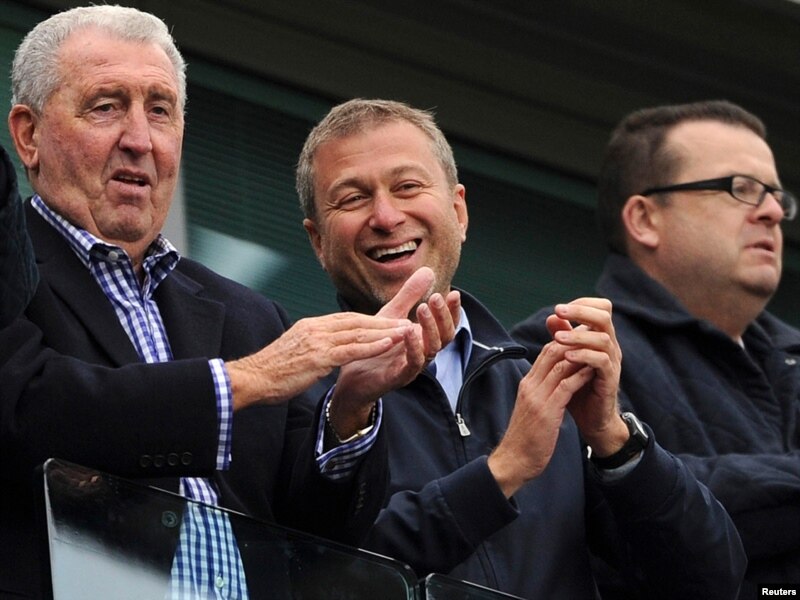
Roman Abramovich (center), seen here watching his English Premier League squad Chelsea, is a part owner of Evraz, which in turn controls the Raspadskaya mine.

The Raspadskaya mine is owned by Evraz, a massive holding company controlled by the Kremlin-connected oligarch Roman Abramovich and steel tycoon Aleksandr Abramov. But both men have emerged seemingly unscathed from the mine disaster, with Putin reserving his wrath for Volkov alone.


Vladimir Milov, a former Russian deputy energy minister, notes that while mine accidents have decreased markedly since the industry was privatized in the late 1990s -- dropping from a late-Soviet average of 450 deaths a year to 50-60 now -- Evraz-owned mines have accounted for a disproportionate share of recent accidents.


"It seems to me that those enterprises owned by Evraz, which is under the control of Abramovich and Abramov, seem to systematically have accidents. This sets them apart from the general decrease in fatal mine accidents," Milov says. "This is a reason to ask the bosses of Evraz Holding what is going on with safety in their mines."


In March 2007, a gas explosion at the Evraz-owned Ulyanovskaya mine in Kemerovo killed 110 people. An investigation later revealed that the methane detector had been disabled. Two months later, 38 miners died in a methane blast at the Yubileinaya mine, also in Kemerovo and also controlled by the Evraz group.


In a commentary that ran in "The Moscow Times" on May 19, political analyst Yulia Latynina writes that "Evraz must pay Putin's bureaucrats large bribes and kickbacks to stay in operation, and these 'corruption taxes' are built into production costs at Raspadskaya, which translates into lower wages and thus the need for miners to circumvent safety regulations in order to earn bonuses."


According to "The New York Times," miners earn a base monthly salary of approximately $830 a month, which can rise to $1,164 if they meet their production quotas. While considerably higher than the average monthly wage of $580, profound health and safety risks make the profession a potentially costly gamble for its workers.


Until this corruption is tackled, analysts say, disasters like the ones at Raspadskaya, Ulyanovskaya, and Yubileinaya will likely continue.


Appealing To The President


Institutions like truly independent trade unions that protect workers' rights and help guarantee their safety in other countries -- as opposed to officially recognized unions that are de facto under the control of the state -- are largely absent in Russia.


"The authorities have done a lot in recent years to fight against independent labor unions. They had the FSB and the security services working on this," Milov says.

Repair and restoration work at the damaged vertical shaft of the Raspadskaya coal mine on May 10

"The liquidation of independent unions was part of what they call the battle against extremism -- that is, any possible opposition to the authorities."


In an appeal to President Dmitry Medvedev posted on the Internet on May 16, a group purporting to represent residents of the area around Raspadskaya and Mezhdurechensk called for an end to the suppression of independent labor unions and a threefold increase in miners' base salaries.


Small rallies were held in a number of Russian cities on May 22 to mourn the victims of Raspadskaya and demand better conditions for miners and the dismissals of Interior Minister Rashid Nurgaliyev and Kemerovo Governor Aman Tuleyev.


Some among the authorities, meanwhile, are claiming that unidentified "enemies" are trying to use the tragedy at Raspadskaya to bring down Russia's current rulers. Governor Tuleyev says the protests in Mezhdurechensk were not organized by miners but by "young people and bandits."


There are also signs that, despite Putin's call for tighter controls over the industry, the Kremlin is doing everything it can to prevent a full accounting of what happened at Raspadskaya and why. When the Communists, Liberal Democrats, and A Just Russia factions in the State Duma attempted on May 19 to initiate a parliamentary investigation into the tragedy, they were blocked by the pro-Kremlin United Russia faction, which controls two-thirds of the legislature.

United Russia lawmaker Sergei Neverov took to the podium and accused them of politicizing the tragedy.


"Stop trying to capitalize on the miners' tragedy," Neverov said to applause from his United Russia colleagues. "It has long been clear that some politicians who lack moral principles and values want to use the Raspadskaya mine tragedy to spark a revolution. We don't need this."


written by Brian Whitmore in Prague with reporting by RFE/RL Russian Service correspondents Anastasia Kirilenko from Raspadskaya and from Veronika Bode and Danila Galperovich in Moscow

View article…

OSAKA, JAPAN: Osaka seeks special business zone

Sunday, May 23, 2010

Governor says with tax breaks prefecture can be Asia gateway

OSAKA (Kyodo) Osaka Gov. Toru Hashimoto called on the central government Sunday to designate his prefecture as a special business zone that would serve as an entry point for businesses across Asia.

The government has been considering legislating a system for special business zones, and during a meeting Sunday with Hashimoto, Senior Vice Cabinet Office Minister Motohisa Furukawa unveiled the administration's intention to submit the bill to the Diet early next year.

"Osaka will aim to become a city connecting (the rest of) Asia and Japan," Hashimoto told Furukawa, who is secretary general of the National Policy Unit.

During their meeting, the popular lawyer and former TV personality outlined a plan to attract tourists and investment from other parts of Asia via Osaka to rejuvenate the country as a whole.

He also shared his analysis that even though corporate tax within the Osaka business zone would be reduced or waived, the central government would still benefit from tax revenues in the long term.

"Please use Osaka as an experiment by letting us take responsibility," he said, adding he will ensure that the prefecture won't be the only winner if the initiative is adopted.

Furukawa noted that Japan's conventional growth strategy has involved creating miniature versions of Tokyo elsewhere in the country. But from now on, Furukawa said, it will be important to ensure that regional success stories spread across the country.

"We will consider a structure that includes taxation," said Furukawa, who is involved in formulating economic and fiscal policy at the Cabinet Office.

Speaking to reporters after the meeting, Furukawa said:

"While Osaka has moved ahead (on this issue), other regions are also making similar requests. By having them compete with each other, I want to make a breakthrough in energizing Japan."

View article…

JAPAN: A Culinary Commemoration of ‘Lost’

Image: Courtesy of Crystal Watanabe of Adventures in Bentomaking

Despite not being the biggest fan of Charlie Pace, the alcoholic former rocker of the fictional Drive Shaft, bento blogger Pikko was moved to create a bento box of what she calls, “one of the most memorable scenes in all seasons.” She admits (SPOILER ALERT) that his death made her emotional, despite the fact that it was many episodes coming. “After I’d wiped away my tears and stopped wondering if you can really write on your wet hand with a wet Sharpie while drowning,” Pikko joked of the infamous “Not Penny’s Boat” scene, “I realized what a turning point that scene was for the show that season.” And what better way to commemorate it than with a bento box of brown rice, shrimp, and vegetables, including a carrot cut into the shape of Charlie’s signature DS ring?

View article…

CHINA: Sign Language: Stubble trouble

Stubble trouble

Location: Unspecified

Spotted by: David Goodman-Smith

View article…

Saturday, May 22, 2010

VLADIVOSTOK, RUSSIA: Rallies Honor Dead In Russian Mine Blasts

Relatives and friends mourning a miner killed in explosions at the Raspadskaya mine in Mezhdurechensk on May 11, two days after the explosions.

Relatives and friends mourning a miner killed in explosions at the Raspadskaya mine in Mezhdurechensk on May 11, two days after the explosions.

May 22, 2010

By RFE/RL

Small numbers of Russians have rallied in several cities across the country to honor the 66 people confirmed killed in a recent double mine explosion in the Siberian town of Mezhdurechensk.

Another 24 coal miners are still missing from the May 9 tragedy at the town's Raspadskaya mine, and rescue efforts have been suspended because of high methane gas levels in the shafts.

Around 100 people gathered in the Russian capital, Moscow, to demand better conditions for miners and the ouster of Interior Minister Rashid Nurgaliyev and Aman Tuleyev, the governor of the coal-rich Kemerovo region where the mine explosions took place.

Some 70 demonstrators gathered in the Western Russian enclave of Kaliningrad at two separate rallies.


Another 30 people turned up for an unsanctioned event in the far eastern city of Vladivostok, where participants held a minute of silence in memory of those killed. Those demonstrators also backed miners' demands for improved wages and work conditions, as well as the dismissals of Nurgaliyev and Tuleyev.


Many in Russia are angry at the way authorities handled the tragedy, despite pledges that the victims' relatives will receive compensation.


Local deputy Dmitry Dolgachyov, who took part in the Vladivostok protest, accused the Kremlin of sanctioning blatant security violations at the mine, which belongs to Russian billionaire Sergei Abramovich.


"Authorities should have declared a national mourning, but they are afraid of admitting their own mistakes. They are afraid of saying that the mine is owned by Abramovich and that Abramovich owns other such mines where laws are violated in order to make more money," Dolgachyov charged. "Authorities support Abramovich and other oligarchs. The fact that they banned us from rallying here today and honoring the miners' memory doesn't make them look good."


The Raspadskaya mine accounts for about 10 percent of Russia's annual coking coal output.


It is still unclear whether protesters will be able to gather in Mezhdurechensk after local authorities banned a rally there, claiming other events were already taking place on the square chosen for the gathering.


Many suspect authorities of seeking to avoid a repeat of the May 14 rallies in the town, when angry coal miners and their families blocked a railway line. On that day, as many as 28 protesters were detained after they clashed with the police.


Andrei Timorshin, a coal miner who took part in the May 14 protest, told an RFE/RL Russian Service correspondent in Mezhdurechensk that miners were simply acting out of despair.


"Decent wages, that's the main thing miners want. There are no other jobs here, just mines, and our wages are measly," Timorshin said. "Only when such tragedies happen do we get help. Only after the noise caused by the last meeting did the governor and the city mayor hear our call of despair."


Miners have denounced, in particular, the failure of the mine's management to apologize following the deadly blasts.


The death toll of 66 includes 17 rescuers who were caught in the second blast, which was so powerful that it severely damaged buildings on the surface.


It was the deadliest coal mine disaster since 110 people were killed by a methane blast at another mine in the Kemerovo region in March 2007.


written by Claire Bigg based on RFE/RL Russian Service and agency reports

View article…