Upcoming Cruises

TBD

Monday, May 24, 2010

S. KOREA: Bizarre Foods with Andrew Zimmern

bizarre_ep_south-korea_228x128.jpg 

In this episode airing on the Travel Channel, Andrew travels to Seoul, South Korea, where he feasts on the country's most authentic soups, barbecues and fermented foods. Andrew's Asian adventure goes beyond eating when he makes his first batch of fresh kimchi.

More details…

CHINA: Beijing's Most Embarrassing Allies

MAY 24, 2010

BY JOSHUA E. KEATING

As China has grown into a major economic and military power in the last two decades, its mad scramble for energy resources and trading partners has led it into alliances with some of the world's most unsavory governments. Here are five regimes that couldn't survive without Beijing.

NORTH KOREA

Beijing's interests:  Stability, bilateral trade, and a buffer between China and South Korea

The relationship:  Chinese support for North Korea dates back to the 1950s, when Beijing loaned military aid and fighters to Kim Il Sung's communist government during the Korean War. China quickly became North Korea's primary benefactor and trading partner, a relationship that has continued under the rule of Kim Jong Il. Ninety percent of North Korea's energy imports, 80 percent of its consumer goods, and 45 percent of its food now come from China.

The relationship isn't all one-sided. An increasing number of Chinese firms are investing in North Korea to take advantage of its rock-bottom labor costs and large coal and mineral deposits. Bilateral trade between the two countries reached $2.79 billion in 2008, up more than 40 percent from the year before. More importantly for Beijing, North Korea provides a friendly buffer zone between China's northeast and capitalist, democratic South Korea -- as well as the 37,500 U.S. troops based there.

China has frequently used its position on the U.N. Security Council to block harsher sanctions against Kim's regime. Since North Korea began its pursuit of nuclear weapons, Beijing has seemed more exasperated with Kim's belligerence and at times, has even supported international sanctions. Although the support is not as unconditional as it once was, China remains North Korea's most important ally, as evidenced by the reclusive Kim Jong Il's recent trip to Beijing, where he met with President Hu Jintao and Premier Wen Jiabao and reportedly suggested once again that he might be willing to return to the negotiating table.

Most embarrassing moment:  China was instrumental in cajoling North Korea into participating in the 2003-2005 six-party talks aimed at denuclearizing the Korean Peninsula, which culminated in a 2005 agreement by North Korea to dismantle its nuclear program in exchange for foreign aid. So when Pyongyang tore up the agreement and tested a nuclear weapon in October 2006, it was widely perceived as a "slap in the face" to a Chinese government that had repeatedly stuck its neck out for its troublesome southeastern neighbor. One week after the tests, China agreed for the first time to support U.N. sanctions on North Korea, and the political relationship between the two countries has been strained ever since. Fearing the chaos and potential refugee crisis that might result if the Kim regime were to fall, however, China is still wary about applying too much pressure, and trade between the countries continues to increase.

IRAN

Beijing's interests:  Oil and gas

The relationship:  The economic relationship between Iran and China dates back to the days of the Silk Road, but has taken on a new geopolitical importance in the last decade, as China has sought out reliable sources of oil to fuel its growing economy, and an increasingly isolated Iran has looked eastward as relations with the United States and Europe have deteriorated.

Iran is China's third-largest source of oil, supplying about 11.4 percent of its oil imports. Bilateral trade between the two countries totaled $21.2 billion in 2009, up from 10.1 billion in 2005. The China National Petroleum Corp. (CNPC) has reached deals to develop new oil and natural gas fields throughout the country. Because Iran lacks the capacity to refine its own oil into gasoline, it's also a major importer of Chinese petroleum products.

As Iran has, over strong U.S. and European opposition, continued to develop its nuclear program, China has repeatedly opposed, on the Security Council, international sanctions against its new business partner, generally proposing that diplomatic efforts be given more time.

Most embarrassing moment:  China's stated position, that the Iranian nuclear issue could be resolved through negotiations, took a hit in November 2009, when Iran rejected a deal to ship its uranium abroad for enrichment. China joined with the other members of the Security Council in expressing disappointment with Iran's decision and has publicly urged Iran to accept the new agreement. China welcomed a similar fuel-swap deal negotiated by Brazil and Turkey this May, but it was apparently too little too late. The United States quickly announced that China had finally agreed to tougher sanctions, but the devil is in the details, and it's still unclear whether Beijing will sign on to the most punitive measures backed by the other big powers.

SUDAN

Beijing's interests:  Oil

The relationship:  As China's insatiable demand for energy has led it to invest more and more in Africa, it has come under frequent criticism for its relationship with unstable and unsavory regimes -- but none has been more controversial than Sudan. Cooperation between the two countries began during the 1970s, when Mao Zedong provided the country's then-Marxist government with loans and medical aid. But it wasn't until the 1990s that energy cooperation between the two countries took off, after American oil companies pulled out due to U.S. sanctions.

The international sanctions applied to Sudan following the country's bloody civil war and the ongoing violence in Darfur have allowed China overwhelming dominance over the country's energy sector. CNPC is the largest investor in Sudan's state-owned oil company, and China purchases 40 percent of the country's oil output, accounting for about 6 percent of China's imports.

Even more controversially, human rights groups allege that China has sold Sudan more than $55 million in small arms -- weapons that have been used to kill more than 300,000 people in the Darfur region. Chinese cooperation with Sudan has continued even as Sudanese President Omar Hassan al-Bashir has been charged with crimes against humanity by the International Criminal Court. China, along with Russia, has blocked sanctions against Sudan on the Security Council.

Most embarrassing moment:  Next to Tibet, China's relationship with Sudan is the most frequent cause of anti-Chinese ire from human rights activists. In the run-up to the 2008 Beijing Olympics, for instance, Darfur activists disrupted the Olympic torch relay and then U.S. Senator Hillary Clinton called on President George W. Bush to boycott the opening ceremony. Bush went, but another high-profile guest, American film director Steven Spielberg, who had signed on as a consultant to the opening ceremonies, pulled out of the project over his objections to China's policies in Sudan.

BURMA

Beijing's interests:  Natural gas and mining

The relationship:  Burma has traditionally exported raw materials like timber and gemstones to China, but nowadays Beijing has its eyes on a much bigger prize: Burma's estimated 21.19 trillion cubic feet of natural gas reserves. CNPC signed a 30-year natural gas deal with Burma in 2008, and a pipeline carrying gas to China's Yunnan province is expected to come online in 2012. China has also begun work on an oil pipeline through Burma that will save Chinese tankers a costly trip through the politically sensitive Strait of Malacca. China gave Burma about $2 billion in military aid between 1995 and 2005, including fighter jets and naval vessels.

Although China has been more than willing to turn a blind eye to Burma's crackdowns on political opposition and has stood up for the Burmese junta in the Security Council, there are signs that the relationship has begun to deteriorate. Burma's long-running military campaign against ethnic minorities in its northeast has sent thousands across the border into China, bringing narcotics and HIV/AIDS with them. China expressed its "deep concern," in August 2009, prompting the junta to issue a rare apology. Above all, China is looking for stability from its southern neighbor and energy provider, and the increasingly isolated junta seems unable to provide it.

Most Embarrassing moment:  Burma's 2007 anti-government protests were a wake-up call to China. The images of Buddhist monks taking to the streets en masse to challenge the junta's authority was not a sight that Chinese leaders particularly wanted to see replicated throughout the region, particularly in Tibet. Burmese Foreign Minister U Nyan Win was publicly admonished on a trip to Beijing that year by senior Chinese diplomat Tang Jiaxuan, who told him to "restore internal stability" and "push forward a democracy process that is appropriate for the country." Perhaps hedging its bets, China has lately begun to reach out to imprisoned Burmese democracy leader Aung San Suu Kyi. China's wavering commitment to the junta will likely be tested again later this year, when the government has tentatively planned to hold elections with Suu Kyi's party banned from participating.

ZIMBABWE

Beijing's interests:  Precious metals

The relationship:  Zimbabwean President Robert Mugabe is a long-time Sinophile, dating back to his days as a rebel leader fighting the white-dominated Rhodesian government, when he received arms, training, and funding from Beijing. Mugabe made a point of visiting China in 1980, the first year of his leadership, to thank the Chinese for their support.

The Chinese government has publicly supported Mugabe's controversial land-reform policies and has granted the country billions in agricultural aid. China has also sold Mugabe's regime the latest military technology, including FC-1 fighter jets, 100 military vehicles, and a state-of-the-art radar system at Mugabe's mansion in the suburbs of Harare.

In exchange, Mugabe has opened up Zimbabwe's vast mineral deposits, including the world's second-largest supply of platinum, to Chinese investment. Chinese companies have pumped millions into rebuilding the country's struggling mining sector, expanding economic cooperation as Western governments have slapped increasingly harsh sanctions on Mugabe's regime.

Most embarrassing moment:  During the Zimbabwean government's 2008 crackdown following a disputed presidential election, China was caught red-handed when a ship carrying small arms intended for Zimbabwe -- including 3 million rounds of ammunition and 1,500 rocket-propelled grenades -- was turned away by South African authorities at the port of Durban. After it was prevented from unloading at several African ports, the ship was eventually forced to return to China.

View article…

S. KOREA: Films Recognized at Cannes International Film Festival

Eric Gaillard/Reuters

The Cannes Film Festival is the world's most prestigious film festival, looming over all others, a privileged moment for celebrating past glories and great expectations. Established in 1946, it takes place each May at Cannes, a town along the French Riviera.

Every year Cannes appears, alluring and forbidding, a haunted palace that knows better than to open wide its doors, become democratic or user-friendly -- leave that to the North Americans. The competition choices obey a certain logic: the festival is faithful to those who have triumphed and those who have suffered.

The Marché du Film, where meetings, negotiations and deals take place in parallel to the Festival de Cannes, draws more than 10,000 buyers and sellers from around the world, according to the festival's organizers.

This year two Korean films were recognized.

Award for Best Screenplay
LEE Chang-dong for POETRY

Movie Picture

Best screenplay went to the South Korean Lee Chang-dong for “Poetry,” a beautifully directed, emotionally wrenching drama about a grandmother who discovers that her only grandson has been party to a horrific crime. Mr. Lee, speaking in English, acknowledged his powerhouse female star, Yun Jung-hee, who gave one of the most memorable performances of the festival.

Un Certain Regard Prize - Groupama Gan Foundation for Cinema
HAHAHA directed by HONG Sangsoo

Movie Picture

On Saturday the Certain Regard prize went to “Ha Ha Ha,” a wistful, intricately structured comedy from the South Korean director Hong Sang-soo. In a festival that tends to be crammed with films that skew toward the grave — religious fundamentalism was a recurrent theme — the humor in “Ha Ha Ha” was also a relief.

Although the Certain Regard films are not part of the main competition, this section has consistently become a showcase for some of the strongest, most innovative and daring work at Cannes. Such was the case this year with a largely well-received slate . . .

View article…

Complete NYT coverage of the Cannes International Film Festival

Festival de Cannes

Sunday, May 23, 2010

THE KOREAS: South Korea to halt all trade with North Korea over sinking of Cheonan warship

Secretary of State Hillary Rodham Clinton greets officials in Beijing.

Secretary of State Hillary Rodham Clinton greets officials in Beijing. (Saul Loeb/associated Press)

Monday, May 24, 2010

By John Pomfret, Washington Post Staff Writer

BEIJING -- South Korean President Lee Myung-bak said Monday that his country is stopping all trade and most investment with North Korea and closing its sea lanes to North Korean ships after the nation's deadly attack on a South Korean warship.

Lee also called for a change in the North's Stalinist regime.

The tough measures, announced in an address to his nation, were bound to ratchet up pressure on the isolated Pyongyang government and add a new flash point in U.S. relations with China.

"Fellow citizens, we have always tolerated North Korea's brutality, time and again. We did so because we have always had a genuine longing for peace on the Korean Peninsula," he said. "But now things are different. North Korea will pay a price corresponding to its provocative acts."

Lee then said that

"no North Korean ship will be allowed to make passage through any of the shipping lanes in the waters under our control" and that "any inter-Korean trade or other cooperative activity is meaningless."

A senior U.S. official, traveling with Secretary of State Hillary Rodham Clinton in China, said the United States will back "all the steps the South Koreans are going to announce." In an indication of the seriousness with which the Obama administration views the drama between the North and South, home to nearly 29,000 U.S. troops, he added:

"We have not faced something like this in decades."

Lee apparently has ruled out military action because he does not want to trigger an all-out war. But Lee did condemn Kim Jong Il's regime.

"North Korea's goal is to instigate division and conflict. For what reason and for whom is it doing what it does? As compatriots, I am truly ashamed," he said. "It is now time for the North Korean regime to change."

Lee also threw down a challenge to China, saying:

"No responsible country in the international community will be able to deny the fact that the Cheonan was sunk by North Korea."

The U.S. official said that, based on talks over the past two days, Chinese officials have not accepted the results of a South Korean investigation -- backed by experts from the United States, Australia, Britain and Sweden -- that implicated North Korea in the attack on the 1,200-ton Cheonan that killed 46 sailors. As such, it is unclear whether Beijing will support Lee's measures or his call, also made in the speech, to take the issue to the U.N. Security Council.

China's reluctance to agree with the report underscores the challenges the United States faces as it seeks to forge closer ties to Beijing. The U.S. official also noted Sunday that China and the United States still do not see eye to eye on the details of planned economic sanctions on Iran for its failure to stop its nuclear enrichment program. Of specific concern, he said, are disagreements between Beijing and Washington about how investments in Iran's oil and gas sector will be treated. China has committed to investing more than $80 billion in Iran's energy sector; tightened sanctions against Tehran could threaten those investments.

U.S. officials said the Obama administration considers the situation in Northeast Asia and Iran so pressing that on Sunday night in Beijing, Clinton dispensed with the niceties of protocol and got down to a substantive discussion in the middle of a private banquet to welcome the biggest delegation of U.S. officials to Beijing to date. The officials -- a band of 200 led by Clinton and Treasury Secretary Timothy F. Geithner and specializing in fields such as health, energy and the environment, counterterrorism, nuclear proliferation, and human rights -- are in Beijing for the U.S.-China Strategic and Economic Dialogue.

Reverberations in Tokyo

Officials and analysts said that the attack on the Cheonan seems to be redefining the security equation in Northeast Asia, bolstering the United States, damaging China and concentrating the minds of Japanese officials.

The attack has provided political cover for Japan's government -- only the second opposition party to take power in nearly 50 years -- to end an eight-month-long feud with the United States and accept a plan to relocate a U.S. Marine base within Okinawa. On Sunday, Japanese Prime Minister Yukio Hatoyama announced that his country would abide by a 14-year-old agreement to move the Futenma air base in Okinawa to a less populated part of the island.

Hatoyama's government had campaigned on a platform that rejected the Futenma deal and advocated a more Asia-centric view of Japan's place in the world. But the Cheonan incident reminded them

"that this is still a very dangerous neighborhood and that the U.S.-Japan alliance and the basing arrangements that are part of that are critical to Japan's security," the senior U.S. official said.

Tough options for China

The attack and its aftermath also threaten China's place in the region and could force it to make an unwanted choice between South Korea and North Korea -- two countries that it has handled deftly since normalizing relations with Seoul in 1992. South Korea wants China, which is a permanent member of the Security Council, to back Seoul's call to take the Cheonan issue to the council. So does the United States, the U.S. official said.

But that could risk hurting Pyongyang, and China appears committed to maintaining the North Korean regime above all.

"For China," the U.S. official said, "they are in uncharted waters."

China reacted slowly to the Cheonan's sinking, waiting almost a month before offering South Korea condolences. Then it feted North Korea's Kim in May, apparently offering him another large package of aid, Asian diplomats said. China's attitude has enraged South Korea.

Michael Green, a national security official during George W. Bush's administration, said the Cheonan crisis highlights just how differently China views its security needs than the rest of the players in Northeast Asia. For years, as China worked with the United States, Russia, South Korea and Japan to try to persuade North Korea to give up its nuclear weapons programs, these differences were obscured. But the Cheonan's sinking has changed that.

While the incident is pushing officials in South Korea, Japan and the United States to contain North Korea and even prepare for a future without a North Korean state, Green said, China appears intent on redoubling its efforts to ensure North Korea's stability.

View article…

RUSSIA: Black Hole: Russian Mining Tragedy Stirs Old Questions Of Class, Privilege

Rescuers carry the body of a miner killed in one of the Raspadskaya coal-mine explosions in Kemerovo region three days after the May 9 blasts.Rescuers carry the body of a miner killed in one of the Raspadskaya coal-mine explosions in Kemerovo region three days after the May 9 blasts.

Last updated (GMT/UTC): 22.05.2010 13:32

By Brian Whitmore

RASPADSKAYA, Russia -- Boris Nefko, a coal miner in Russia's Kemerovo Oblast, says he routinely violates safety regulations in order to boost output and earn bonuses.


It's a common practice, experts and union officials say, in an industry where oversight is lax and workers can dramatically increase their salaries if they meet monthly production quotas.
But it's also a practice that costs scores of Russian miners their lives in accidents every year -- and it's likely to continue as long as the financial incentive exists.


"I've violated [the safety regulations] myself," Nefko says. "All they care about is that we produce more and more coal. And what do we get? Just 7-8 kopeks for every ruble [of profit]. They take the rest. They need to raise our salaries and reduce the production quotas."


It is still unclear what caused the twin explosions on May 9 in the Raspadskaya coal mine in Russia's Siberian region of Kemerovo. A total of 90 miners and rescue workers died as a result of the dual blasts.


Officials point to a large emission of highly combustible methane, despite the fact that the mine's safety detectors failed to register any such buildup at the time of the blasts. Miners, however, often disable the methane detectors themselves by blanketing them with wet rags, while management turns a blind eye -- in order to keep working as they push to fill quotas.


The tragedy at Raspadskaya, which produces more than 10 percent of the coking coal used to make Russian steel, is exposing lingering class resentments in Russian society.


It is also spooking the Kremlin, which has a long-standing fear of politicized miners.


Citizen Volkov


On May 15, a week after the explosion, scores of miners in the town of Mezhdurechensk, near the Raspadskaya mine, took to the streets to protest the fact that they must routinely risk their lives in order to earn a decent wage. Some 28 people were arrested as demonstrators blocked a railway line and clashed with police.


"It was a significant move when they decided to block the rail lines," Svetlana Klimova of the Russian Academy of Sciences Institute of Sociology tells RFE/RL's Russian Service, adding that the desperation the miners are feeling may have political consequences.


"This means they lost their last illusions that the authorities in Moscow would understand their plight."


Miners and their supporters bitterly point out that the authorities declared a national day of mourning following the March 29 bombing in the Moscow metro that killed dozens of rush-hour commuters, but offered no such honor for the scores who died in the Raspadskaya blast.

Raspadskaya head Igor Volkov (pictured) stepped down after Vladimir Putin lambasted him.

In an effort to stem the anger, Prime Minister Vladimir Putin held a nationally televised videoconference with the management of the Raspadskaya mine on May 17. In his trademark style, Putin openly berated the mine's director, Igor Volkov, who prior to the explosions had repeatedly been accused of infractions by Rostekhnadzor, Russia's main safety agency.

Addressing Volkov derisively as "citizen" -- a pointed throwback to the Soviet era, when police and prosecutors routinely used the word when speaking to criminals -- Putin openly wondered why Volkov still had a job.


"Last year Rostekhnadzor asked the court four times to remove the mine director, Volkov, who is present here now, from his position for multiple violations. There was no reaction," Putin said.
"As you know a terrible tragedy happened at the mine on May 9. But Citizen Volkov is still working, and he is still sitting in this room with all of you now."


Unsurprisingly, Volkov resigned the following day. He now faces charges for criminal negligence.


Oligarch Owners


But while critics welcome Volkov's dismissal, they say the miners' problems run deeper.
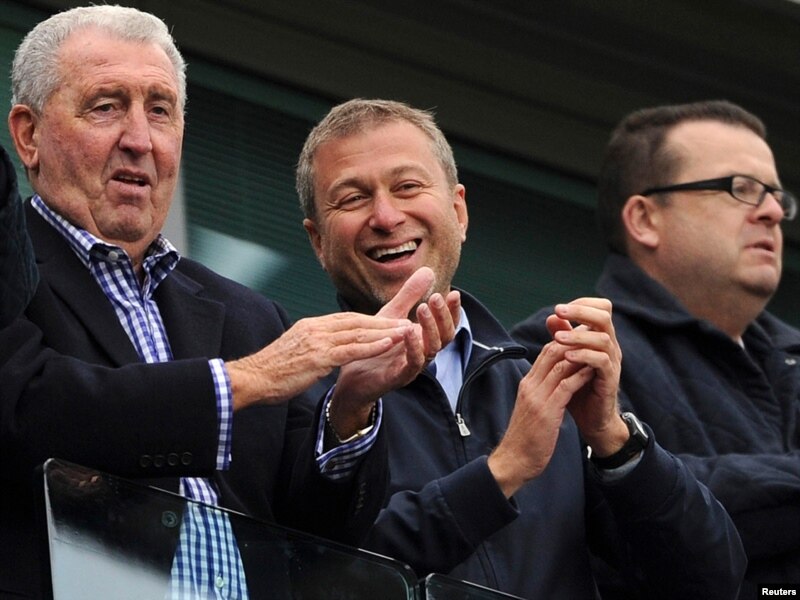
Roman Abramovich (center), seen here watching his English Premier League squad Chelsea, is a part owner of Evraz, which in turn controls the Raspadskaya mine.

The Raspadskaya mine is owned by Evraz, a massive holding company controlled by the Kremlin-connected oligarch Roman Abramovich and steel tycoon Aleksandr Abramov. But both men have emerged seemingly unscathed from the mine disaster, with Putin reserving his wrath for Volkov alone.


Vladimir Milov, a former Russian deputy energy minister, notes that while mine accidents have decreased markedly since the industry was privatized in the late 1990s -- dropping from a late-Soviet average of 450 deaths a year to 50-60 now -- Evraz-owned mines have accounted for a disproportionate share of recent accidents.


"It seems to me that those enterprises owned by Evraz, which is under the control of Abramovich and Abramov, seem to systematically have accidents. This sets them apart from the general decrease in fatal mine accidents," Milov says. "This is a reason to ask the bosses of Evraz Holding what is going on with safety in their mines."


In March 2007, a gas explosion at the Evraz-owned Ulyanovskaya mine in Kemerovo killed 110 people. An investigation later revealed that the methane detector had been disabled. Two months later, 38 miners died in a methane blast at the Yubileinaya mine, also in Kemerovo and also controlled by the Evraz group.


In a commentary that ran in "The Moscow Times" on May 19, political analyst Yulia Latynina writes that "Evraz must pay Putin's bureaucrats large bribes and kickbacks to stay in operation, and these 'corruption taxes' are built into production costs at Raspadskaya, which translates into lower wages and thus the need for miners to circumvent safety regulations in order to earn bonuses."


According to "The New York Times," miners earn a base monthly salary of approximately $830 a month, which can rise to $1,164 if they meet their production quotas. While considerably higher than the average monthly wage of $580, profound health and safety risks make the profession a potentially costly gamble for its workers.


Until this corruption is tackled, analysts say, disasters like the ones at Raspadskaya, Ulyanovskaya, and Yubileinaya will likely continue.


Appealing To The President


Institutions like truly independent trade unions that protect workers' rights and help guarantee their safety in other countries -- as opposed to officially recognized unions that are de facto under the control of the state -- are largely absent in Russia.


"The authorities have done a lot in recent years to fight against independent labor unions. They had the FSB and the security services working on this," Milov says.

Repair and restoration work at the damaged vertical shaft of the Raspadskaya coal mine on May 10

"The liquidation of independent unions was part of what they call the battle against extremism -- that is, any possible opposition to the authorities."


In an appeal to President Dmitry Medvedev posted on the Internet on May 16, a group purporting to represent residents of the area around Raspadskaya and Mezhdurechensk called for an end to the suppression of independent labor unions and a threefold increase in miners' base salaries.


Small rallies were held in a number of Russian cities on May 22 to mourn the victims of Raspadskaya and demand better conditions for miners and the dismissals of Interior Minister Rashid Nurgaliyev and Kemerovo Governor Aman Tuleyev.


Some among the authorities, meanwhile, are claiming that unidentified "enemies" are trying to use the tragedy at Raspadskaya to bring down Russia's current rulers. Governor Tuleyev says the protests in Mezhdurechensk were not organized by miners but by "young people and bandits."


There are also signs that, despite Putin's call for tighter controls over the industry, the Kremlin is doing everything it can to prevent a full accounting of what happened at Raspadskaya and why. When the Communists, Liberal Democrats, and A Just Russia factions in the State Duma attempted on May 19 to initiate a parliamentary investigation into the tragedy, they were blocked by the pro-Kremlin United Russia faction, which controls two-thirds of the legislature.

United Russia lawmaker Sergei Neverov took to the podium and accused them of politicizing the tragedy.


"Stop trying to capitalize on the miners' tragedy," Neverov said to applause from his United Russia colleagues. "It has long been clear that some politicians who lack moral principles and values want to use the Raspadskaya mine tragedy to spark a revolution. We don't need this."


written by Brian Whitmore in Prague with reporting by RFE/RL Russian Service correspondents Anastasia Kirilenko from Raspadskaya and from Veronika Bode and Danila Galperovich in Moscow

View article…

OSAKA, JAPAN: Osaka seeks special business zone

Sunday, May 23, 2010

Governor says with tax breaks prefecture can be Asia gateway

OSAKA (Kyodo) Osaka Gov. Toru Hashimoto called on the central government Sunday to designate his prefecture as a special business zone that would serve as an entry point for businesses across Asia.

The government has been considering legislating a system for special business zones, and during a meeting Sunday with Hashimoto, Senior Vice Cabinet Office Minister Motohisa Furukawa unveiled the administration's intention to submit the bill to the Diet early next year.

"Osaka will aim to become a city connecting (the rest of) Asia and Japan," Hashimoto told Furukawa, who is secretary general of the National Policy Unit.

During their meeting, the popular lawyer and former TV personality outlined a plan to attract tourists and investment from other parts of Asia via Osaka to rejuvenate the country as a whole.

He also shared his analysis that even though corporate tax within the Osaka business zone would be reduced or waived, the central government would still benefit from tax revenues in the long term.

"Please use Osaka as an experiment by letting us take responsibility," he said, adding he will ensure that the prefecture won't be the only winner if the initiative is adopted.

Furukawa noted that Japan's conventional growth strategy has involved creating miniature versions of Tokyo elsewhere in the country. But from now on, Furukawa said, it will be important to ensure that regional success stories spread across the country.

"We will consider a structure that includes taxation," said Furukawa, who is involved in formulating economic and fiscal policy at the Cabinet Office.

Speaking to reporters after the meeting, Furukawa said:

"While Osaka has moved ahead (on this issue), other regions are also making similar requests. By having them compete with each other, I want to make a breakthrough in energizing Japan."

View article…

JAPAN: A Culinary Commemoration of ‘Lost’

Image: Courtesy of Crystal Watanabe of Adventures in Bentomaking

Despite not being the biggest fan of Charlie Pace, the alcoholic former rocker of the fictional Drive Shaft, bento blogger Pikko was moved to create a bento box of what she calls, “one of the most memorable scenes in all seasons.” She admits (SPOILER ALERT) that his death made her emotional, despite the fact that it was many episodes coming. “After I’d wiped away my tears and stopped wondering if you can really write on your wet hand with a wet Sharpie while drowning,” Pikko joked of the infamous “Not Penny’s Boat” scene, “I realized what a turning point that scene was for the show that season.” And what better way to commemorate it than with a bento box of brown rice, shrimp, and vegetables, including a carrot cut into the shape of Charlie’s signature DS ring?

View article…

CHINA: Sign Language: Stubble trouble

Stubble trouble

Location: Unspecified

Spotted by: David Goodman-Smith

View article…

Saturday, May 22, 2010

VLADIVOSTOK, RUSSIA: Rallies Honor Dead In Russian Mine Blasts

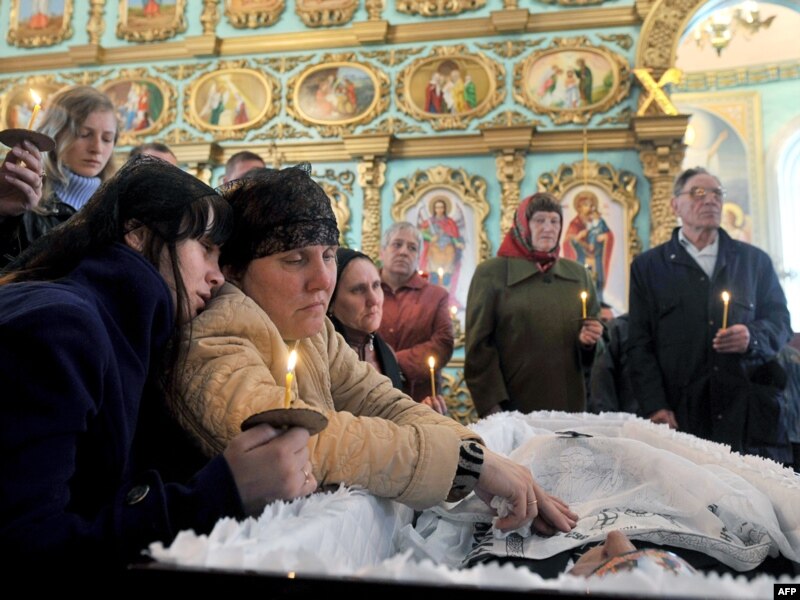
Relatives and friends mourning a miner killed in explosions at the Raspadskaya mine in Mezhdurechensk on May 11, two days after the explosions.

Relatives and friends mourning a miner killed in explosions at the Raspadskaya mine in Mezhdurechensk on May 11, two days after the explosions.

May 22, 2010

By RFE/RL

Small numbers of Russians have rallied in several cities across the country to honor the 66 people confirmed killed in a recent double mine explosion in the Siberian town of Mezhdurechensk.

Another 24 coal miners are still missing from the May 9 tragedy at the town's Raspadskaya mine, and rescue efforts have been suspended because of high methane gas levels in the shafts.

Around 100 people gathered in the Russian capital, Moscow, to demand better conditions for miners and the ouster of Interior Minister Rashid Nurgaliyev and Aman Tuleyev, the governor of the coal-rich Kemerovo region where the mine explosions took place.

Some 70 demonstrators gathered in the Western Russian enclave of Kaliningrad at two separate rallies.


Another 30 people turned up for an unsanctioned event in the far eastern city of Vladivostok, where participants held a minute of silence in memory of those killed. Those demonstrators also backed miners' demands for improved wages and work conditions, as well as the dismissals of Nurgaliyev and Tuleyev.


Many in Russia are angry at the way authorities handled the tragedy, despite pledges that the victims' relatives will receive compensation.


Local deputy Dmitry Dolgachyov, who took part in the Vladivostok protest, accused the Kremlin of sanctioning blatant security violations at the mine, which belongs to Russian billionaire Sergei Abramovich.


"Authorities should have declared a national mourning, but they are afraid of admitting their own mistakes. They are afraid of saying that the mine is owned by Abramovich and that Abramovich owns other such mines where laws are violated in order to make more money," Dolgachyov charged. "Authorities support Abramovich and other oligarchs. The fact that they banned us from rallying here today and honoring the miners' memory doesn't make them look good."


The Raspadskaya mine accounts for about 10 percent of Russia's annual coking coal output.


It is still unclear whether protesters will be able to gather in Mezhdurechensk after local authorities banned a rally there, claiming other events were already taking place on the square chosen for the gathering.


Many suspect authorities of seeking to avoid a repeat of the May 14 rallies in the town, when angry coal miners and their families blocked a railway line. On that day, as many as 28 protesters were detained after they clashed with the police.


Andrei Timorshin, a coal miner who took part in the May 14 protest, told an RFE/RL Russian Service correspondent in Mezhdurechensk that miners were simply acting out of despair.


"Decent wages, that's the main thing miners want. There are no other jobs here, just mines, and our wages are measly," Timorshin said. "Only when such tragedies happen do we get help. Only after the noise caused by the last meeting did the governor and the city mayor hear our call of despair."


Miners have denounced, in particular, the failure of the mine's management to apologize following the deadly blasts.


The death toll of 66 includes 17 rescuers who were caught in the second blast, which was so powerful that it severely damaged buildings on the surface.


It was the deadliest coal mine disaster since 110 people were killed by a methane blast at another mine in the Kemerovo region in March 2007.


written by Claire Bigg based on RFE/RL Russian Service and agency reports

View article…

JAPAN: What happens when samurai chase a racewalker?


EMBED-Would He Run? - Watch more free videos

Watch the video to see whether or not he runs . . .

View article…

HONG KONG: Sign Language: Winging it

Winging it

Location: Hong Kong

Spotted by: Erik Munch-Fals

View article…

CHINA: Jordan Romero, 13, 'becomes youngest to scale Everest'

Jordan Romero in Kathmandu, 10 April Jordan Romero was due to do some school work during his trip

Page last updated at 9:43 GMT, Saturday, 22 May 2010 10:43 UK

A 13-year-old American boy has become the youngest person to reach the summit of Mount Everest, his family says.

Jordan Romero, from California, telephoned his mother from the peak of the world's highest mountain, she said.

"Mom, I'm calling you from the top of the world," Leigh Anne Drake quoted her son as saying.

He was climbing with his father and three Sherpa guides. The previous record was held by a Nepalese boy of 16.

The 13-year-old has now conquered the highest mountains on six of the world's seven continents.

JORDAN'S SUMMITS

  • Africa - Kilimanjaro: 2006
  • Europe - Elbrus: 2007
  • South America - Aconcagua: 2007
  • North America - Denali: 2008
  • Oceania - Carstensz Pyramid: 2009
  • Everest - Asia: 2010

He climbed Africa's Mount Kilimanjaro aged 10. He just needs to scale the Vinson Massif in Antarctica.

He has also scaled Mount Kosciuszko in Australia.

The team set off from Nepal's capital, Kathmandu, last month, heading for the base camp on the Chinese side of the mountain.

While Nepal insists that anyone planning to climb Mount Everest must be 16, China does not impose any age restrictions.

Some mountaineers have criticised the Romero family for letting him attempt the feat but his father said the ascent from the Chinese side is less dangerous, the AFP news agency reports.

Last month, his mother told the BBC he would do some school work during the trip.

Also on Saturday, Apa Sherpa, 50, climbed Everest for the 20th time, surpassing his own record.

View article…

Friday, May 21, 2010

RUSSIA & US: An Arsenal We Can All Live With

May 21, 2010

By GARY SCHAUB Jr. and JAMES FORSYTH Jr.

Maxwell Air Force Base, Ala. - THE Pentagon has now told the public, for the first time, precisely how many nuclear weapons the United States has in its arsenal: 5,113. That is exactly 4,802 more than we need.

Last week, Secretary of Defense Robert Gates and Secretary of State Hillary Clinton testified before the Senate to advocate approval of the so-called New Start treaty, signed by President Obama and President Dmitri Medvedev of Russia last month. The treaty’s ceiling of 1,550 warheads deployed on 700 missiles and bombers will leave us with fewer warheads than at any time since John F. Kennedy was president. Yet the United States could further reduce its reliance on nuclear weapons without sacrificing security. Indeed, we have calculated that the country could address its conceivable national defense and military concerns with only 311 strategic nuclear weapons. (While we are civilian Air Force employees, we speak only for ourselves and not the Pentagon.)

This may seem a trifling number compared with the arsenals built up in the cold war, but 311 warheads would provide the equivalent of 1,900 megatons of explosive power, or nine-and-a-half times the amount that Secretary of Defense Robert McNamara argued in 1965 could incapacitate the Soviet Union by destroying “one-quarter to one-third of its population and about two-thirds of its industrial capacity.”

Considering that we face no threat today similar to that of the Soviet Union 45 years ago, this should be more than adequate firepower for any defensive measure or, if need be, an offensive strike. And this would be true even if, against all expectations, our capacity was halved by an enemy’s surprise first strike. In addition, should we want to hit an enemy without destroying its society, the 311 weapons would be adequate for taking out a wide range of “hardened targets” like missile silos or command-and-control bunkers.

The key to shrinking our nuclear arsenal so radically would be dispersing the 311 weapons on land, at sea and on airplanes to get the maximum flexibility and survivability.

Ideally, 100 would be placed on single-warhead intercontinental ballistic missiles, like the Minuteman III systems now in service. These missiles, which have pinpoint accuracy, are scattered around the country in such a way that only one potential enemy, Russia, would have any chance of rendering the arsenal impotent with a surprise strike. (And it is likely that our unilateral cuts would entice Moscow, which has been retiring its systems at a fast clip in recent years, to follow suit.) Equally important, these missile sites are easily detected and monitored, which would reassure our friends and provide a credible threat to our enemies.

The sea leg of the plan would involve placing 24 Trident D-5 missiles, each with a single nuclear warhead, on each of our Ohio-class submarines. Today’s fleet of 14 can be cut to 12, with eight on patrol at a given time, together carrying 192 missiles ready to launch. The Tridents are extremely effective, as they can be moved around the globe on the submarines, cannot be easily detected, and present a risk to even hardened targets. And should any of our allies feel that our cuts in seaborne missiles are worrisome, we can remind them that the British and French will keep their complementary nuclear capabilities in the Atlantic.

Finally, for maximum flexibility in our nuclear arsenal, each of our B-2 stealth bombers could carry one air-launched nuclear cruise missile. While we have 20 such bombers, we assume that one would be undergoing repairs at any given time, giving us the final 19 warheads in our 331-missile plan. Our B-2 fleet is more than adequate for nuclear escalation control and political signaling, and giving it an exclusive role in our nuclear strategy would allow us to convert all our B-52H bombers to a conventional role, which is far more likely to be of use in our post-cold-war world.

While 311 is a radical cut from current levels, it is not the same as zero, nor is it a steppingstone to abandoning our nuclear deterrent. The idea of a nuclear-weapon-free world is not an option for the foreseeable future. Nuclear weapons make leaders vigilant and risk-averse. That their use is to be avoided does not render them useless. Quite the opposite: nuclear weapons might be the most politically useful weapons a state can possess. They deter adversaries from threatening with weapons of mass destruction the American homeland, United States forces abroad and our allies and friends. They also remove the incentive for our allies to acquire nuclear weapons for their own protection.

We need a nuclear arsenal. But we certainly don’t need one that is as big, expensive and unnecessarily threatening to much of the world as the one we have now.

Gary Schaub Jr. is an assistant professor of strategy at the Air War College and James Forsyth Jr. is a professor of strategy at the School of Advanced Air and Space Studies.

View article…

CHINA: Sign Language: Hannibal's Chinese

Sign Language: week 95

Hannibal's Chinese

Location: Nanning, China

Spotted by: Anthony Steward

View article…

Thursday, May 20, 2010

CHINA, JAPAN, & S. KOREA: Seoul hosts trilateral trade talks

Friday, May 21, 2010

Kyodo News

Trade ministers from Japan, China and South Korea will meet in Seoul on Sunday to discuss ways to promote trilateral and regional cooperation, the Ministry of Economy, Trade and Industry said Thursday.

The gathering, expected to be attended by South Korean Trade Minister Kim Jong Hoon, his Tokyo counterpart, Masayuki Naoshima, and Chinese Commerce Minister Chen Deming will take place ahead of the May 29-30 summit in South Korea.

Earlier this month, the three countries began a joint study involving industry, government and academia as a step toward commencing government-level negotiations on a trilateral free-trade agreement.

View article...

JAPAN: Cherry Blossom Viewing

1000 places to see

Every year after the bleak winter skies disappear, tens of millions of Japanese flock to the parks and temple gardens in pursuit of hanami, or cherry blossom viewing. When a gentle breeze carries snowflake-size pink-and-white petals fluttering to the ground on a spring day, it is easy to understand how the Japanese passion for these ephemeral blossoms is an almost spiritual thing. In Tokyo, city-dwelling office workers make do with nighttime hanami, sake-drinking parties in the large Ueno Park or along the moat encircling the Imperial Palace. But purists and hanami connoisseurs who aim to get as much as possible out of the one- to two-week-long season head for Yoshino Mountain in the Yoshino-Kumano National Park, not far from Nara and Kyoto, Japan's first capital cities. The mountain is virtually covered with tens of thousands of centuries- old white mountain cherry trees divided into groves (called Hitome-Sembon, or One Thousand Trees at a Glance) that, according to their altitude, bloom at different times, usually beginning in early April. Marked pathways, scattered temples, a predominantly Japanese blossom-viewing crowd, and the shops and teahouses in the pleasant town of Yoshino promise an unforgettable experience.

WHEN: usually in Apr, with lowest grove blossoming in early Apr.

Image brought to you courtesy of GalleryPlayer's Image Collection.

View article…

CHINA: The Forbidden City

1000 places to see

The magnificent Forbidden City, so named because it was off-limits to commoners for 500 years, was the imperial court for twenty-four emperors from the early days of the Ming dynasty in the 15th century until the fall of the Qing dynasty in 1911. It is the largest, most complete, and best-preserved cluster of ancient buildings in China, representing the work of battalions of laborers. Fires and lootings over the years have left a largely post-18th-century shell that mimics its original layout, and much of its storied wealth and opulent furnishings are long gone. Nonetheless, this vast complex of halls, pavilions, courtyards, and walls is a masterwork of architectural balance, monumental but never oppressive. A self-guiding tape narrated by Roger Moore helps bring it alive, with tales of eunuchs, concubines, ministers, priests, court intrigues, and terrific excesses. Occupying more than 183 acres, the expansive complex earns the title of "city." It was not unusual for emperors and servants alike never to venture beyond the moat-surrounded 35-foot walls and formidable gates - ever. That they believed themselves to be at the cosmic center of the universe is a fantasy visitors can readily appreciate today.

 Image brought to you courtesy of GalleryPlayer's Image Collection.

View article…

CHINA & JAPAN: Shanghai Expo Pays 300 Million Yen for Plagiarized Japanese Song

shanghai expo song

Just a little update on the 2010 Shanghai Expo song scandal, to let all of you who followed the story here on Japan Probe know that it seems to have been resolved in a satisfactory manner:

The Shanghai World Expo will pay 300 million Japanese yen (approximately US$3.2 million) to Japanese singer Maya Okamoto for plagiarizing her song, according to a report published on Japanese news websites last week.

The song Right Here Waiting for You 2010 was used for the month of promotion leading up to the opening of the Shanghai World Expo and organizers had reportedly spent 10 million yuan (US$1.46 million) producing the song.

Soon after its premiere on Chinese television on April 1, Internet users pointed out that 95 percent of the melody was identical to Japanese pop singer Maya Okamoto’s Stay the Way You Are from 1997.

View article...

EAST ASIA: Reconsidering Genghis Khan

This statue of Genghis Khan is a reproduction of a huge statue that sits in front of a government building in Ulaanbaatar, Mongolia. It is one of many images of Genghis Khan that appear throughout the city. (Photo by Batsaikhan M)

Posted: 05/20/2010 12:00:00 AM PDT

By Charlie McCollum

In history written from a Western perspective, Genghis Khan — the ruler of the 13th-century Mongolian empire — occupies a place of infamy, perceived as a brutal, ruthless and primitive warlord who brought death and destruction to the civilized world.

When Don Lessem — the organizer of "Genghis Khan: The Exhibition," which opens Saturday at the Tech Museum — first traveled to Mongolia in the late 1980s, he had the Western view of Genghis. But then, he says,

"I saw all these glowing descriptions of him and all the statues to him and thought, 'Why?' Because I had this impression of him as a bloodthirsty villain. Then the Mongolian people set me straight, and I came away thinking, 'This guy is incredible.' "

In fact, says William Fitzhugh of the Smithsonian Institution's Arctic Studies Center, Genghis was an extraordinary ruler whose historical legacy needs to be reassessed in the West.

Records from the period, many only now being uncovered,

"give you a view of a person who is a superb organizer, a superb lawmaker, a fair and judicious ruler, somebody who supported women and gave women a lot of rights," says Fitzhugh, who is a consultant for the exhibition. "It's wrong to say that Genghis created a democracy, but, for the time, he was remarkably enlightened."

It is the accomplishments of this "other Genghis" — as well as the achievements of his sons and grandsons — that are at the heart of the show, which recently drew 175,000 visitors during a three-month run at the Denver Museum of Nature & Science. In the exhibit, which will take up 14,000 square feet in Parkside Hall adjacent to the Tech, there is an array of artifacts, many of which have never previously left Mongolia, and elaborate re-creations of Mongolian life during Genghis' time.

"We're always trying to mirror Silicon Valley," says Elizabeth Williams, vice-president of marketing for the Tech. "Each of the big exhibitions we've had here — 'The Human Body,' 'Leonardo,' 'Star Trek' — have had that spirit of Silicon Valley, innovative, global impact component. It also dovetails nicely with the technology piece, because similar to what Leonardo was doing back in his day, Genghis Khan had some similar impact in terms of the warfare technology. And I think it has that educational component that we're always looking for as well."

Genghis Khan was born around 1162 into one of the many nomadic tribes that roamed what is now Mongolia. He was illiterate and was born into a hard life. But by 1206, he had united all the warring Mongolian factions. Before his death in 1227,

"in the space of just two decades, he was able to set the foundation of the Mongol Empire, which then rolled on until long after he died," Fitzhugh notes.

At its height, the Mongol Empire — ruled by Genghis' sons and grandsons — covered nearly 13 million square miles (four times the size of the Roman Empire at its height) and stretched from the Danube River in Eastern Europe to the Sea of Japan. It held sway over more than 100 million people. It promoted free trade from China to Europe (the so-called Silk Road) and incorporated technologies from conquered countries into the empire's way of life.

Genghis "wanted to be a benevolent ruler of a civilized world," Lessem says. "Once you were in the pale of the empire, it was a wonderful place to live — for the time."

For one thing, Fitzhugh says, Genghis displayed a religious tolerance uncommon in that era.

"He allowed all faiths to be represented in Karakorum, the capital city. There were at least 15 religious temples in the city. There were Hindus, Buddhists and Shamanists and Christians of various types. In fact, the Christians were quite powerful."

Another aspect of his rule was a reliance on a meritocracy,

"which was a real breakthrough because — up until that time — the leaders, the generals, had always been picked on the basis of clan affiliation," Fitzhugh says. "All that meant was that everybody fought with everybody. So he broke down all those clans and set up a military that — although it was controlled by the central government — was an army where all the general and officers were chosen on the basis of performance and loyalty.  So you could be a slave who was captured by the Mongols, and 10 years later, you could be a Mongol general."

While there have been museum exhibits about Genghis' time in the past, Lessem notes that

"they all basically just used his name and included very few pieces from the period.  So I went to the Mongolian government, and because they are such a small country, they were willing to let a private exhibit person work with them and try to mount an exhibition. They knew I cared about the subject, and they thought I would treat it right. So they were willing to loan me just about anything they had from his time."

Although Fitzhugh notes that "there's hardly anything that is known to have been owned by Genghis or that his hand touched," Lessem and his consultants were able to assemble close to 250 artifacts drawn from Mongolia's Archaeology Institute, five Mongolian museums, private collectors and — in the case of an 800-year-old mummy — the Smithsonian. They include shamans' costumes, elaborately woven silk robes, finely crafted gold bracelets and beautifully detailed swords, saddles and armor from the period.

But, Lessem says,

"this is not an artifact exhibit per se. What I don't like is going to exhibits and just seeing things in cases — no matter how cool. To me, that's not a learning experience or a fun experience."

The exhibition has 10 videos on aspects of life at the time, giant video maps, interactive (and kid-friendly) games and one exhibit that gives you the sense of being caught in the middle of a herd of horses. There are replicas of tribal villages and such war technology as a trebuchet, a siege engine designed by Chinese engineers that the Mongolians incorporated into their armies.

Each visitor's ticket has a representation of one of five or six different people who would have lived during the time of the empire, and in each room, there are computers where you can go and see what happens to that person over the course of time.

In addition,

"we have a whole bunch of demonstrators showing how the villages were set up and letting you fire a catapult," Lessem says. "You get to put on Mongolian-style robes, and what I really like is that we have live entertainment every day for a couple of hours. The same traditions of dance and music that were around then are still around now — which is wonderful."

Fitzhugh predicts that those who visit the exhibit will not only come away with just a very different view of Genghis Khan but also of "ancient history in Asia, something Americans generally don't know very much about.

"That's the central thrust of the exhibit: Let's familiarize Americans with a particular period of Mongol history from a time when Mongol and Asian history changed the world."

Genghis Khan: The Exhibition

When: Saturday through Nov. 1
Where: The Tech Museum,
201 S. Market St.,
San Jose, California
Tickets: $15-$25,
www.thetech.org

Related Stories

View article…

TRAVEL: Delta receives final approval for Seattle-Beijing service

Delta Air Lines says it has received final Chinese government approval to launch nonstop flights between Seattle and Beijing, beginning June 4. The new route, which will operate five times weekly, will connect customers from destinations throughout Delta's and codeshare partner Alaska Air Group's network to the Chinese capital.


Departure and arrival times have been revised from the initial announcement. Flights from Seattle and Beijing will depart at 9:05 p.m. and 8:55 a.m., respectively. - By Roger Yu

View article...

TIBET: Teacher

The Dalai Lama delivers a teaching at Radio City Music Hall in New
 York City.Mario Tama / Getty Images


The Dalai Lama delivers a teaching at Radio City Music Hall in New York City.

View article...

JAPAN: Fish Forwards

image Yuriko Nakao / Reuters

A blue tang, symbolising Japan's national soccer team, and a flame angelfish, symbolising Denmark's national soccer team, swim near a transparent "soccer" ball containing fish food inside a tank made to look like a soccer stadium at Hakkeijima Sea Paradise aquarium in Yokohama, Japan. The two teams are part of Group E in the upcoming 2010 FIFA Soccer World Cup.

View article...

JAPAN: Sign Language: Rear view

Rear view in Japan

Rear view

Location: aquarium in Shimoda, Japan

Spotted by: Simon Enstone

View article…

THE KOREAS: Today in Korean History

May 20


1949 -- Kim Yak-su and Lee Mun-won, then lawmakers in South Korea's first National Assembly, are arrested for arguing for the withdrawal of foreign troops from the country and negotiations for reunification of the two Koreas. As a result of their assertions, the two lawmakers were accused of being communist sympathizers.

1954 -- The country's third parliamentary election is held.


1962 -- The South Korean government revives a nationwide curfew. The curfew was originally imposed in 1945 and finally abolished in 1982.


1980 -- The Supreme Court confirms the death sentence for Kim Jae-gyu, former head of the Korean Central Intelligence Agency, who assassinated then President Park Chung-hee in October 1979. He was executed in May 1980.


1986 -- Lee Dong-su, a student activist at Seoul National University, burns himself to death at the school's student center, calling for "the eradication of U.S. imperialism" and punishment of then President Chun Doo-hwan, who Lee called a fascist.


2003 -- Lee Keun-young, former head of the Financial Supervisory Commission, is arrested on charges of arranging illegal loans to Hyundai affiliates in 2000 in connection with a scandal involving payoffs to North Korea ahead of the first-ever inter-Korean summit.

View article…

Wednesday, May 19, 2010

THE KOREAS: Ling Sisters Recount Laura's Capture In North Korea

President Clinton, Al Gore, Laura Ling, Euna LeeVice President Al Gore hugs Laura Ling as Euna Lee greets President Bill Clinton upon their arrival in California on Aug. 5, 2009. Following a meeting in Pyongyang with Clinton, North Korean leader Kim Jong Il pardoned Ling and Lee, allowing them to return to the U.S.  AFP/Robyn Beck/Getty Images

May 19, 2010

On March 17, 2009, journalists Euna Lee and Laura Ling were apprehended by North Korean soldiers while filming a documentary along the China-North Korea border. The two women were charged with illegal entry for crossing into North Korea — and after several months of interrogation by North Korean officials, sentenced to 12 years of hard labor in one of North Korea's prison camps.

After finding out that Laura had been arrested in North Korea, Lisa Ling — Laura's sister and a special correspondent on The Oprah Winfrey Show and CNN — started calling every diplomatic official she knew. She also contacted other journalists to publicize Laura's ordeal. For several weeks, Lisa appeared on national media outlets alongside other family members as part of a campaign to bring the two journalists home.

In an interview with Fresh Air contributor Dave Davies, the sisters describe their dual experiences with Laura's detention and release. They detail their infrequent phone conversations, in which Laura was able to tell Lisa that the only way she and Euna would be released was if a special envoy — former President Bill Clinton — traveled to Pyongyang to meet with North Korean leader Kim Jong Il. Clinton made the trip in August 2009, after Laura and Euna had spent 140 days in captivity, and helped secure their release.

Somewhere Inside: Cover Detail

Somewhere Inside: One Sister's Captivity in North Korea and the Other's Fight to Bring Her Home
By Laura Ling and Lisa Ling
Hardcover, 336 pages
William Morrow
List price: $26.99

Laura and Lisa Ling's book about the five-month ordeal is called Somewhere Inside: One Sister's Captivity in North Korea and the Other Sister's Fight to Bring Her Home. Lisa Ling is also the author of Mother, Daughter, Sister, Bride: Rituals of Womanhood. She is the host of National Geographic Explorer and reports frequently for The Oprah Winfrey Show and CNN. Laura Ling is a reporter for Current TV, where she explores the effects of globalization.


Interview Highlights

On the story Laura Ling and Euna Lee were looking for at the China-North Korea border

Laura Ling: "We were covering a story about North Korean defectors, people who are fleeing the very desperate conditions in North Korea — mass starvation, a brutal dictatorship — and they're crossing over into China. Now many of these defectors are women, and many of these women are trafficked into really horrendous situations in neighboring China. They are forced into marriages. They are lured into the prostitution industry. And because China does not regard North Korean defectors as refugees ... they will send them back across the border to North Korea if they are caught. And that means that these people face certain punishment. They will be sent to North Korea's notorious labor camps and possibly face torture or worse. That's the story I was trying to bring to light for Current TV."

On the local guide they hired to take them to the border

Laura Ling: "Foreign journalists who are working overseas often hire what we call fixers — local guides in the area who have worked with other media entities before to help them with the story. And this is a man we had hired who had previously seemed very cautious. And there were some actions that were in retrospect very suspicious. ... We went to the river to film the thoroughfare where North Koreans are crossing into China. It was never our intention when we were there that morning to cross the [Tumen] River [that separates China and North Korea]. And our guide began making some low hooting noises across the border. ... Now previously, our guide had told us that he had connections in North Korea. Our guide was involved in smuggling goods himself. And so, in my mind, I thought he was trying to make a connection with some of the border guards that he knew. He said in the past that he had taken some media to actually converse with some of these border guards on the other side. And he continued to walk closer to the North Korean side of the river and he got to the other side, stepped foot on the soil and motioned for us to follow him, which we did. We ended up on the other side of the border, and he pointed out safe houses where defectors are kept until they're ready to be smuggled across the border. And really, it was about that time — we were not on the soil for more than a minute — when we knew we had to leave. And that's when we turned back and walked back across the ice to the Chinese side."

Lisa and Laura LingLisa Ling (left) went on Larry King Live to plead for her sister Laura's release. She chose CNN, she writes in Somewhere Inside, because Kim Jong Il reportedly watches it in Pyongyang.  Courtesy of Laura and Lisa Ling

On what they initially told their captors

Laura Ling: "When we were initially caught, Euna had told our captors that we were students, that we were working on a documentary and were working on the piece about the border region and trade in the region. We knew that the subject we were covering — North Koreans fleeing these horrible conditions in their country — was not going to be looked upon well by our captors. And so we were hoping, while we were still on the border, that we might be able to convince them to send us back across the border to China. And that became very clear, after about 24 hours, that that was not going to happen."

On Lisa's reaction when she found out Laura had been detained

Lisa Ling: "I got a call at 2:30 in the morning on March 17 from my brother-in-law, Laura's husband, Ian. And he said, 'Laura has been abducted by North Korean border guards.' And that just sent a complete shock through my system because Laura — there was never any intention to go anywhere near North Korea. Their assignment was to go to China and South Korea, so we were shocked. I knew the story they were covering, but I didn't think they were going to get close to North Korea. So Ian and I immediately — I had Ian call our parents because we needed our mother to make contact with Chinese authorities in China, and she's proficient in Mandarin — and I just started calling everyone in the diplomatic world that I knew. One of my first calls was to Richard Holbrooke, who was the U.S. special representative to Afghanistan and the most senior diplomat I know. And I wanted to get word to Secretary of State Clinton that this was happening. And one of the first calls we also made was to the chairman of Current TV, Laura's employer, [former] Vice President Al Gore. Because we felt like, if this was going to become the international incident that we thought it could, we needed Vice President Gore to help us."

On Laura's reaction when she was sentenced to 12 years of hard labor

Laura Ling: "I had tried to prepare myself for a lengthy sentence but nothing could prepare me for the verdict, when I heard the words '12 years.' And it was after the judge said '12 years,' he said, 'No forgiveness, no appeal.' And that really cut into me, because all along I had been hoping that there might be the opportunity for an appeal despite the long sentence. And I was wondering if those words meant that the window of opportunity had closed and my fate was sealed."

Laura and Lisa LingLisa and Laura Ling grew up in Sacramento, Calif. The two sisters say the North Korean incident brought them closer together.  Courtesy of Laura and Lisa Ling

On former President Clinton's arrival in North Korea

Lisa Ling: "We're so used to seeing a jovial character, and when he descended off that plane, just to see that completely deadpan expression on his face was so out of the ordinary."

Laura Ling: "And he later said that he, in fact, had to practice [his stoicism]. That Hillary and Chelsea had to coach him so that he could maintain that look of total stoicism. We also learned that there was a whole itinerary that the North Koreans wanted [President] Clinton and his team to attend, visits to various monuments — a whole stadium filled with child acrobatic performers. And they had to be careful to walk that line and not attend any of those events so as not to seem like they were being chummy with the North Koreans or the North Korean leader. ... And I think they walked that line very well. They stuck to the mission at hand, which was to bring us home."

Lisa Ling: "No money was exchanged and no diplomacy was conducted. It truly was a private humanitarian mission."

View article…

JAPAN: Behold, Japan's Largest Elevator

Enormous Elevator This elevator can hold 80 people. Mitsubishi Elevator

Posted 05.19.2010 at 6:00 pm

By Rebecca Boyle

A new Japanese office building that opened earlier this month in Osaka is home to two dozen ginormous window-view elevators, the largest in Japan.

Each can hold 80 passengers and are 12 feet wide, 9 feet long and 8.5 feet high, with a floor space of about 102 square feet.

Japanese architecture is often notable for its smallness -- this is the country that invented the capsule hotel, after all. But the commodious elevator is a more efficient way to move large amounts of people.

They are operated as shuttles between Hankyu Department Store’s Umeda store and several floors of offices, according to a press release [PDF].

The department store is located near one of Japan’s largest train terminals, and the shops nearby are a popular destination, meaning the elevators will probably see much more traffic than the picture shown above.

The Japanese also want to be the first to elevate to space, so perhaps it makes sense they’d install an enormous one in a building first.

[via Gizmodo]

View article…

SHANGHAI, CHINA: A Bed for the High and Mighty

highest hotel bed in the world is at Shanghai's Park Hyatt hotel, 88 floors above

World's Best Hotel Beds

by Josey Miller

From such great heights: Each guest room on the 88th floor of the Park Hyatt Shanghai boasts the highest hotel bed in the world—and the view to prove it. Talk about bragging rights.

Snooze factor: Way up there. If you're looking for calm in this chaotic city setting, dream on; despite the sleek and sophisticated decor, the hotel is surrounded by Shanghai's frenzied Lujiazui financial district. But once the workday is done, you can escape to the Park Hyatt's Tai Chi courtyard, the Water's Edge Spa—or your private room. Besides sweeping views of the Bund or the Huangpu River, 88th-floor guest rooms feature a bathing area with a heated floor and a rain shower that streams water down from—surprise, surprise—unusually high 12-foot ceilings. Now that's uplifting.

Who goes there: Needless to say, a sky-scraping bed 1,279 feet above street level is not intended for the acrophobic. But if you're a thrill-seeker with an appetite for power and the "Vertical City" is just the first stop in your plot to conquer the world, this is the bed for you.

Undercover info: Want to get really high? Take the elevator to the 100 Century Avenue bar on the 92nd floor for another moment of Zen: sipping sparkling wine while listening to live jazz and watching the sun set through floor-to-ceiling windows.

Park Hyatt Shanghai
Tel: 86 21 6888 1234
Rooms on the 88th floor from $849

INTERESTED IN THIS DESTINATION?

See all our expert advice and travel recommendations for:

But Wait—There's More

Find other great ideas in these related stories:

View article…